Battle of Cottonwood
In July 1877, approximately 800 Nez Perce men, women, children, and elderly - along with 2,000 horses - were fleeing across Idaho Territory, pursued by the U.S. Army. Their crime was refusing to abandon their homeland for a reservation. Their leader, Chief Joseph, has become the face of this resistance, though he was primarily a civil chief while others like Looking Glass and Ollokot led the warriors. At Cottonwood on the Camas Prairie, the Nez Perce encountered Captain Stephen Whipple with 85 soldiers and civilian volunteers blocking their path. Over three days of fighting, the Nez Perce demonstrated the tactical superiority that would astonish military observers throughout their 1,400-mile journey. They killed seventeen soldiers and volunteers while suffering only one warrior dead. They protected their families, bypassed the entrenched soldiers, and continued east toward the Bitterroot Mountains. The Battle of Cottonwood was just one chapter in the epic Nez Perce War, but it captured the essence of their strategy: fight only enough to allow the safe passage of their people.
The Flight
The Nez Perce had not wanted war. For decades they had maintained peace with Americans, even helping Lewis and Clark survive their crossing in 1805. But in 1877, the government demanded they abandon the Wallowa Valley of Oregon for a reservation in Idaho. Several young warriors, angry at past injustices, killed settlers. Knowing retaliation would fall on all of them, the non-treaty Nez Perce bands - perhaps 750 people - fled. On June 17, they annihilated a cavalry force at White Bird Canyon. Then began the long march east, hoping to cross the mountains, reach Montana, and eventually find sanctuary in Canada with Sitting Bull's Sioux. They traveled as families with all their possessions, driving thousands of horses. The warriors fought only to protect this vulnerable column. What began as a desperate escape became one of the most remarkable military campaigns in American history.
The Trap at Cottonwood
After White Bird Canyon, General Oliver O. Howard pursued with 400 soldiers. The Nez Perce used the landscape brilliantly: they crossed and recrossed the Salmon River, stranding Howard on the wrong bank while they doubled back east. On July 3, they approached the Camas Prairie where Captain Whipple waited at Norton's Ranch (later called Cottonwood) with 65 soldiers and volunteers. Whipple sent Lieutenant Sevier Rains with ten soldiers and two civilians to scout the approaching Nez Perce. They found them - and the Nez Perce killed all thirteen in a swift ambush. Whipple dug in, and Captain David Perry arrived with reinforcements, bringing his force to about 85 men. For two days they huddled in rifle pits while Nez Perce snipers kept them pinned.
The Breakthrough
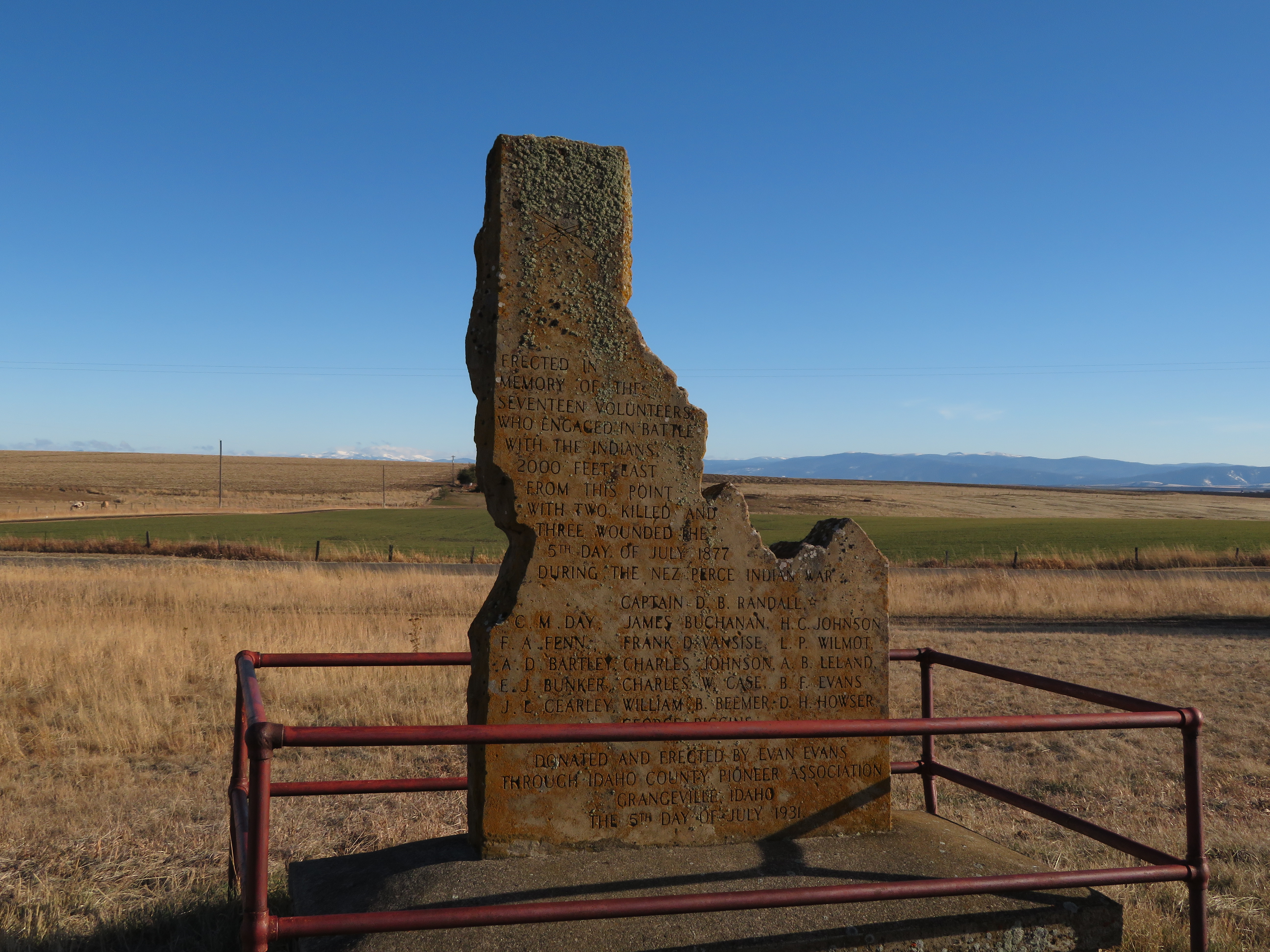
On July 5, the Nez Perce executed their plan. They detailed fourteen young warriors to keep the soldiers pinned down with long-range fire. Meanwhile, the rest of the tribe - men, women, children, elderly, and 2,000 horses - simply passed by the entrenchments about a mile away. The soldiers could see them but didn't dare leave their defenses. A group of seventeen civilian volunteers appeared, trying to reach Perry's position. They became trapped on a hilltop, cut off by Nez Perce warriors. Three volunteers died and two were wounded. One elderly Nez Perce warrior was killed - the first tribal death of the war - and one wounded. Captain Perry could see the volunteers' desperate situation but refused to send help until the Nez Perce had withdrawn. His caution, whatever its military justification, earned him lasting criticism.
The Brave Seventeen
The seventeen civilian volunteers who became trapped trying to reach Perry entered Idaho legend as the 'Brave Seventeen.' Their predicament illustrated the tensions between military and civilian efforts throughout the campaign. Perry faced a court of inquiry for his failure to rescue them, which found his delay 'not excessive under the circumstances.' But the volunteers saw soldiers watching them fight and die without coming to their aid. By evening, fifty more civilian volunteers arrived, but the Nez Perce were gone, continuing their journey east. They paused to rest at the Clearwater River, where Looking Glass's band joined them, bringing their strength to about 800 people with 200 warriors. Howard would catch up there, and the Battle of the Clearwater would follow. But that was just another engagement in a journey that still had 1,100 miles to go.
The Legacy
The Nez Perce War continued through the summer and into October 1877. The tribe fought battle after battle across Montana, repeatedly outmaneuvering and outfighting larger forces. Military observers, including British officers, studied their tactics with admiration. But forty miles from Canada, cold and exhausted, most of the remaining Nez Perce surrendered at the Bear Paw Mountains. Chief Joseph's surrender speech - 'From where the sun now stands, I will fight no more forever' - became one of the most famous in American history, though recent scholars note he spoke primarily for his own band. The survivors were sent not to Idaho but to Oklahoma, where many died of disease. The battlefield at Cottonwood is commemorated with historical markers near modern Cottonwood, Idaho. The soldiers who fell there rest at Fort Walla Walla Cemetery. The Nez Perce who died across those 1,400 miles left descendants who still remember the path their ancestors walked.
From the Air
Located at 46.03°N, 116.33°W in Idaho County, Idaho, on the Camas Prairie. The battlefield area is visible as rolling prairie terrain south of the town of Cottonwood. The Clearwater River lies to the north. Highway 95 passes through the area. Lewiston, Idaho and its small airport (LWS) are 50 miles northwest. Spokane (GEG) is 130 miles north. The terrain transitions from prairie to forested mountains to the east.