Battle of Cowpens
When Cornwallis received the news, he leaned on his sword until the blade snapped. On the morning of January 17, 1781, at a place called Hannah's Cowpens -- nothing more than a well-known grazing area for local cattle in the South Carolina backcountry -- Brigadier General Daniel Morgan had done what no American commander had managed since Saratoga. He had not merely beaten a British force; he had annihilated it. Banastre Tarleton's crack troops suffered an 86 percent casualty rate. The battle lasted barely an hour. And the tactical blueprint Morgan drew up that morning, using untrained militia as bait in a layered defense, has been studied by military academies ever since.
The Old Wagoner's Gamble
Morgan was 45 years old, plagued by sciatica so severe he sometimes could not mount his horse, and bitter about being passed over for promotion. His military career stretched back to the French and Indian War. He had served at the siege of Boston, been captured at the Battle of Quebec, exchanged, and then given command of 500 handpicked riflemen whose marksmanship helped turn the tide at Saratoga in 1777. He had quit the army in frustration in 1779, only to return a year later when promoted to brigadier general. Now Greene had sent him west of the Catawba River with 600 men to raise morale and find supplies. By the time he reached Hannah's Cowpens, militia from South Carolina, Georgia, and North Carolina had swelled his ranks, and Andrew Pickens had arrived with a large body of irregular fighters. Morgan knew Tarleton was close behind. The Broad River at his back was flooding. There was nowhere left to run.
Three Lines, One Trap
Morgan's genius lay in understanding what militia could not do -- and asking only what they could. British officers despised militia. At Camden, half the American force had broken and fled at the first volley, leaving the regulars exposed. Morgan turned that expectation into a weapon. He placed 150 sharpshooters from North Carolina and Georgia in a skirmish line out front, with orders to fire at officers and sergeants, then fall back. Behind them stood 300 militia under Pickens with a single instruction: fire two aimed volleys, then retreat behind the hill. On the hill itself waited Morgan's veterans -- Continental regulars from Maryland and Delaware, supported by experienced Virginia and Georgia militia. The deliberate retreat of the first two lines would look exactly like the rout the British expected. By the time Tarleton's men charged uphill, they would be winded, disorganized, and walking into the teeth of the strongest American line.
Exhaustion Meets Ambition
Tarleton roused his troops at two in the morning and marched them straight to the battlefield. His men had been on the move for five days, covering rough terrain in winter conditions. In the 48 hours before the battle, they had run out of food and slept less than four hours total. None of that mattered to Tarleton, who at 26 had built a reputation as the most aggressive cavalry commander in the British army. He had captured American General Charles Lee in New Jersey, fought with distinction at Charleston and Camden, and earned the nickname "Bloody Ban" after his men were accused of killing surrendering soldiers at the Battle of Waxhaws. He formed his battle line the moment he reached the field: infantry in the center, dragoons on the flanks, the 71st Highlanders in reserve, and his British Legion cavalry held back for the pursuit he considered inevitable.
The Minute Everything Turned
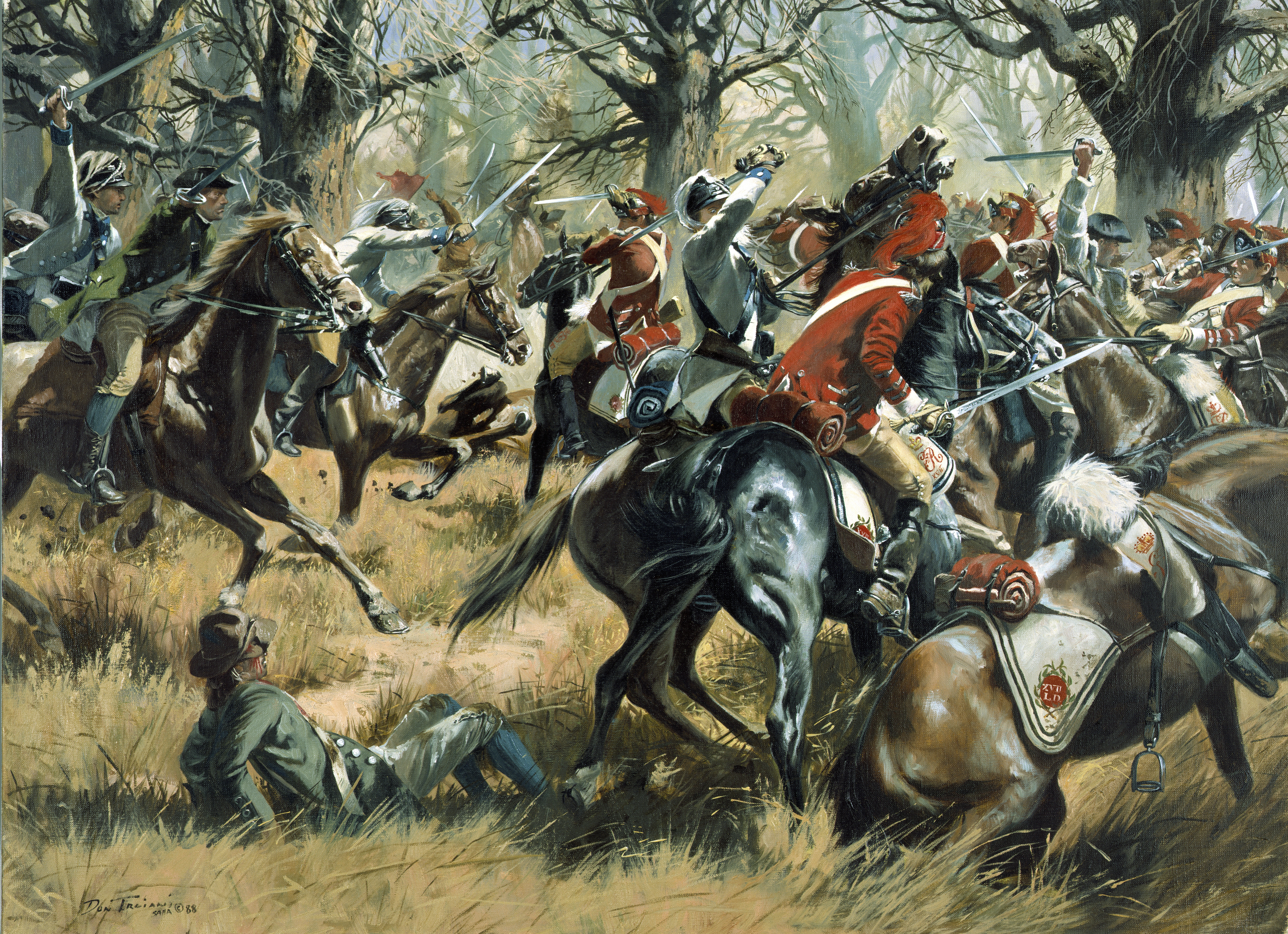
The sharpshooters fired and fell back. The militia fired their two volleys and retreated. Tarleton's troops pushed forward, convinced the Americans were collapsing. Then a misunderstood order changed everything. When Howard spotted the 71st Highlanders attempting to flank the American right, he ordered the Virginia militia to turn and face them. In the noise of battle, the militiamen thought they were being told to withdraw. They began to pull back. The British saw retreat and charged, breaking their own formation to rush forward in a disorganized mass. Morgan seized the moment. Howard's men suddenly stopped, turned, and fired a devastating volley at 30 yards. Howard shouted, "Charge bayonets!" The Continentals surged forward. William Washington's cavalry swept around from behind to hit the British right flank and rear. Pickens's reorganized militia completed a full 360-degree circle to slam into the Highlanders. The double envelopment -- compared by one historian to a small-scale Battle of Cannae -- broke the British in minutes.
The Chain That Led to Yorktown
When the smoke cleared at eight o'clock that morning, Morgan's army had taken 712 prisoners, 200 of them wounded. One hundred and ten of Tarleton's men were dead. Every artilleryman was killed or severely wounded. Tarleton himself escaped with about 40 horsemen after his own cavalry refused to charge. The destruction of some of the best units in Cornwallis's army forced the British general to abandon his pacification of South Carolina. He stripped his force of excess baggage and chased Greene north through the Carolinas, skirmishing at fords along the Catawba, until they met at the Battle of Guilford Court House. Cornwallis won that fight but was so weakened he withdrew to Wilmington, then marched into Virginia -- where Washington and Rochambeau trapped him at Yorktown. As John Marshall wrote, the battle at Cowpens set in motion an unbroken chain of consequences that finally separated America from the British crown. The site is preserved today as Cowpens National Battlefield.
From the Air
Located at 35.14N, 81.82W near the town of Cowpens in Cherokee County, South Carolina. Cowpens National Battlefield is a roughly circular park with walking trails and monuments visible from the air. The terrain is gently rolling Piedmont grassland -- the open cattle grazing ground that gave the battle its name. Nearby airports: KSPA (Spartanburg Downtown Memorial, 20nm east), KGSP (Greenville-Spartanburg International, 30nm northeast), KHKY (Hickory Regional, 35nm north). Best viewed at 2,000-3,000 ft AGL. The Broad River lies to the west; the Blue Ridge escarpment is visible to the northwest. The Daniel Morgan Monument is located in downtown Spartanburg, approximately 20nm east.