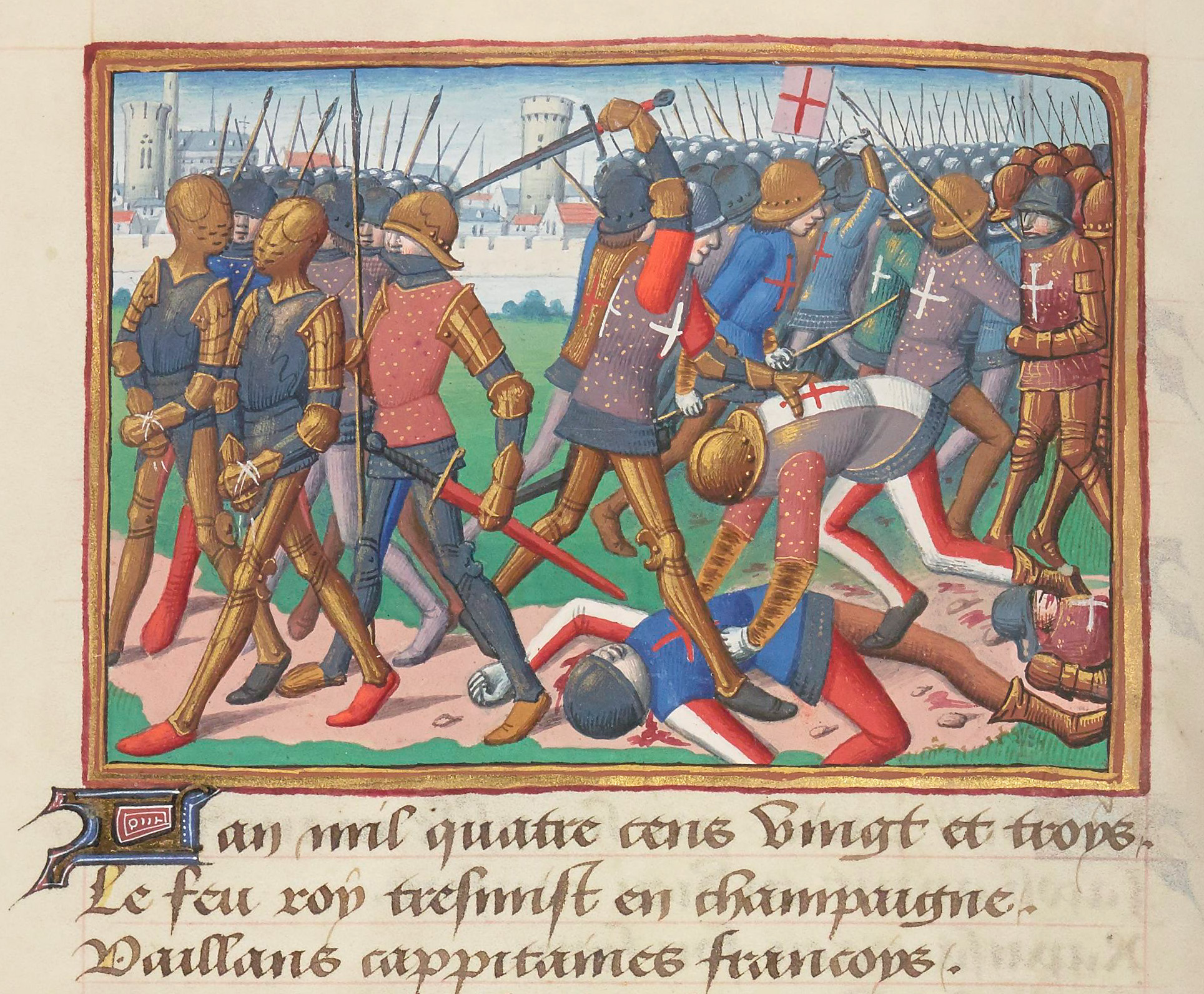
Battle of Cravant
For three hours, two armies stared at each other across the river Yonne. Neither side wanted to attempt the crossing. The water was waist-deep, the current steady, and the 50-meter width offered ample time for archers to cut down anyone wading through. It was July 31, 1423, at the village of Cravant in Burgundy, and the fate of the Hundred Years' War's next chapter hung on whether anyone would be reckless enough to go first. Then the Scots began shooting, and Thomas Montacute, Earl of Salisbury, decided that the question had been answered for him.
An Infant King's War
The battle grew from a dynastic crisis. Henry V of England had won the Treaty of Troyes in 1420, gaining the right to occupy France north of the Loire and succeed to the French throne. But Henry died suddenly in 1422, leaving an infant -- Henry VI -- as king of both England and, by treaty, France. The French Dauphin Charles, refusing to accept the arrangement, assembled an army at Bourges in the summer of 1423 with the aim of invading Burgundian territory. His force was a polyglot coalition: French troops, roughly 4,000 Scottish soldiers under John Stewart of Darnley, and mercenaries from Aragon and Lombardy. This Dauphinist army, perhaps two to three times the size of its opponents, besieged the small town of Cravant on the Yonne.
Prayers in the Cathedral
Cravant's garrison sent a plea for help to the Dowager Duchess of Burgundy, who raised troops and appealed to England for support. English and Burgundian forces converged on Auxerre, arriving on July 29. That evening, the allied commanders gathered in Auxerre Cathedral for a council of war. The plan they drafted reveals how seriously they took the fight ahead: the army would dismount, horses sent to the rear, archers would prepare anti-cavalry stakes. The soldiers were ordered to pray for victory through the night. The combined force numbered about 4,000 -- roughly 2,000 English and 2,000 Burgundians -- including 1,500 men-at-arms, 1,500 English longbowmen, Burgundian crossbowmen, and 40 light artillery pieces crewed by citizens of Auxerre.
Crossing Under Fire
The allied army marched throughout July 30, sighting the enemy that evening about six kilometers short of Cravant. The next day, finding the Dauphinist position too strong for a direct assault, they crossed the Yonne and attempted a flanking approach. But the Franco-Scottish force had repositioned itself on the opposite bank, and the two armies found themselves facing each other across the river once more. The three-hour standoff ended when Scottish archers opened fire. Allied artillery and bowmen answered, and as Dauphinist casualties mounted, Salisbury seized the initiative. His men waded into the waist-deep river under covering volleys from the English longbowmen. Simultaneously, Lord Willoughby led a force across a narrow bridge, splitting the Dauphin's army in two. The French began to fall back, but the Scots held their ground and paid for it dearly.
The Scots Who Refused to Run
When the French troops broke and withdrew, the Scottish contingent refused to flee. They fought on at the bridgehead and along the riverbanks, and they were cut down by the hundreds. Between 1,200 and 3,000 Scots fell in the fighting. More than 2,000 prisoners were taken, including Darnley himself, who lost an eye in the battle, and the Comte de Vendome. While this slaughter was underway, the Burgundian garrison inside Cravant saw their chance. Knights under the lord of Chastellux sallied from the fortress and launched a cavalry charge into the Dauphinist rear. Crushed between the river crossing and the sally, the Dauphin's army collapsed and fled south to the Loire.
A Victory Without a Sequel
Cravant was the first battlefield success for a joint English and Burgundian army, and the scale of the Scottish losses sent shockwaves through the Franco-Scottish alliance. On August 2, the victors parted ways -- the Burgundians marching to Dijon, the English to Montaiguillon -- and that separation proved symbolic. Despite their shared triumph at the Yonne crossing, the English and Burgundians would rarely fight together again, preferring to operate independently. The Dauphinists, meanwhile, suffered an even more devastating defeat the following year at the Battle of Verneuil. Today, Cravant is a quiet village in the Yonne department of Burgundy, its medieval bridge a reminder of the summer afternoon when the river ran with the blood of Scottish soldiers who chose to stand when everyone else was running.
From the Air
Located at 47.68°N, 3.69°E at the village of Cravant in Burgundy, at the confluence area of the river Yonne southeast of Auxerre. The Yonne river and the bridge where the battle's fiercest fighting occurred are visible from the air. Auxerre lies approximately 15 km to the northwest. Nearest significant airport: Auxerre-Branches (LFLA). The Burgundian countryside of rolling hills and vineyards provides context for the medieval battlefield.