Battle of Damme
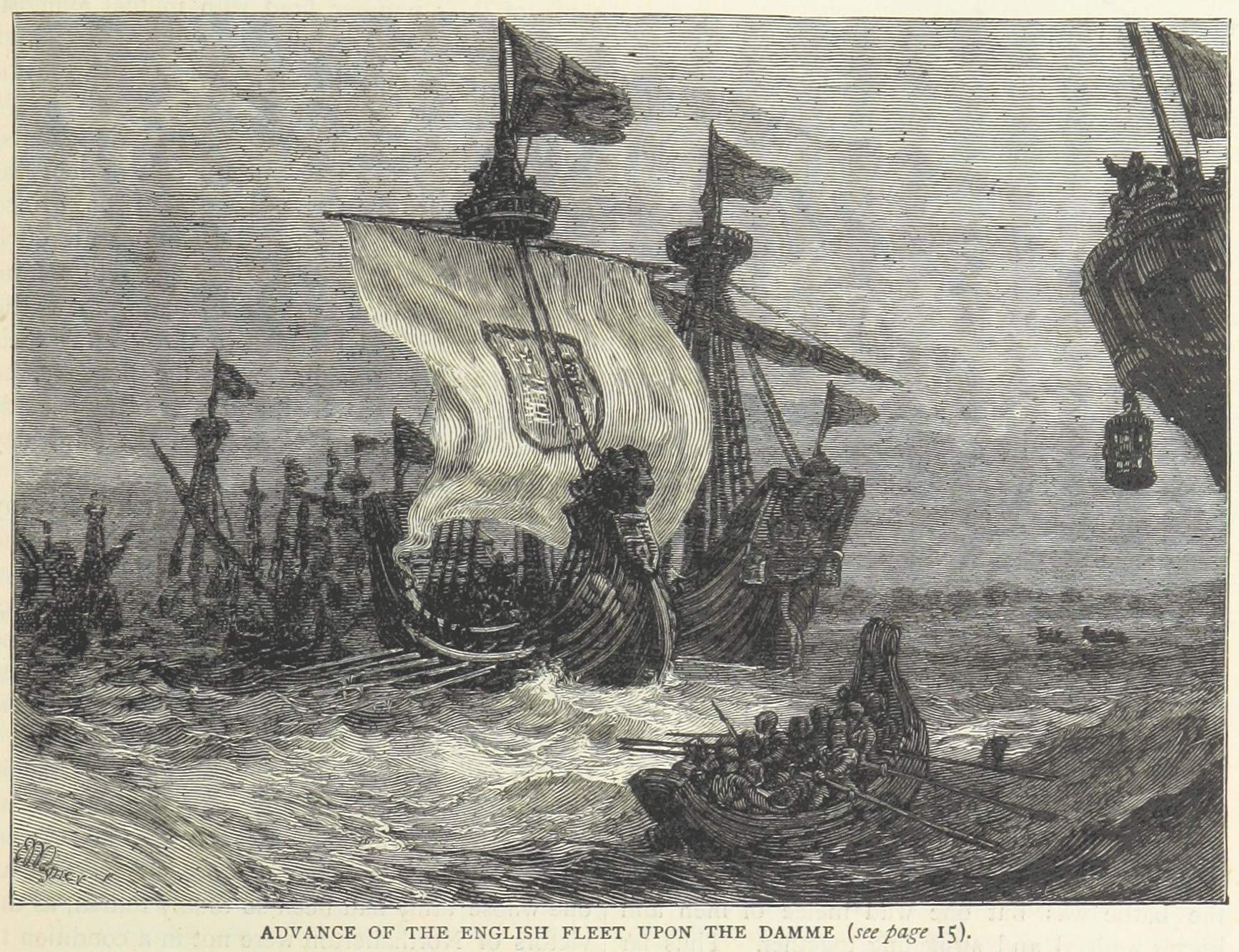
The English sailors could not believe their luck. On May 30, 1213, Earl William Longespee led his fleet into the estuary of the Zwyn expecting to support his Flemish allies. Instead, he found the entire French invasion armada at anchor, hundreds of ships laden with wine, bacon, pay chests, and the personal treasures of French barons. Most of the crews were ashore, pillaging the Flemish countryside while King Philip II besieged Ghent. Within two days, the English had captured 300 ships, burned another 100, and sailed home with such plunder that chroniclers declared 'never had so much treasure come into England since the days of King Arthur.' The Battle of Damme ended France's immediate hope of invading England and became celebrated as the first great naval victory in English history.
A Pope's Intervention
King John of England had lost nearly all his French territories by 1204 and spent years scheming to recover them. By 1212, both John and his nephew Otto, the Holy Roman Emperor, were locked in disputes with Pope Innocent III. John's refusal to accept the Pope's candidate for Archbishop of Canterbury had resulted in England being placed under interdict and John himself excommunicated. Philip II of France saw opportunity: he could invade England under the banner of the Church. But the papal legate Pandulf Verraccio was playing both sides. John secretly agreed to accept papal authority, and suddenly France's planned crusade against an excommunicate became an attack on a faithful vassal of Rome. The Pope ordered Philip to stand down. Philip redirected his army into Flanders instead, where Count Ferdinand had defied him.
The Fleets Assemble
Medieval naval warfare relied on two types of vessels. Galleys, adapted from Mediterranean designs, were highly maneuverable and effective for raiding. Cogs, the merchant ships of the era, had deep hulls and high sides that made them floating fortresses when fitted with wooden fighting platforms at bow and stern. Both the English and French requisitioned every available vessel for the coming campaign. The French fleet, commanded by Savari de Mauleon, a noble who had recently served King John, assembled at Boulogne before sailing to Gravelines and finally to Damme. This was no minor force: contemporary chronicler William the Breton claimed 1,700 ships, though modern historians consider this wildly exaggerated. Even a more conservative estimate of several hundred ships represented an enormous concentration of maritime power.
Slaughter in the Estuary
Damme sat on the estuary of the Zwyn, serving as the port of Bruges and one of the most important commercial harbors in Europe. When Longespee's 700 men-at-arms and their fleet of fighting ships entered the estuary on May 30, they initially mistook the French vessels for Flemish allies. Scouts soon confirmed the truth: the armada was French, and it was virtually undefended. The crews had scattered to pillage the countryside while their commanders assumed the army besieging Ghent provided sufficient protection. The English attacked with devastating effect, seizing 300 anchored ships and slaughtering the skeleton crews. Another 100 vessels pulled up on the beach were looted and burned. The following day, English landing parties attempted to storm Damme itself but were repulsed by the French garrison.
A King's Fury
When Philip learned of the disaster, he abandoned the siege of Ghent and force-marched his army to Damme. He arrived on June 2 to find English ships still looting and burning his fleet almost at will. Suspecting treachery from crews recruited from recently-lost English territories in Poitiers and Normandy, and from their commander who had so recently switched allegiances, Philip ordered the remaining ships burned rather than risk their capture. He then turned his rage on Flanders, commanding that every town his army passed through be razed and the peasants killed or sold into slavery. He extracted 30,000 marks from the captured Flemish cities before withdrawing. The English fleet sailed home with their prizes, but the larger war continued. Philip would decisively defeat John's continental allies at the Battle of Bouvines the following year, ending English hopes of recovering Normandy.
From the Air
Located at 51.25N, 3.27E at the site of medieval Damme in West Flanders, Belgium. The Zwyn estuary where the battle occurred has largely silted up over the centuries, transforming the former major port into quiet agricultural land. The town of Damme remains visible, connected to Bruges by a tree-lined canal that follows the old waterway. Best viewed at 2,000-3,000 feet. Nearest airports include Ostend-Bruges (EBOS) to the west and Maldegem (EBES) to the northeast. The flat landscape makes the medieval canal network clearly visible from altitude.