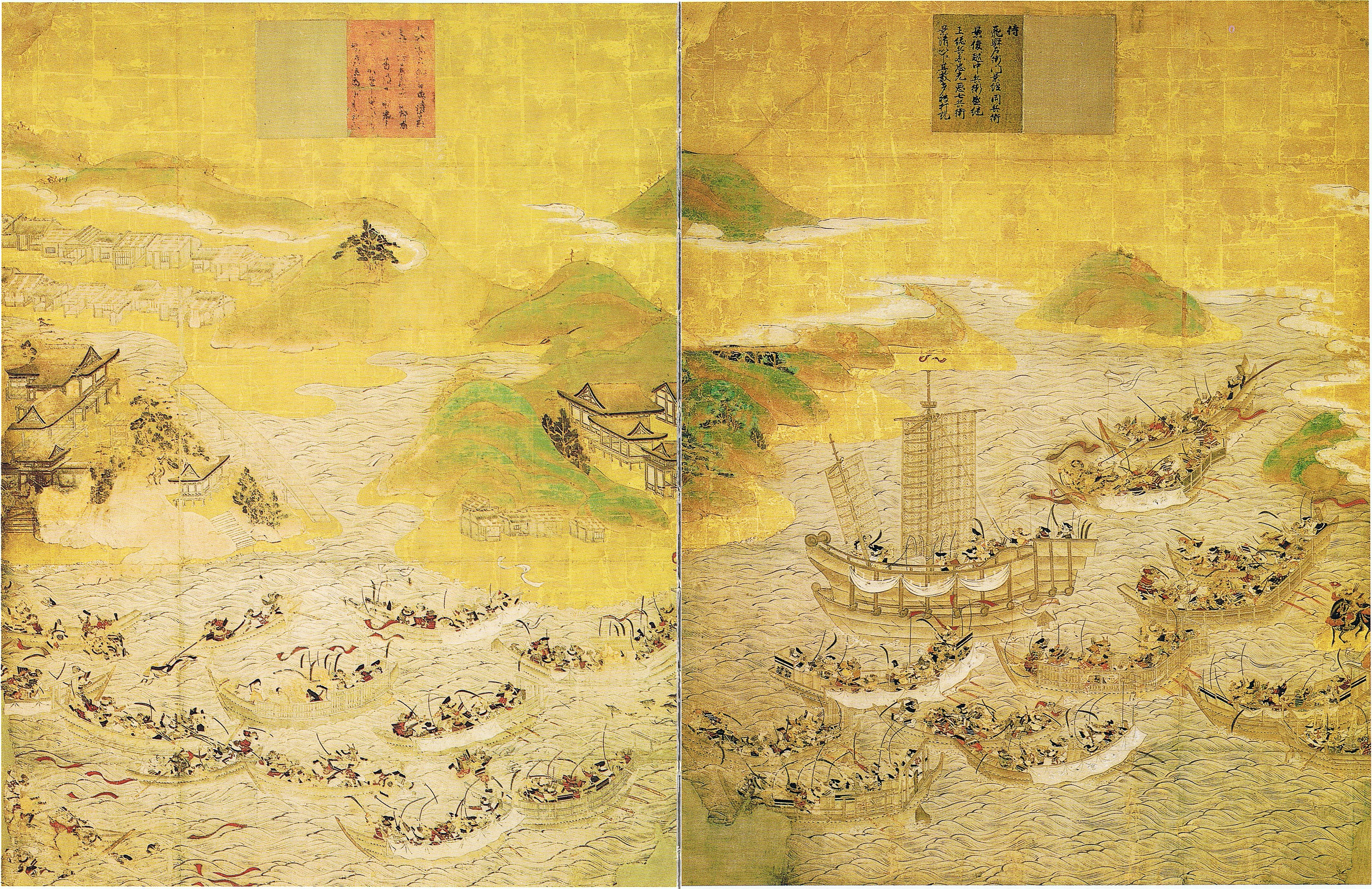
Battle of Dan-no-ura
The Taira brought the emperor to battle. He was six years old, dressed in full court regalia, placed aboard a warship in the Shimonoseki Strait to inspire the fleet with the legitimacy of his presence. It was April 25, 1185, and the Genpei War -- five years of civil war between the Taira and Minamoto clans -- was about to reach its climax. The Taira controlled the waterway. They understood its currents. They had more ships. But they also had a traitor in their ranks, and the tides of the strait do not stay still.
Tides and Treachery
The geography of Dan-no-ura, at the southern tip of Honshu where the Kanmon Strait funnels the current between the Inland Sea and the open ocean, made it a natural chokepoint. The Taira knew these waters; the Minamoto did not. In the morning, the rip tide favored the Taira, and they pressed the advantage, splitting their fleet into three squadrons to encircle the Minamoto ships. The Minamoto arrived en masse, archers ready at the rails, and the opening exchange was an archery duel across the water. When ships closed, the fighting shifted to hand-to-hand combat with swords and daggers as crews boarded each other's vessels. The Taira held one key advantage: Taguchi Shigeyoshi, a general whose son was held hostage by the Minamoto. Despite warnings from fellow Taira commanders that Shigeyoshi was a liability, their leader kept him on. It was a fatal miscalculation. In the afternoon, the tide reversed, and Shigeyoshi revealed to the Minamoto which ship carried Emperor Antoku.
The Emperor's Grandmother Leaps
Minamoto archers concentrated their fire on the helmsmen and rowers of the imperial ship, crippling its ability to maneuver. As one Taira vessel after another lost control, warriors began to see the battle turning irreversibly against them. What followed was a mass suicide. Taira nobles threw themselves into the strait rather than face capture. Among them was Nii-no-Ama, Taira no Tokiko, the widow of the great Taira no Kiyomori and grandmother of Emperor Antoku. She gathered the child and the Imperial Regalia -- the sacred mirror, jewel, and sword that symbolized the emperor's divine authority -- and leaped into the sea. The jewel was later recovered by divers. The mirror, according to legend, destroyed the woman who tried to cast it overboard when she glimpsed its spiritual power. The sword, Kusanagi no Tsurugi, is generally believed to have been lost forever, though later accounts offer various explanations -- recovery, supernatural replacement, a hidden replica. A new sword was eventually enshrined at Atsuta Shrine.
The First Shogun
The destruction of the Taira at Dan-no-ura ended not just a war but an entire political order. Minamoto no Yoritomo, the elder half-brother of the battle's victorious general Yoshitsune, leveraged the triumph to establish the Kamakura shogunate -- the first military government in Japanese history. The emperor remained as a symbolic figurehead, but real power passed to the shogun and his warrior class. This arrangement, in various forms, would persist for nearly seven centuries until the Meiji Restoration of 1868. The battle also killed a remarkable number of Taira leaders in a single afternoon: Tomomori, Noritsune, Norimori, Tsunemori, Sukemori, Arimori, and Yukimori all perished. The clan was effectively decapitated.
Ghosts in the Strait
The waters of Dan-no-ura have never quite released their dead, at least not in Japanese cultural memory. The heikegani crabs found in the Shimonoseki Strait bear shell patterns that resemble angry human faces, and tradition holds that they carry the spirits of the fallen Taira warriors. The legend of Hoichi the Earless, set at a temple overlooking the strait, tells of ghostly Taira soldiers summoning a blind musician each night to perform the story of their defeat. The battle appears in Masaki Kobayashi's 1964 film Kwaidan, in the 2021 animated film Inu-Oh, and in the anime series The Heike Story. Yoshitsune's famous 'eight-boat jump' -- leaping across consecutive vessels to escape a Taira champion trying to drag him overboard -- has been depicted in art for centuries, though historians believe the actual leap covered a single boat. At Dan-no-ura, the line between history and legend dissolved eight centuries ago and shows no sign of resolving.
From the Air
Dan-no-ura (33.97N, 130.96E) is located in the Kanmon Strait (Shimonoseki Strait), the narrow waterway separating Honshu from Kyushu at Japan's western tip. The strait is spanned by the Kanmon Bridge and an undersea tunnel. Kitakyushu Airport (RJFR) is approximately 12 km east. The strait carries heavy shipping traffic. Akama Shrine, dedicated to the drowned Emperor Antoku, stands on the Shimonoseki waterfront overlooking the battle site.