Battle of Derna (1805)
"My head or yours." That was the reply from the governor of Derna when offered peace terms in April 1805. The man who received that message, William Eaton -- a brash American diplomat who had appointed himself general of a ragtag army -- was standing outside the walls of a city defended by 800 soldiers, having just marched 500 miles across the Libyan Desert with seven United States Marines, a deposed prince, and roughly 400 Arab and Greek mercenaries who had tried to mutiny at least four times along the way. He attacked anyway.
A Scheme Born of Piracy
The First Barbary War began because the young United States refused to keep paying tribute to North African states that seized American merchant ships and enslaved their crews. By 1804, the situation had reached a humiliating low: the frigate USS Philadelphia sat captured in Tripoli's harbor, and its 307 crew members languished in prison. President Thomas Jefferson authorized an unconventional solution. William Eaton, the former consul to Tunis, received permission to find Hamet Karamanli -- the rightful heir to the throne of Tripoli, living in exile in Egypt after his younger brother Yusuf had seized power by murdering their eldest brother in front of their mother. The plan was audacious: restore Hamet to the throne by force, and the piracy problem would solve itself. Eaton was given seven Marines under First Lieutenant Presley O'Bannon, naval support from three warships, and essentially nothing else.
Fifty Days Across the Desert
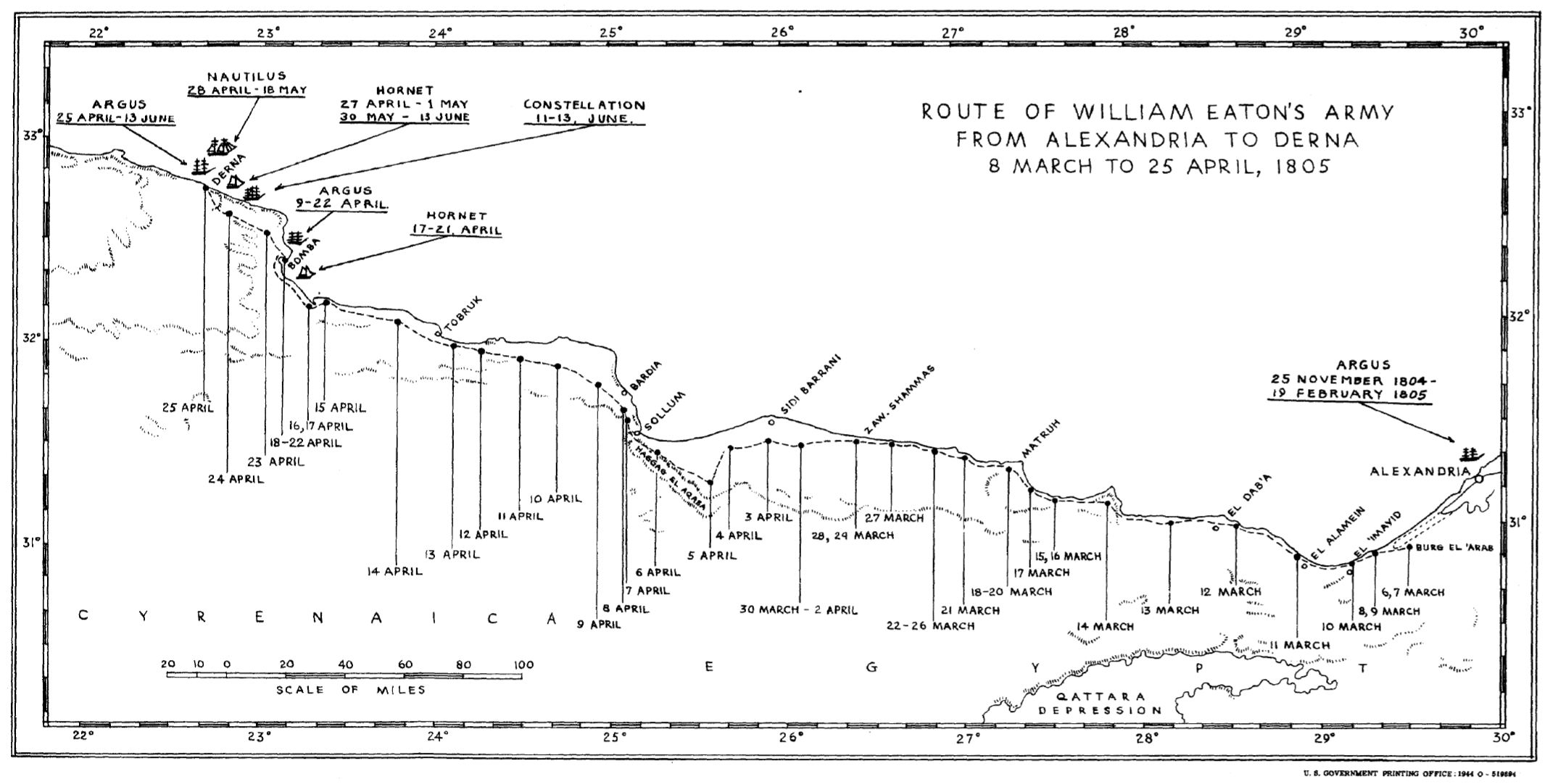
On 8 March 1805, Eaton led his motley force westward from Alexandria into the Libyan Desert. The objective was Derna, capital of the Ottoman province of Cyrenaica, 500 miles away across waterless wasteland. The army he had assembled was a volatile mixture: Christian Greek mercenaries and Muslim Arab and Turkish fighters who distrusted each other intensely, held together by promises of money and supplies that would arrive only when they reached the coast. Supplies dwindled until Eaton reported their daily rations as "a handful of rice and two biscuits." The mercenaries attempted to raid the supply wagon and were beaten back by Marines manning the expedition's single cannon. Between 10 and 30 March, Arab camel drivers and mercenaries under Sheik el Tahib staged repeated mutinies. Eaton quelled them through a combination of force, diplomacy, and sheer will. By early April, he crossed into Tripolitan territory with his fractious army still intact -- barely.
The Assault on Derna
In late April, the force reached the port of Bomba, where the warships Argus, Nautilus, and Hornet waited with fresh supplies and pay for the mercenaries. On 26 April, they arrived before Derna and found 800 defenders behind its walls with a Tripolitan army nearby. Eaton offered terms; the governor refused with his memorable threat. The attack came at dawn on 27 April. The warships opened fire on the town's batteries while O'Bannon led the Marines, Greek mercenaries, and gunners against the harbor defenses. Hamet's cavalry struck from the southwest, seizing an old castle. When the city batteries fell silent under naval bombardment, the Tripolitans shifted to reinforce against O'Bannon's advance. Eaton, desperate, ordered a bayonet charge and took a musket ball through his left wrist. The Marines and Greeks stormed the battery wall under heavy fire from surrounding houses, planted the American flag, and turned the captured guns on the remaining defenders. By 4:00 PM, Derna had fallen -- the first city in the Old World to fly the Stars and Stripes.
Holding and Losing
Victory brought new dangers. On 8 May, 1,200 Tripolitan reinforcements arrived under Hassan Bey. On 13 May, they drove through Hamet's outposts and pushed into the city as far as the palace before a shot from one of the warships killed two attackers and broke the assault. A larger attack on 10 June lasted four hours, with Hamet's cavalry and American guns repelling the Tripolitans at a cost of 40 to 50 killed on each side. Then, on 11 June, USS Constellation sailed into the harbor with devastating news: a peace treaty had been signed. Eaton, who had dreamed of marching on to Tripoli itself, was ordered to evacuate immediately. Fearing massacre if the locals learned of their departure, the Americans staged a fake attack preparation as a distraction, then slipped away in the night -- cannoneers and Greeks first, then Hamet, then the Marines, and finally Eaton in a small boat. The people they left behind fled to the mountains, terrified of Yusuf's reprisals. Mercifully, the promised amnesty was honored.
To the Shores of Tripoli
The Battle of Derna was the first American land battle on foreign soil after the Revolutionary War and the nation's first foreign military intervention. The peace treaty, signed between Yusuf Karamanli and Tobias Lear, traded Derna's hard-won gains for the release of the Philadelphia's 307 crew members and a $60,000 ransom. Eaton returned home a national hero, embittered by a treaty he considered a betrayal. O'Bannon was awarded a sword of honor by his home state of Virginia, and legend -- though uncorroborated by contemporary sources -- holds that Hamet presented him with a Mameluke sword that inspired the style still carried by Marine officers today. What is beyond dispute is the hymn. "From the Halls of Montezuma to the shores of Tripoli" -- that line commemorates what happened at Derna, where seven Marines and a self-appointed general proved that a nation barely two decades old would fight across oceans to protect its interests and its people.
From the Air
Located at 32.77°N, 22.63°E on the Libyan coast. Derna sits where the Jebel Akhdar mountains meet the Mediterranean, creating a distinctive green coastal enclave visible from altitude. The harbor area where O'Bannon's assault took place lies on the eastern shore. Nearest major airport: Benina/Benghazi (HLLB) approximately 250 km west. The 500-mile route from Alexandria crosses featureless desert plateau before reaching the greener Cyrenaican coast. Best viewed at 3,000-6,000 ft to see the harbor, the old castle southwest of the city, and the coastal terrain.