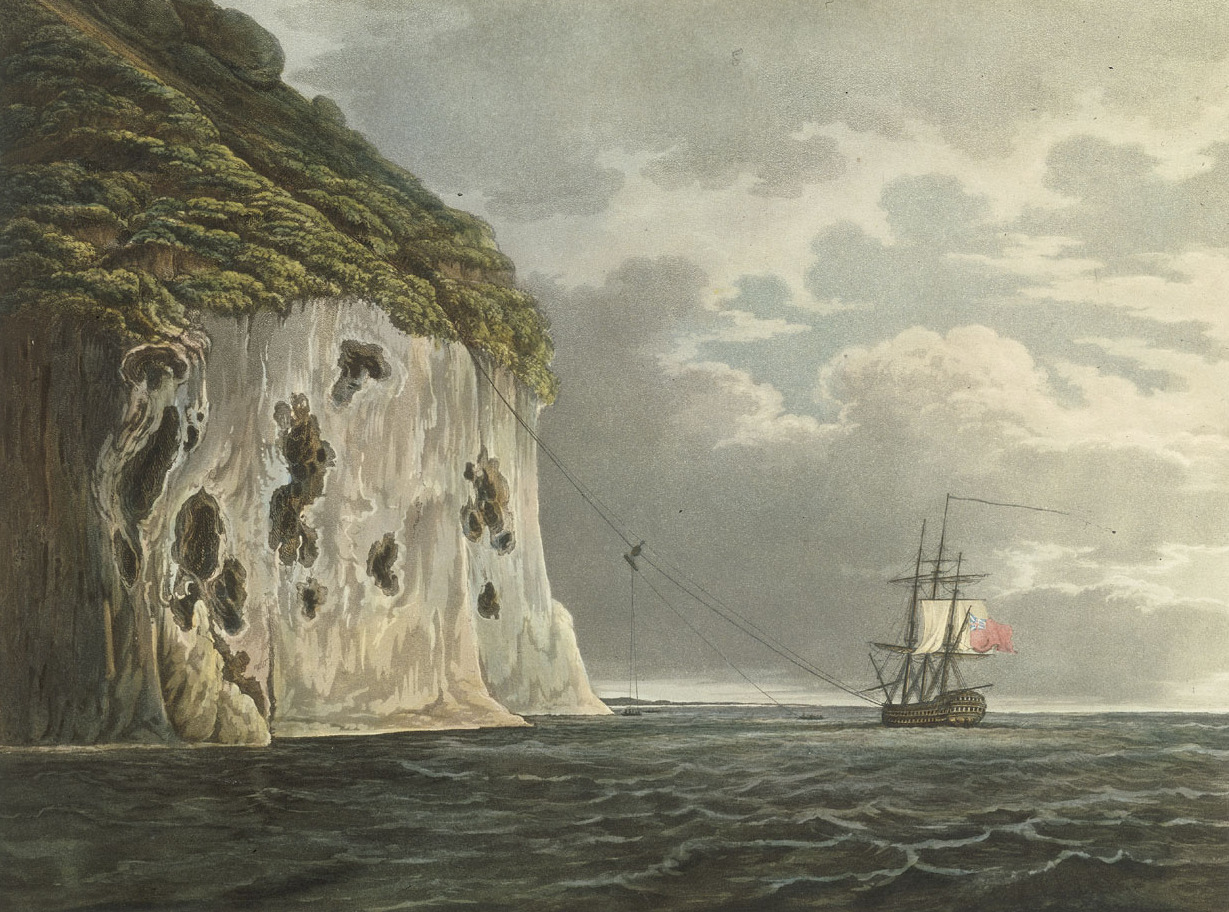
Battle of Diamond Rock
For seventeen months, the Royal Navy's most unusual vessel never moved. HMS Diamond Rock was not a ship at all but a 175-meter volcanic spire jutting from the Caribbean Sea off Martinique's southern coast, commissioned as a sloop of war in February 1804 and garrisoned with over 100 sailors and marines who hauled cannons up its sheer cliffs. From this improbable fortress, Commander James Maurice and his men harassed French shipping, blockaded Fort-de-France, and drove the governor of Martinique to distraction -- until a fleet under Vice-Admiral Pierre-Charles Villeneuve arrived to end the experiment by force.
A Rock Becomes a Warship
The idea belonged to Commodore Sir Samuel Hood, who in 1803 was tasked with blockading Martinique, the center of French power in the eastern Caribbean. Hood recognized that Diamond Rock, rising sheer from the sea roughly a mile off Martinique's southwestern coast, commanded the approaches to Fort-de-France Bay. If guns could be mounted on its summit, French vessels would have to run a gauntlet every time they entered or left port. The problem was getting those guns up there. Hood assigned Lieutenant James Maurice and a working party to scale the rock, rig pulleys, and haul 18- and 24-pounder cannons hundreds of feet up near-vertical basalt. The Black population of Martinique, largely sympathetic to the British, provided intelligence that helped the garrison avoid French interference during the vulnerable construction period. By February 1804, the rock was armed, provisioned, and formally commissioned. Maurice commanded a crew of about 120 men who lived in tents and caves, maintained a small hospital, and operated what amounted to a stationary warship.
Seventeen Months on Basalt
Life on Diamond Rock was austere but effective. The garrison's guns controlled the channel between the rock and Martinique, forcing French ships to take longer routes and disrupting supply lines to Fort-de-France. The governor, Louis Thomas Villaret de Joyeuse, ordered a road built to the coast opposite the rock and a battery constructed there, but the British -- forewarned by local intelligence -- sent a raiding party ashore, captured the French engineer and three of his men, and shut the project down. A French attempt to land soldiers on the rock by night also failed. Four boatloads of troops set out under cover of darkness, but the strong currents around the rock swept the exhausted men out to sea before they could land. They eventually made it back to Martinique. The British did not learn of the attempt for several days. For all its strategic value, the rock was profoundly isolated. Maurice's men depended on a small supply vessel for food, water, and communication with the fleet. Their existence was monastic in its discipline and relentless in its discomfort.
Villeneuve's Reluctant Assault
On May 14, 1805, a large French fleet under Vice-Admiral Villeneuve sailed into Fort-de-France Bay, exchanging fire with the rock's batteries as it passed. Shortly after, the garrison discovered a catastrophe unrelated to combat: their main water cistern, which held a month's supply, had cracked during earth tremors. The vibration from their own guns had worsened the leak. With barely two weeks of water remaining and French warships now blockading any resupply, Maurice's position became untenable. Villeneuve lingered in the bay for two weeks, apparently reluctant to spend resources on what was, strategically, a sideshow. But Governor Villaret de Joyeuse, who had endured seventeen months of humiliation, persuaded him to act. On May 29, a flotilla of schooners, brigs, and frigates weighed anchor to attack. It took them two days to work into position windward of the rock. The final assault came on May 31 and continued for two days.
Surrender and Salute
The terms were generous. Maurice negotiated the honors of war on June 2: his garrison of 107 men would be taken to Fort-de-France and repatriated to a British settlement at the first opportunity, under parole. The French split the prisoners between two 74-gun ships of the line, the Pluton and the captured British vessel Berwick. By June 6, Maurice was back in Barbados, writing a letter to Horatio Nelson, who had just arrived in the Caribbean hunting Villeneuve's fleet. The subsequent court-martial for the loss of his "ship" exonerated Maurice completely, commending his defense. When Martinique was returned to France in 1815, Diamond Rock went with it and has remained French since. But the Royal Navy has never quite let go. To this day, British warships passing Diamond Rock are said to render the honors due a vessel still nominally in commission -- personnel standing at attention on the upper deck, the bridge offering a salute to the rock that once flew the White Ensign.
From the Air
Located at 14.44N, 61.04W, Diamond Rock rises 175 meters (574 feet) from the sea approximately 1.8 km off the southwestern tip of Martinique. From the air it is unmistakable: a steep-sided basalt spire standing alone in deep blue water, with the coast of Martinique's commune of Le Diamant visible to the northeast. The rock is part of a dramatic volcanic coastline that includes the sweeping curve of Grande Anse du Diamant beach. Mount Pelee is visible to the north on clear days. Nearest airport: Aime Cesaire International Airport (TFFF/FDF) in Le Lamentin, approximately 30km northeast. Approach from the south for the most dramatic view of the rock against the Martinique coastline.