Battle of Dien Bien Phu
Colonel Charles Piroth had made a promise. The one-armed artillery commander at Dien Bien Phu assured his superiors that no Viet Minh gun could fire three rounds without being destroyed by French counter-battery fire. When the siege began on March 13, 1954, and shells rained from positions the French could neither see nor reach, Piroth retreated to his dugout and killed himself with a grenade. His commanders buried him in secret to keep morale from collapsing further. That single act of despair captured the essence of Dien Bien Phu: a battle built on fatal miscalculation, where every French assumption about their enemy proved catastrophically wrong.
A Rice Bowl Turned Trap
The valley of Dien Bien Phu sits in the remote northwest corner of Vietnam, near the Laotian border, a basin roughly sixteen kilometers long and six wide, ringed by forested hills. In November 1953, French General Henri Navarre ordered 9,000 paratroopers dropped into this valley as part of Operation Castor. The plan was to build a fortified airbase that would cut Viet Minh supply lines into Laos and lure General Vo Nguyen Giap into a pitched battle where superior French firepower would annihilate his forces. The strategy drew on the French success at Na San the previous year, where a similar hedgehog defense had repelled Viet Minh attacks. But Navarre's officers failed to account for critical differences. At Na San, the French held the high ground. At Dien Bien Phu, Giap's forces occupied the ridgelines looking down into what he memorably described as a rice bowl, with his troops holding the rim and the French trapped at the bottom.
Cannons Through the Clouds
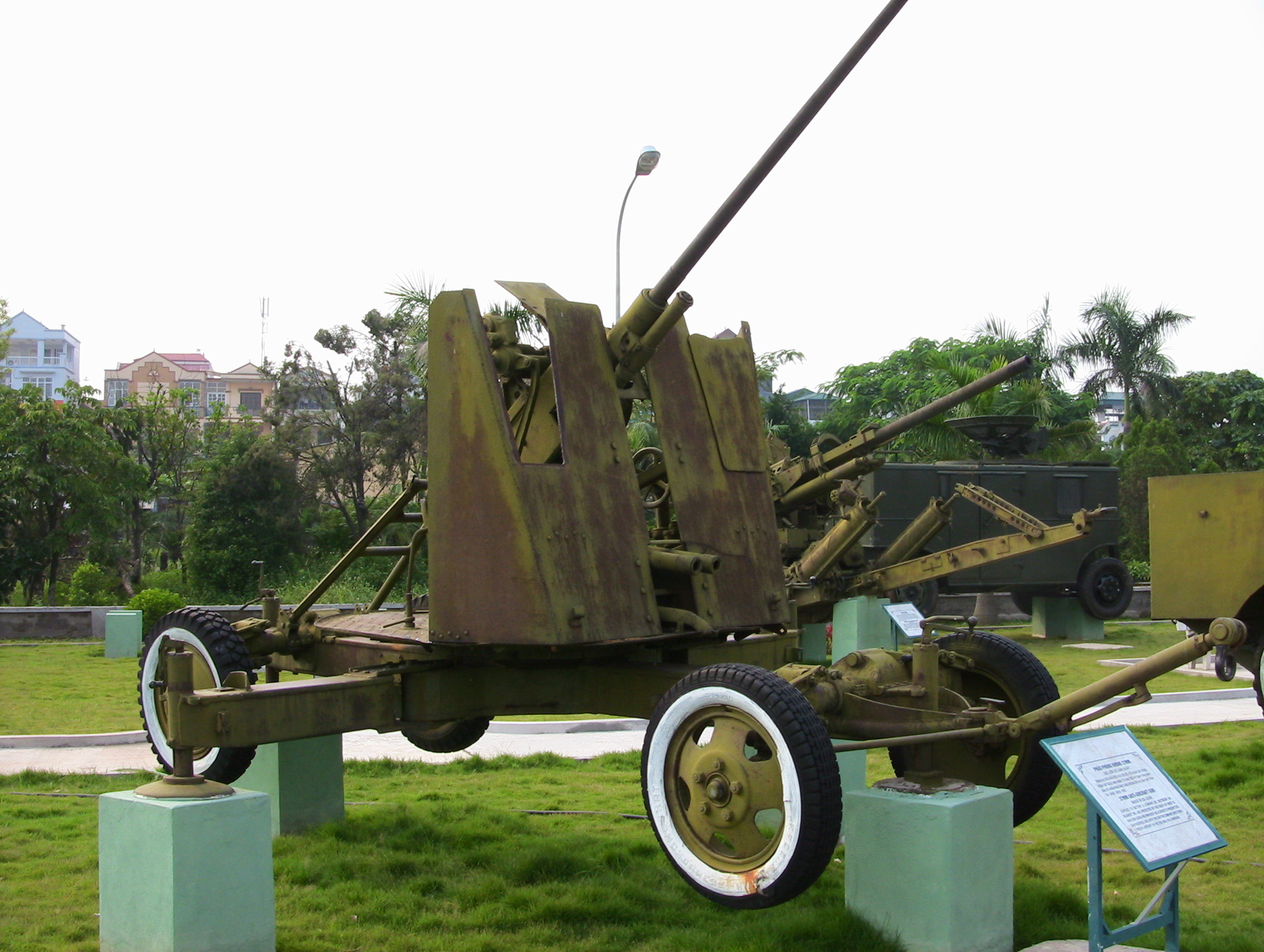
What Giap accomplished in the months before the battle defied every French intelligence estimate. Tens of thousands of porters, many of them civilians including women, hauled disassembled howitzers, anti-aircraft guns, and vast quantities of ammunition through seemingly impassable mountain jungle. They dragged artillery pieces up rear slopes and dug them into camouflaged casemates on the forward faces of the hills, each gun positioned to be rolled out, fired, and pulled back into its tunnel before counter-battery fire could respond. By the time the siege opened, the Viet Minh had emplaced over 200 artillery pieces, including 105mm howitzers captured from American stocks in Korea and supplied by China. French intelligence had estimated Giap could field perhaps a few dozen guns at most. The bombardment that began on March 13 shattered not just fortifications but the entire strategic premise of the battle. Supply aircraft were shot from the sky, the airstrip was cratered beyond repair, and the garrison found itself cut off from everything except parachute drops that grew more suicidal by the day.
The Strongpoints Fall
The French had named their fortified positions after women: Beatrice, Gabrielle, Anne-Marie, Huguette, Dominique, Claudine, Eliane, Isabelle. Beatrice fell first, on the opening night. A shell killed the battalion commander and most of his staff almost immediately, and the 312th Division overran the position by morning. Roughly 350 legionnaires were killed, wounded, or captured. Two days later, Gabrielle fell after Algerian troops held through the night but broke under a dawn assault when their own headquarters was destroyed by shellfire. The fighting that followed resembled the trench warfare of the Western Front more than any modern campaign. Viet Minh sappers dug approach trenches steadily closer to French lines. Positions changed hands in desperate night attacks. On Eliane 2, one of the most contested hills, the Viet Minh eventually tunneled beneath the fortifications and detonated a massive mine, and what defenders survived the blast were overrun within hours.
The Last Transmission
By early May 1954, the French perimeter had contracted to a fraction of its original size. Parachute reinforcements trickled in, but never enough to replace the mounting casualties. Some volunteer paratroopers jumped into the besieged camp knowing capture or death was virtually certain. On May 7, Giap launched a final all-out assault with over 25,000 troops against fewer than 3,000 able defenders. At 17:00, General de Castries radioed French headquarters in Hanoi. The last transmission from the garrison reported enemy troops outside the command bunker. The radio operator's final words were: "The enemy has overrun us. We are blowing up everything. Vive la France!" Of nearly 16,000 French Union soldiers who served at Dien Bien Phu, 11,721 were captured. Force-marched over 600 kilometers to prison camps, only 3,290 would be repatriated four months later. The death rate among prisoners approached sixty percent.
The End of Empires
The Geneva Conference opened the day after the garrison fell. Within months, France agreed to partition Vietnam and began withdrawing from Indochina entirely. But the shock waves reached far beyond Southeast Asia. Ferhat Abbas, who would become Algeria's first post-colonial president, called Dien Bien Phu the "Valmy of the colonized peoples," a reference to the French Revolutionary battle that proved ordinary citizens could defeat a professional army. The parallel was deliberate and devastating: France's own revolutionary mythology was being turned against it. Today the valley holds a modern museum and preserved battlefield positions, including the bunkered French headquarters and the vast crater atop Eliane 2 where the Viet Minh mine detonated. The site draws visitors who walk ground where two months of fighting consumed an army and ended a colonial era. The hills still ring the valley, quiet now, but the geography that made it a trap remains unmistakable from the air.
From the Air
Located at 21.39°N, 103.02°E in the Muong Thanh Valley of northwestern Vietnam near the Laotian border. The valley basin is clearly visible from altitude, roughly 16 km long by 9 km wide, surrounded by forested hills. Best viewed from 5,000-8,000 ft AGL. Nearest airport is Dien Bien Phu Airport (VVDB), located within the former battlefield itself. Hanoi Noi Bai International Airport (VVNB) is approximately 300 km to the southeast. The terrain is mountainous with peaks reaching 1,500 m around the valley. Weather can include low clouds and monsoon conditions, particularly May through September.