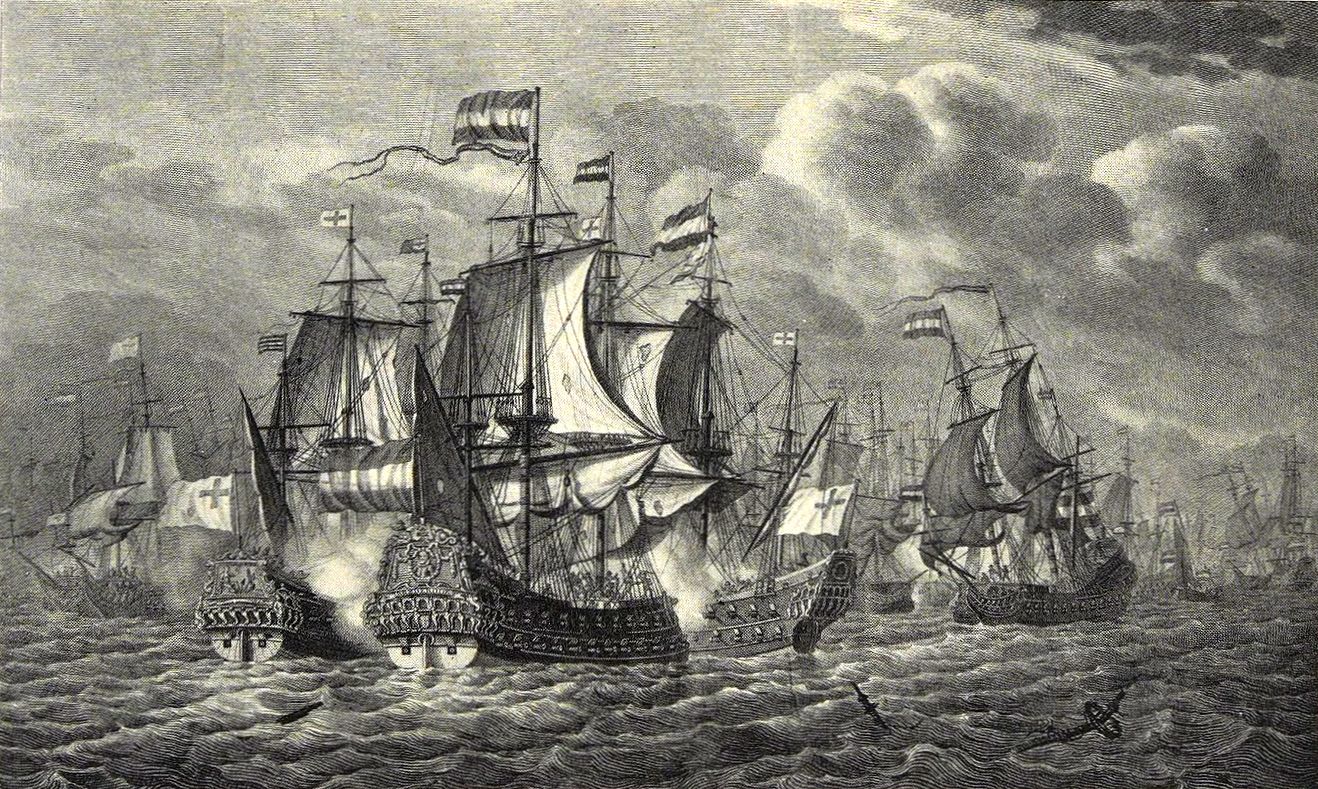
Battle of Dover (1652)
It began with a flag that did not dip. On 19 May 1652, Lieutenant-Admiral Maarten Tromp was cruising the English Channel with forty Dutch warships when he met Robert Blake's English fleet off Dover - and refused to strike his colors in salute, as Oliver Cromwell had recently ordained that all foreign warships must do. Blake fired two warning shots. Tromp ran up a red battle flag. Five hours later, Dutch and English broadsides had shredded each other's rigging, two Dutch ships had been captured, and a war neither country had quite declared was unmistakably on.
A Quarrel Made of Paper and Salt
The trouble was already eight months old when the cannons spoke. In October 1651, the English Parliament had passed the first Navigation Act, designed to throttle the Dutch carrying trade that fed the United Provinces. Early in 1652, George Ayscue's squadron seized 27 Dutch merchantmen caught trading with royalist Barbados in defiance of the embargo. Dutch merchants raged. English ministers stood firm. Both republics began arming, both still hoping the talks in The Hague might hold. The Channel between them, only twenty-one miles wide at its narrowest, became the place where pride and economics rubbed hardest against each other - and Cromwell's flag ordinance, demanding that foreign warships acknowledge English sovereignty over these home waters, made every encounter a potential incident.
Brederode and James
Tromp was protecting a convoy when the dispatch ketch reached him with orders to attack Blake if he found him. Coming up on the English fleet between Nieuwpoort and the mouth of the Meuse, he kept his flag flying. Blake, aboard his flagship James, took the gesture as defiance and fired two warning shots. The third shot, fired in answer to Tromp's red battle ensign, struck the Dutch flagship Brederode and wounded crew. Tromp replied with a warning broadside. James fired back in earnest, and the rest of both fleets crashed into action. The two flagships passed within pistol range, exchanging full broadsides, then turned to do it again. While Brederode was tacking for another pass, the English ship President rammed into her side, grappled, and sent boarders swarming over the rails.
Five Hours Off the Cliffs
What followed was the kind of melee that the gun era was supposed to have made obsolete. Tromp's sailors drove the English boarders back across the bulwarks. The English Garland came up on Brederode's other side, pinning her between two enemies. Then Johan Evertsen pulled alongside President and unleashed broadsides that severed every one of her masts, before Dutch boarders swarmed the dismasted hulk in their turn and were beaten back in hand-to-hand fighting on slick, splintered decks. The fight wandered along the chalk coast for five hours, each shot rolling against the cliffs and echoing back. Neither admiral could land a decisive blow. As the light began to fail, the Dutch formed a defensive line around their convoy and pulled away. The English took two Dutch stragglers as prizes - Sint Laurens, which they hauled home but never used, and Sint Maria, abandoned sinking but later drifting back to the Netherlands on her own.
Excuses, and a Declaration
Tromp, perhaps already calculating the diplomatic cost, sent word to Blake apologizing for the engagement and asking for his prize back. Blake refused. The Dutch admiral's gesture was probably honest - he had not been ordered to start a war - but the politicians in London were not interested in excuses. On 8 July 1652, the Commonwealth of England formally declared war on the United Provinces. The First Anglo-Dutch War would run for two more years, with set-piece battles in the North Sea and the Channel between fleets larger than anything Europe had previously fielded. Historians still argue who actually won the May skirmish off Dover. The more important verdict was rendered in the months that followed, when both sides began building warships at a pace that would, by 1653, see hundreds of guns answering each other across these narrow seas.
Where the Channel Narrows
The waters that hosted the fight are still among the busiest on Earth. Forty thousand ships a year now thread the Dover Strait between the white cliffs and the French shore, watched over by traffic separation schemes that did not exist in Tromp's day, when the only navigation aid was a dispute about who saluted first. The fight took place in plain sight of Dover's chalk wall and the gun-emplacements on the heights - close enough that townspeople could probably hear the broadsides rolling across the water for most of an afternoon, and certainly close enough to count the masts as the smoke drifted off toward Calais.
From the Air
Battle area centered roughly 51.27N, 1.51E, in the Dover Strait off the Kent coast. Visible from cruising altitude in clear weather as the narrowest pinch of the English Channel between Dover and Cap Gris-Nez. Nearest airports are Lydd (EGMD) to the southwest and Manston (EGMH, now retired) to the north; Le Touquet (LFAT) lies across the strait. Watch for very heavy commercial shipping density below.