Battle of Drobak Sound
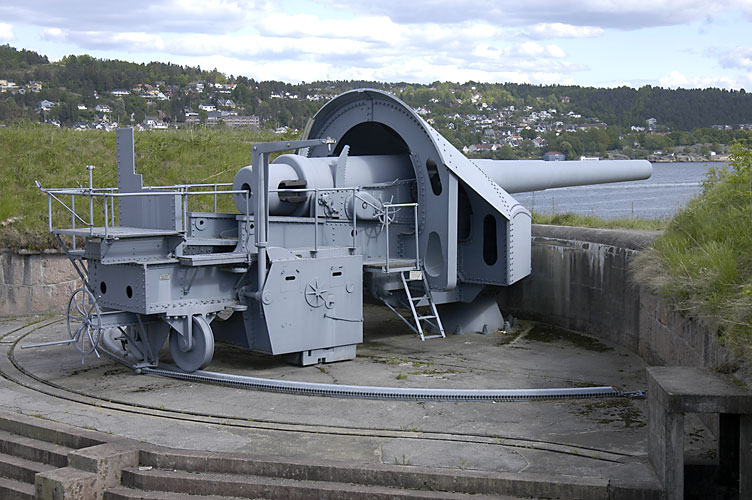
Three Krupp guns named Moses, Aron, and Josva. A retired artillery commander recalled to active duty. And a 64-year-old colonel who had received no clear orders but decided, in the predawn darkness of 9 April 1940, to open fire anyway. The Battle of Drobak Sound lasted barely half an hour, but it altered the course of World War II in Norway -- and arguably in all of Western Europe.
The Colonel's Decision
Oscarsborg Fortress sat on islands in Drobak Sound, the narrow northern passage of the Oslofjord, roughly 30 kilometers south of Oslo. By 1940, the fortress had been relegated to training conscripts. Its main battery consisted of three 28-centimeter Krupp guns dating to the 19th century, and there were only enough trained gunners to operate one of them. The garrison was filled out with 450 raw recruits who had been conscripted just a week earlier. Colonel Birger Eriksen commanded from a backup station on South Kaholmen island. He knew Norway was neutral. He did not know whether the warships approaching through the darkness were German or British. What he did know was that they had not been invited. At 4:21 a.m., he ordered his guns to fire.
The Sinking of the Blucher
The first shell from the main battery struck the German heavy cruiser Blucher near the mainmast, igniting ammunition stores for the ship's reconnaissance floatplanes -- oil, incendiary bombs, depth charges. The explosion disabled the electrical system that powered the cruiser's main guns, leaving the pride of the German fleet unable to return effective fire. As the burning Blucher drifted slowly north through the sound, Norwegian shore batteries pounded it with thirteen 15-centimeter shells and around thirty 57-millimeter rounds. Then came the weapon the Germans never expected. Retired commander Anderssen, who had first served at the fortress in 1909, fired two torpedoes from a concealed battery. The second struck amidships, blowing open bulkheads and flooding compartments. The fires reached a magazine for the anti-aircraft guns, ripping open the ship's side. The Blucher sank. Aboard had been Generalmajor Erwin Engelbrecht, Admiral Oskar Kummetz, Gestapo agents, and a special unit tasked with capturing the Norwegian king.
The Hours That Changed Everything
When the Blucher went down, the commander of the heavy cruiser Lutzow -- unaware of the torpedo battery -- assumed the sound was mined and ordered a retreat. The surviving German troops had to be landed outside the range of the fortress guns and advance on Oslo by land. This delay, measured in hours rather than days, proved decisive. King Haakon VII and the Norwegian government fled the capital with the royal treasury and critical state documents. The government was granted wartime emergency powers through the Elverum Authorization, issued that same day, and eventually reconstituted itself as a government-in-exile in the United Kingdom on 7 June 1940. Had the Blucher reached Oslo as planned, the king and parliament would have been captured, and the legal basis for Norwegian resistance would have been lost.
The Price of Defiance
The Luftwaffe responded with fury. Twenty-two Junkers Ju 87 Stuka dive bombers from Kiel-Holtenau pounded Oscarsborg for nearly nine hours, dropping approximately 500 bombs. The fortress eventually fell. The garrison went into captivity -- enlisted men and NCOs from secondary batteries were released within three days, those from the main battery within a week. Officers were sent first to Fredriksten Fortress, then to the Grini detention camp, with most released by late May 1940. The Norwegian army surrendered on 10 June. But the government's escape meant the occupation would never be legitimate, and Norway fought on from abroad for the duration of the war.
Echoes in the Fjord
The wreck of the Blucher still lies on the bottom of Drobak Sound, leaking oil that occasionally surfaces as a reminder of what happened here. Oscarsborg Fortress is now a museum and hotel, its guns preserved on their mountings. The torpedo battery where Anderssen made his shots remains accessible to visitors. The battle was depicted in the 2016 film The King's Choice and the 2025 Norwegian film The Battle of Oslo. But the most striking detail may be the simplest one: at 4:21 a.m. on a dark April morning, a colonel with no orders, a retired artilleryman, and a garrison of week-old recruits held off an invasion fleet -- and gave their king just enough time to run.
From the Air
Located at 59.70N, 10.59E in Drobak Sound, the narrow passage in the northern Oslofjord. The islands of Oscarsborg Fortress are visible from the air, with the narrow channel clearly defined between the mainland and the fortress islands. Nearest major airport is Oslo Gardermoen (ENGM), approximately 70 km north. The fjord passage and fortress layout are best appreciated at 2,000-4,000 ft AGL.