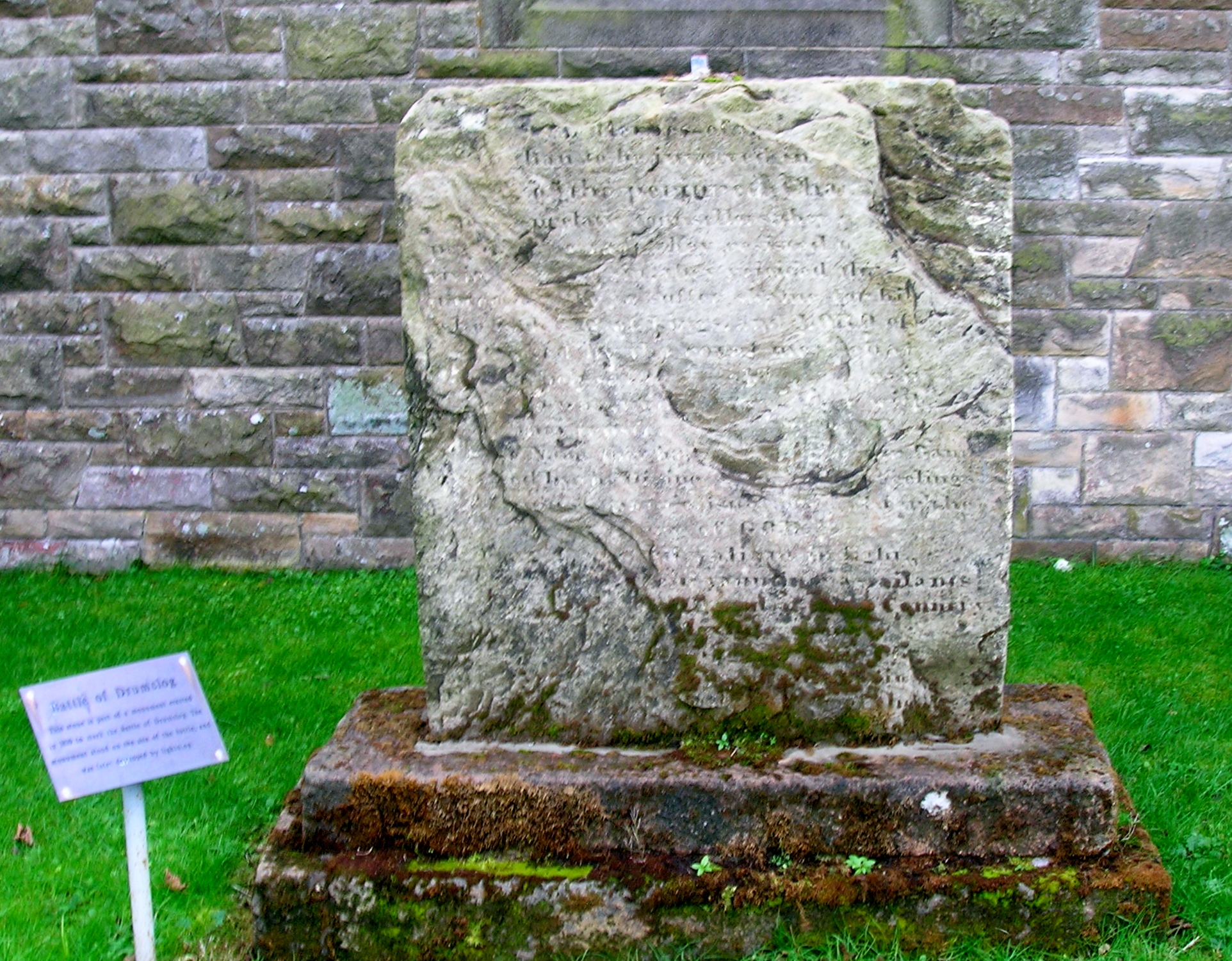
Battle of Drumclog
"Ye have got the theory, now for the practice." With those words, the Reverend Thomas Douglas allegedly broke off his sermon on the morning of Sunday 1 June 1679, when riders brought news that government dragoons were approaching. The illegal outdoor prayer meeting near Loudoun Hill, where Covenanters had gathered in defiance of royal authority, was about to become a battlefield. What happened next on the boggy moor near Drumclog in South Lanarkshire was one of the most unlikely military victories in Scottish history.
Worshippers With Muskets
The Covenanters who gathered that morning were not ordinary churchgoers. They were Presbyterians who had refused to accept the re-imposition of Episcopal church governance after the Restoration of Charles II, and the government's response had been escalating persecution. Outdoor worship meetings, called conventicles, were illegal. Dragoons patrolled southwest Scotland under orders to disperse them, led by Captain John Graham of Claverhouse, known to his enemies as "Bluidy Clavers." But the Covenanters had come prepared. Around 200 were armed, roughly 40 on horseback, the rest carrying muskets and pitchforks. Under the command of Robert Hamilton, they moved east from the prayer meeting to take up a defensive position behind a stretch of marshy ground near the farm of Drumclog. The boggy terrain, called a "stank" in local dialect, would become the key to the battle.
The Bog That Won a Battle
When Claverhouse's dragoons arrived, they found the Covenanters dug in behind ground that cavalry could not cross. For a time, skirmishers from both sides exchanged musket fire across the stank, and Claverhouse believed he was gaining the advantage. But he could not close the distance. His mounted soldiers bogged down every time they tried to advance, their horses sinking in the soft peat. Then the Covenanters made their move. William Cleland led a force around the edge of the bog and charged Claverhouse's line from an unexpected direction. Despite heavy fire, the attack broke the government formation. The dragoons routed, leaving 36 dead on the field, and Claverhouse himself fled toward Glasgow. A fleeing trumpeter was reportedly caught and killed by Covenanters at Caldermill, and the Trumpeter's Well was named in his memory.
Euphoria and Its Price
The victory electrified the Covenanter movement, but euphoria proved dangerously short-lived. Just three weeks later, on 22 June 1679, the Duke of Monmouth crushed the Covenanter army at the Battle of Bothwell Bridge. The defeat there was devastating, and the government repression that followed became known as "the Killing Time." Drumclog had shown that poorly armed worshippers could defeat professional soldiers if the ground favoured them, but it also hardened the government's resolve to stamp out the movement completely. The battle became a touchstone for Covenanter identity, celebrated in song and story, its significance far outweighing its modest scale. Sir Walter Scott fictionalised it in his 1816 novel Old Mortality, and the encounter is preserved in a Child Ballad titled Loudoun Hill, or Drumclog.
Stones That Remember
A monument was first erected on the battlefield in 1839. Lightning struck it down, and the current memorial was built in 1867, standing above the moorland as a testament to the Covenanters' faith. The battlefield has been inventoried and protected by Historic Scotland. In 1912, the village that grew up along the nearby railway acquired the Drumclog Memorial Kirk, whose stained glass windows depict the Covenanters in battle. The kirk holds an annual memorial service on the first Sunday of June, gathering at the monument where the bog once stopped the dragoons. Inside a museum in Scotland, the Covenanters' original battle flag survives, bearing its thistle and its inscription: "For Reformation of Religion In Church And State According To The Word Of God And Our Sworn Covenants." It is the banner of people who chose prison, exile, and death over surrendering their conscience.
From the Air
Located at 55.63N, 4.18W in South Lanarkshire, on the boundary of Ayrshire and Lanarkshire near Loudoun Hill. The battlefield is an area of open moorland, with the Drumclog Memorial Kirk visible along the A71 Edinburgh-to-Kilmarnock road. Nearest airports: Glasgow Prestwick (EGPK) approximately 18 nm southwest; Glasgow (EGPF) approximately 20 nm northwest. Best viewed at 2,000-3,000 ft AGL.