Battle of Dublin
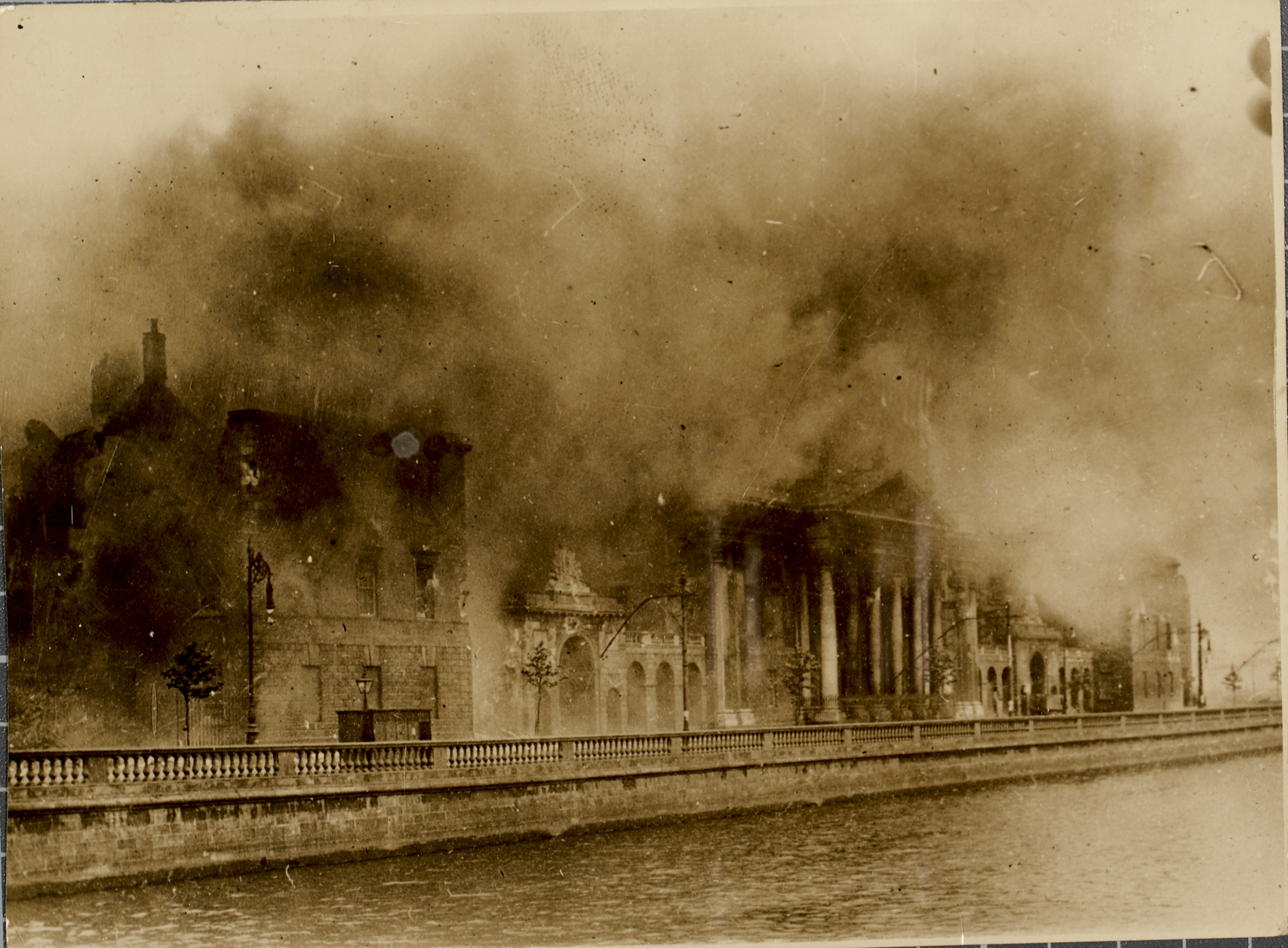
At 4:00 a.m. on 28 June 1922, two 18-pounder field guns borrowed from the British Army opened fire across the River Liffey at the Four Courts. The men inside -- who six months earlier had been comrades of the men firing the guns -- had occupied the building since April, hoping to provoke a new confrontation with Britain that would unite the fractured IRA. Instead, Michael Collins, under intense British pressure, authorized the bombardment that would begin the Irish Civil War. The shells were British. The guns were British. The men on both sides were Irish, and most of them had fought together during the War of Independence.
Comrades Across the Barricade
The roots of the battle lay in the Anglo-Irish Treaty of December 1921, which ended the War of Independence but split the republican movement. Anti-Treaty IRA fighters rejected the oath of allegiance to the British Crown and the creation of a Free State rather than a republic. In April 1922, about 200 militants under Rory O'Connor occupied the Four Courts, Dublin's centre of legal administration. Winston Churchill pressed Collins to act, threatening that Britain would re-invade Ireland if the occupation continued. After the assassination of Sir Henry Wilson in London on 22 June and the kidnapping of Free State Deputy Chief of Staff J.J. O'Connell, the Provisional Government issued an ultimatum. When it expired, the bombardment began.
The Siege of the Four Courts
The anti-Treaty garrison of roughly 180 men had rifles, five Thompson submachine guns, two Lewis machine guns, and a captured armored car they named "The Mutineer." Their leadership ordered them not to fire first, to retain moral authority, which allowed Free State troops to surround the complex unopposed. The first day's shelling proved ineffective, so the British supplied two more 18-pounder cannon and offered 60-pounder howitzers and aerial bombing. Collins refused the latter two because of the risk to civilians. On 29 June, Free State troops stormed the eastern wing, losing three killed and fourteen wounded. By the next morning, the building was on fire and Ernie O'Malley, who had taken over military command after Paddy O'Brien was hit by shrapnel, surrendered at 3:30 p.m. on 30 June.
The Explosion That Erased Centuries
Hours before the surrender, a devastating explosion destroyed the Irish Public Record Office, housed in the western block of the Four Courts. The blast sent a mushroom cloud 200 feet into the air and injured forty advancing Free State troops. Centuries of irreplaceable Irish state records -- documents stretching back to the Norman conquest -- were obliterated in moments. Who caused the explosion remains contested. The Free State alleged deliberate sabotage. A 2018 study by Michael Fewer found no evidence of intentional detonation and suggested the blast resulted from fires reaching ammunition stored in the building. The loss has permanently impaired Irish historical research, though a consortium led by Trinity College Dublin has worked to create a virtual reconstruction of the destroyed archive.
O'Connell Street Burns Again
Fighting spread beyond the Four Courts. On 29 June, anti-Treaty IRA units under Oscar Traynor occupied the northeastern section of O'Connell Street, tunneling between buildings to create a connected stronghold called "the block." They were joined by about 150 Irish Citizen Army fighters who brought weapons hidden since the 1916 Easter Rising. Traynor hoped for reinforcements from the countryside, but units from Belfast and Tipperary arrived too late. Free State forces under General Tom Ennis drew a tightening cordon, used artillery at point-blank range against the barricaded buildings, and planted incendiary bombs. When the fires became uncontrollable, Traynor and most of his force -- 70 men and 30 women -- slipped away by mingling with civilian crowds.
Brugha's Last Stand
Republican leader Cathal Brugha stayed behind with fifteen men in the Hammam Hotel after Traynor's escape. At 5:00 p.m. on 5 July, as flames consumed the building, Brugha ordered his men to surrender. He refused to join them. He emerged from the burning hotel alone, armed with a revolver, and was shot in the thigh by Free State troops. He died later from blood loss, with Kathleen Barry and Linda Kearns at his side. The week of fighting had killed at least 80 people: 15 anti-Treaty volunteers, 29 National Army soldiers, one British RAF serviceman, and 35 civilians. Over 280 were wounded. More than 450 Republicans were captured. The street where Brugha fell was later renamed Cathal Brugha Street. Four of the captured Republican leaders -- O'Connor, Mellows, McKelvey, and Barrett -- were executed months later in reprisal for the killing of a government TD.
From the Air
Located at 53.34N, 6.27W centred on the Four Courts and O'Connell Street area of central Dublin. The Four Courts dome on the River Liffey's north bank is a prominent landmark from the air. O'Connell Street runs north from O'Connell Bridge. The Liffey bisects the battle area. Nearest airports: Dublin (EIDW) 10km north, Weston (EIWT) 15km west. Best viewed in context of a Dublin city overflight at 2,000-3,000 feet.