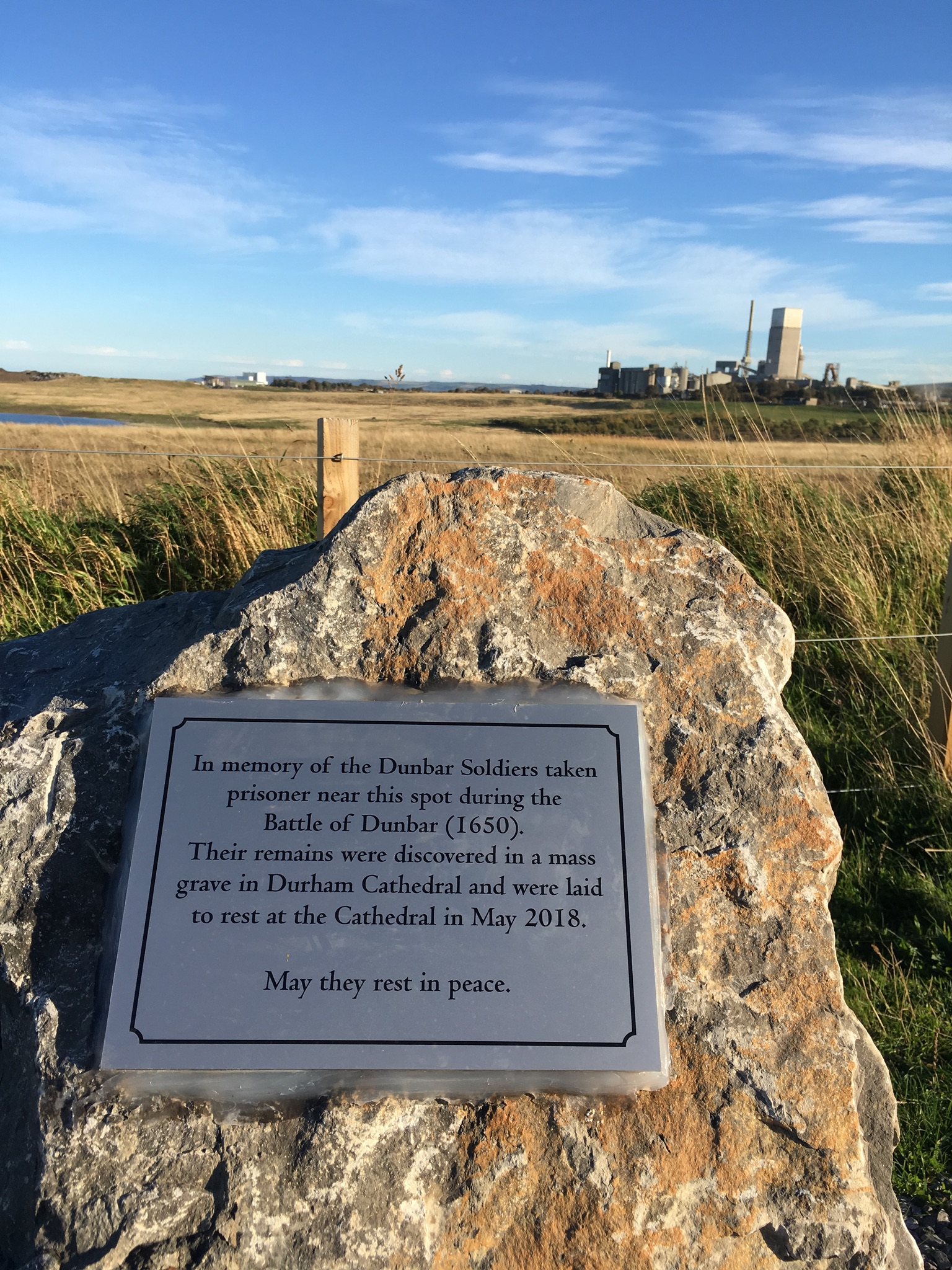
Battle of Dunbar (1650)
"Let God arise, let his enemies be scattered." Oliver Cromwell reportedly spoke these words as his cavalry charged into the Scottish flank at dawn on 3 September 1650. His army had been trapped -- weakened by disease, short of food, and penned against the sea at Dunbar with a vastly superior Scottish force holding the high ground above. By every reasonable assessment, Cromwell should have been forced to evacuate by sea or surrender. Instead, he attacked. By sunrise, the Scottish army was destroyed.
A Republic Goes to War
The battle grew from the wreckage of the English Civil War. After Parliament executed Charles I in January 1649, the English established a republican Commonwealth. Scotland responded by recognising Charles II as king of all Britain on 1 May 1650 and began recruiting an army to support him. The English could not tolerate a hostile kingdom on their northern border, so they dispatched the New Model Army under Cromwell. He crossed into Scotland on 22 July with over 16,000 men, but the campaign went badly from the start. The Scottish commander David Leslie refused to be drawn into a pitched battle. He withdrew to Edinburgh, stripping the countryside of provisions and forcing the English to rely on their supply line from Dunbar.
Trapped at Dunbar
By late August, Cromwell's army was in serious trouble. Disease and hunger had reduced his effective force to roughly 11,000 men. Unable to break through the Scottish defensive lines around Edinburgh, he fell back to the port of Dunbar, where ships could resupply his men or evacuate them if necessary. Leslie followed with an army of roughly 22,000 and occupied Doon Hill, a commanding position overlooking the town and the coastal road south. Cromwell was boxed in between the Scottish army, the sea, and steep terrain. The situation seemed hopeless. Letters sent south at this point suggest Cromwell was seriously considering evacuation.
Leslie's Fatal Mistake
What happened next has been debated for centuries. On 2 September, the Scottish army began moving down from Doon Hill toward the lower ground near the Brox Burn. The traditional explanation is that the Kirk Party -- hardline Presbyterian clergy who wielded enormous influence over the Scottish army -- pressured Leslie to attack, fearing that Cromwell would escape by sea. A purge of officers considered politically unreliable had already stripped the army of many experienced soldiers. Whatever the reason, by evening the Scots had extended their right flank eastward toward the sea, stretching their line and compressing their troops into a position where they could not easily manoeuvre. Cromwell, studying the Scottish dispositions from the walls of Dunbar, saw the opportunity and said to his officers: "The Lord hath delivered them into our hand."
The Dawn Attack
The assault began at roughly four in the morning on 3 September, before first light. Cromwell concentrated his attack on the Scottish right flank, where the terrain allowed his cavalry to operate. The initial Scottish resistance was fierce -- the lancers of the Scottish horse fought hard before being overwhelmed. But once the English cavalry broke through on the right, the rest of the Scottish line began to unravel. Many Scottish troops had spent the night in the open with their musket matches extinguished, and the sudden attack caught units unprepared. As daylight spread across the battlefield, the Scottish army collapsed. Leslie's men fled south and west, pursued by English cavalry. Cromwell's losses were minimal -- perhaps thirty to forty killed. Scottish casualties were devastating: Cromwell reported to Parliament that 3,000 were killed and 10,000 taken prisoner, though modern historians estimate the dead at 300–500 and prisoners at roughly 6,000.
The Prisoners' Fate
The aftermath of Dunbar was grim for the captured Scots. Roughly 5,000 prisoners were marched south to Durham, where they were held in the cathedral and the castle. Weakened by the march and already suffering from disease, many died in captivity -- perhaps as many as 1,700 in the weeks that followed. Others were transported to English colonies as indentured labourers, sent to Virginia, New England, and the Caribbean. The battle opened Scotland to English conquest and led ultimately to Cromwell's forcible union of Scotland with the Commonwealth. For the Scots, Dunbar was a military humiliation compounded by a humanitarian catastrophe. For Cromwell, it was providential confirmation that God favoured his cause -- a belief that would shape his actions for the rest of his life.
From the Air
The Battle of Dunbar battlefield is located south of Dunbar, East Lothian, Scotland, at approximately 55.986N, 2.516W. Doon Hill, from which the Scottish army descended, is clearly visible as a prominent feature south of the town. The coastal setting -- the town backed against the sea, with the battlefield on rising ground to the south -- illustrates why Cromwell's position seemed hopeless. Best viewed at 2,000-4,000 ft AGL. The harbour of Dunbar is visible to the north. Nearest ICAO: EGPH (Edinburgh) approximately 25nm west.