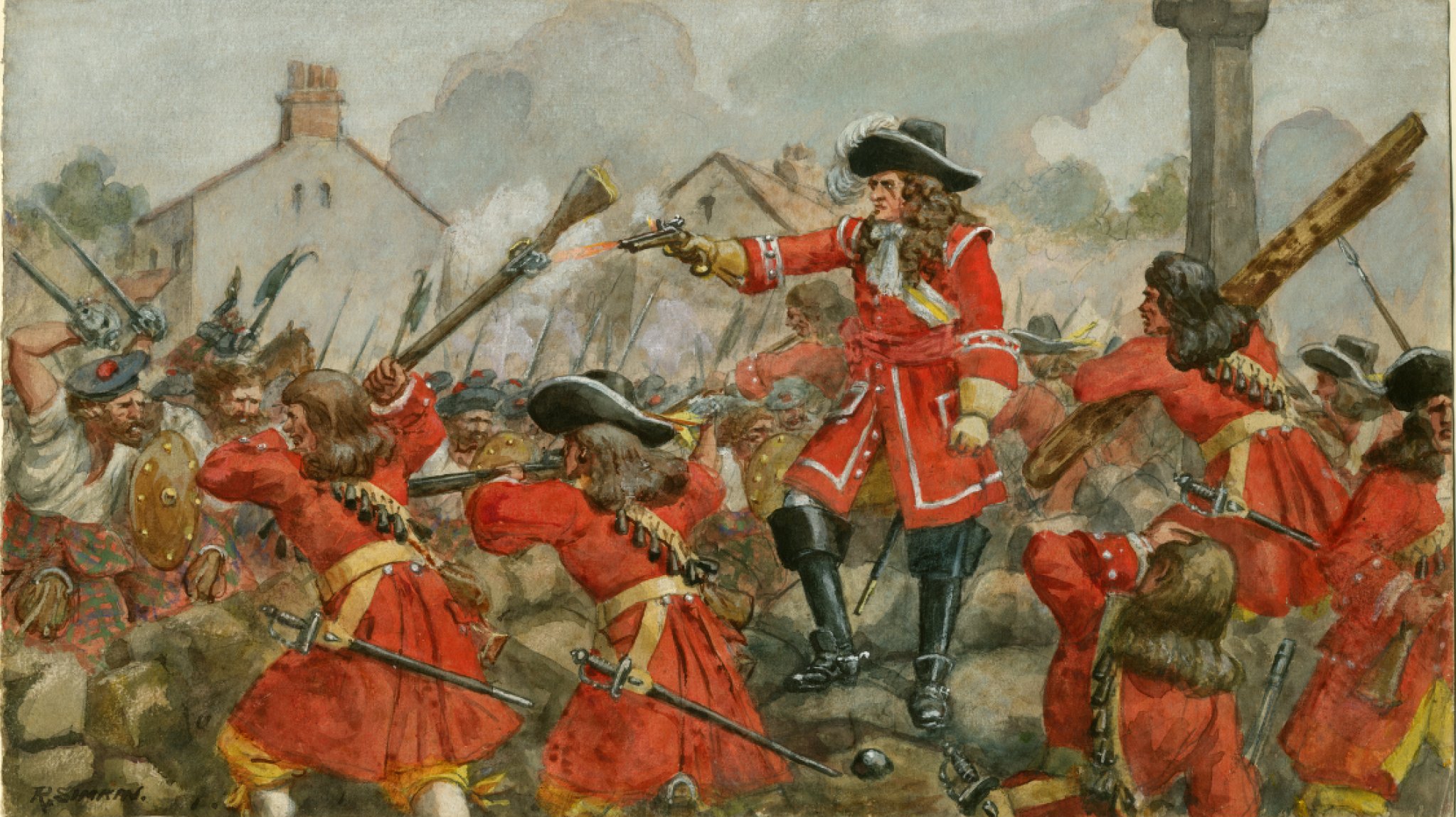
Battle of Dunkeld
The Cameronians were not born to be soldiers. They were Lowland tenant farmers and tradesmen, raised as a regiment barely weeks earlier from the followers of the martyred preacher Richard Cameron, men who prayed before breakfast and saw no contradiction between psalm-singing and musket drill. When the Scottish Privy Council ordered them north to hold the small cathedral town of Dunkeld against a Jacobite army flushed with victory, they marched into a fight that would last sixteen hours, consume hundreds of lives, and end with defenders melting lead from rooftops to fashion ammunition. It was 21 August 1689, and Scotland's future hung on whether a few hundred untested soldiers could survive the night.
After Killiecrankie
Three weeks earlier, the Jacobite cause had triumphed spectacularly at the Battle of Killiecrankie, twenty miles to the north. A Highland charge had shattered a government army in minutes. But the victory cost the Jacobites their brilliant commander, Viscount Dundee, killed at the moment of his greatest success. Command passed to Colonel Alexander Cannon, an Irish officer whose appointment so insulted the formidable Sir Ewen Cameron of Lochiel that the Highland chief packed up and left, taking some of his clan with him. The Jacobite army was winning battles but losing cohesion. Meanwhile, the Scottish Privy Council was on the verge of abandoning Edinburgh. They needed someone to slow the Jacobite advance. The task fell to Lieutenant Colonel William Cleland, a twenty-seven-year-old poet and soldier, and his newly mustered Cameronian regiment -- men whose religious zeal would have to substitute for battlefield experience.
A Cathedral Turned Fortress
Dunkeld had no town walls, no castle, no conventional defences. Cleland did what he could with what was available. He barricaded his roughly 1,200 men behind the enclosing wall of the cathedral and the nearby mansion of the Marquess of Atholl, turning ecclesiastical architecture into improvised fortification. When the Jacobite Highlanders -- some 5,000 strong -- stormed the town from all sides, they quickly overran the outlying positions. But Dunkeld's narrow, winding streets denied them the one weapon that had devastated the government at Killiecrankie: the Highland charge. There was no room for it. Instead, the battle dissolved into house-to-house fighting, point-blank exchanges across garden walls, and a grinding contest of endurance that neither side had anticipated.
Lead from the Rooftops
Cleland was killed early in the fighting, shot through the head and the liver. But his regiment did not break. Command passed to Captain George Munro, and the Cameronians fought on with a ferocity born of religious conviction and sheer desperation. When Highlanders barricaded themselves inside captured houses, the defenders set the buildings alight, burning some of the occupants alive. When ammunition ran out on both sides, the Cameronians stripped lead sheeting from the roof of Atholl House and melted it down to cast musket balls. For sixteen continuous hours the battle raged, a grinding, intimate slaughter fought at distances measured in yards rather than fields. The cathedral itself bore the scars -- musket ball holes are still visible in the east gable, pockmarks in grey stone that no restorer has thought to fill.
A Victory That Ended a War
At eleven o'clock that night, the Jacobite Highlanders withdrew. They had lost roughly 300 dead in the streets and houses of Dunkeld. Cameronian losses were far smaller -- reported as somewhere between 20 and 50 killed -- though the regiment was exhausted and its commander was dead. The withdrawal marked the effective end of the 1689 Jacobite rising. Without Dundee's leadership, the Highland army never recovered its momentum. The cause would rise again in 1715 and 1745, but the particular combination of Irish professionals, Highland clansmen, and Lowland converts that had won Killiecrankie was broken at Dunkeld's cathedral walls. Cleland was buried inside the building he had died defending. The battlefield was added to the Inventory of Historic Battlefields in Scotland in 2012, and the cathedral still stands on the banks of the Tay -- half ruin, half parish church -- its stones carrying the evidence of a night when a regiment of psalm-singing farmers held the line.
From the Air
The battle site is centred on Dunkeld Cathedral at approximately 56.57N, 3.59W, on the north bank of the River Tay. The cathedral and surrounding town are visible from 2,000-3,000 ft AGL. Perth/Scone airfield (EGPT) is approximately 15 nm south-southeast. The River Tay and its wooded valley provide clear navigational context. The A9 road corridor passes just west of the town.