Battle of Dunsinane
Shakespeare had Birnam Wood march to Dunsinane. The reality of 27 July 1054 was less theatrical but considerably more complex. The real Macbeth was not a haunted tyrant undone by witches and guilt -- he was a competent king who had ruled Scotland for fourteen years after killing Duncan I in battle, not in his sleep. The force that came to unseat him was led by Siward, Earl of Northumbria, one of the most powerful men in England, who brought an army north on behalf of Malcolm Canmore, Duncan's exiled son. The battle they fought in the hills of Perthshire would cost thousands of lives and begin the slow process by which Macbeth lost first his southern territories, then his crown, and finally his life.
A King, Not a Villain
Macbeth became King of Scotland in 1040 by defeating Duncan I at the Battle of Pitgaveny near Elgin -- a legitimate, if violent, transfer of power in an era when Scottish kingship was routinely contested by force. He ruled from Moray and held Scotland together for fourteen years, long enough to make a pilgrimage to Rome in 1050, where he reportedly distributed silver to the poor -- not the act of a man consumed by paranoid guilt. Duncan's son Malcolm, meanwhile, had fled to England, where he grew up at the court of Edward the Confessor. Whether Edward ordered the 1054 invasion or whether Siward launched it on his own initiative to install a friendly king on Scotland's throne remains debated. What is certain is that a large English army crossed the border in the summer of that year.
The Day of the Seven Sleepers
The battle was fought on 27 July, the feast day of the Seven Sleepers, which gave it its alternative name. Siward's army pushed north into Perthshire, crossing the River Tay and engaging Macbeth's forces on ground traditionally identified as Dunsinane Hill, though the connection owes as much to literary tradition as to solid historical evidence. Macbeth's army included some Norman allies -- two knights expelled from England in 1052 who had entered his service -- a detail that undercuts any simple reading of the battle as English versus Scots. The fourteenth-century historian John of Fordun noted that the invasion caused confusion among the local population, who were unsure which side to support, suggesting that Scots loyal to Malcolm may have fought alongside the English.
Three Thousand Scots, Fifteen Hundred English
The battle ended in defeat for Macbeth, but the cost was staggering on both sides. The Annals of Ulster recorded 3,000 Scots and 1,500 English killed -- enormous figures that suggest a major engagement rather than a skirmish. Siward's own son Osbeorn and his nephew, also named Siward, were both killed. The twelfth-century chronicler Henry of Huntingdon recorded that Siward ravaged the kingdom after his victory, plundering as he went, before returning home relatively quickly. The campaign was decisive but not final. Macbeth was forced to cede his southern territories to Malcolm but retained control of Scotland north of the Mounth, the mountain range that divides the Lowlands from the Highlands.
From Dunsinane to Lumphanan
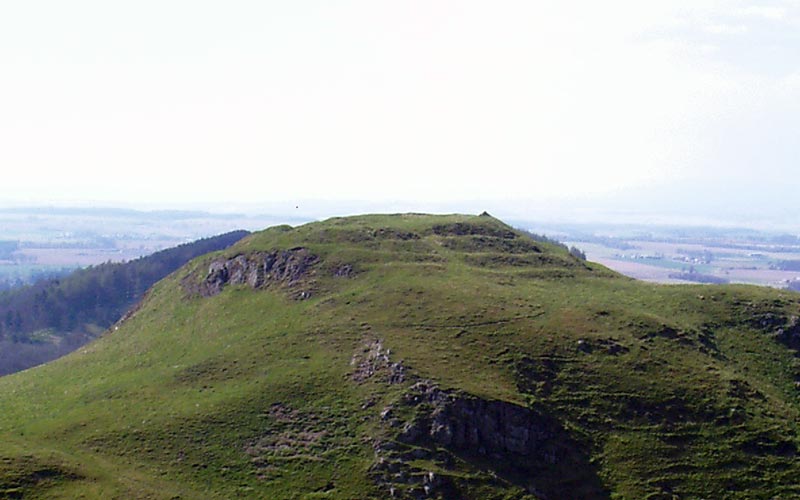
It took three more years for Malcolm to finish what Siward had started. Macbeth was finally killed at the Battle of Lumphanan in Aberdeenshire on 15 August 1057 -- not at Dunsinane, and not by the hand of Macduff, as Shakespeare would have it five centuries later. Macbeth's stepson Lulach was briefly installed as king but was himself ambushed and killed by Malcolm near Rhynie in March 1058. Malcolm was crowned as Malcolm III and began the long process of reorienting Scotland away from its Gaelic roots toward the Anglo-Norman culture that would eventually dominate the Lowlands. Dunsinane Hill itself carries the remains of a late Iron Age hillfort, much older than the battle, and its connection to Macbeth in literary tradition has given it, as Historic Environment Scotland has noted, a place in the national consciousness of Scotland that outweighs its uncertain claim to be the actual battlefield.
From the Air
Dunsinane Hill is at approximately 56.47N, 3.28W, a prominent hill in the Sidlaw range about 8 miles northeast of Perth. The hill's summit carries the remains of an Iron Age hillfort. Perth/Scone airfield (EGPT) is approximately 8 nm southwest. Best viewed at 2,000-3,000 ft AGL. Birnam Wood, referenced in Shakespeare's play, is visible approximately 12 nm to the northwest in the Tay valley near Dunkeld.