Battle of Dupplin Moor
On the night of 10 August 1332, the Scots were so confident of victory that they spent the evening "playing, drinking and making merry." They had reason -- their army outnumbered the English invaders by at least ten to one. By noon the next day, thousands of Scottish soldiers lay dead in heaps taller than a spear's length, suffocated by the press of their own comrades in a narrow Perthshire valley. The Battle of Dupplin Moor was a catastrophe born of overconfidence, and the tactical innovations it revealed would reshape European warfare for a century.
The Cowards' Peace
The roots of Dupplin Moor lay in the Treaty of Northampton of 1328, which recognized Robert Bruce as King of Scots after thirty years of war. The English despised it, calling it the turpis pax -- the cowards' peace. When Bruce died in 1329, leaving five-year-old David II as heir, the moment arrived for the dispossessed. Edward Balliol, son of the deposed King John, gathered disinherited Scottish nobles in Yorkshire and plotted an invasion. Edward III of England officially forbade it, writing to northern officials that anyone planning such an attack should be arrested. Then he turned a blind eye as Balliol's ships sailed from English ports on 31 July 1332. The Scots knew they were coming, but their experienced regent, Thomas Randolph, Earl of Moray, died ten days before the invasion force sailed.
A Midnight Crossing
Balliol's force was small: 500 men-at-arms and 1,000 infantry, mostly longbowmen. After landing in Fife and fighting through a beach assault, they marched on Perth -- then the Scottish capital. The new Scottish guardian, Donald, Earl of Mar, positioned his massive army on the north bank of the River Earn, two miles south of the city, and broke down the bridge. The Scots numbered more than 15,000. Any frontal assault across the river would have been suicide for the English. Instead, under cover of darkness, Balliol's entire force forded the Earn at an unguarded spot. At midnight they stumbled upon a Scottish camp and overran it. At dawn, they saw the full Scottish army advancing in two great formations -- and realized the camp had been only a fragment of Mar's host.
Death in the Valley
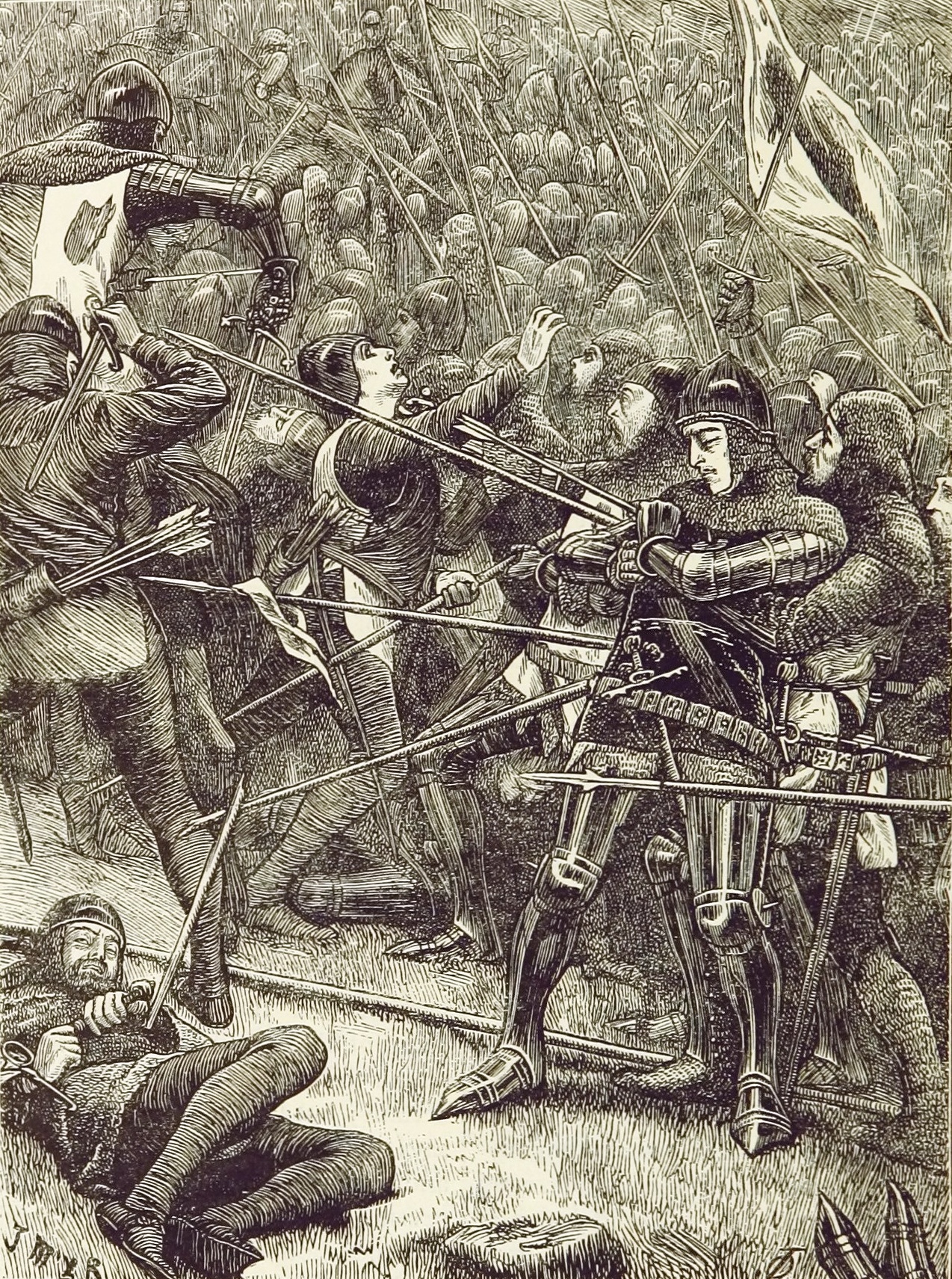
The English chose their ground with devastating skill, positioning themselves where a valley narrowed into hilly terrain -- about 600 feet wide, with longbowmen placed on the higher ground flanking their men-at-arms. What happened next was a prototype for the English victories at Halidon Hill and Crecy. Mar and Robert Bruce, commanding the two Scottish schiltrons, raced each other to strike first, their rivalry disorganizing both formations. Bruce's men hit the English centre with such force they drove it back ten yards, but the terrain funneled the Scots inward, ignoring the archers on the slopes. The longbowmen shot into the exposed flanks, blinding and wounding men who wore no visors. As Mar's schiltron crashed into Bruce's from behind, the Scottish mass became a death trap. Men were pressed too tightly to breathe, let alone fight. Contemporary accounts speak of more than a thousand Scots smothered without ever touching an English weapon.
A Crown Won and Lost
The English dead numbered 35 men-at-arms. Not a single archer fell. On the Scottish side, both Mar and Bruce died, along with two other earls, 14 barons, and 160 knights. English chronicles claim over 15,000 Scots perished; Scottish accounts admit at least 3,000. Balliol occupied Perth, and on 24 September 1332 he was crowned King of Scots at Scone. But his grip was feeble. Within six months he was ambushed at Annan, fleeing to England half-dressed and riding bareback. He would be deposed and restored three more times before David II's supporters finally prevailed in 1336. The tactics of Dupplin Moor, however, endured -- historian Ranald Nicholson noted that Edward III copied them precisely at Crecy in 1346, dismounting his men-at-arms and posting archers on each flank. Historic Environment Scotland added the battlefield on the Dupplin plateau to its Inventory of Historic Battlefields in 2011.
From the Air
The battlefield lies on the Dupplin plateau at approximately 56.36N, 3.56W, southeast of Dupplin Loch and about 5 miles southwest of Perth. The River Earn is visible winding below. Best viewed from 2,000-3,000 ft AGL. Perth/Scone airfield (EGPT) is the nearest landing strip, approximately 5 nm northeast. The terrain narrows into the valley described in accounts of the battle, still visible in the landscape.