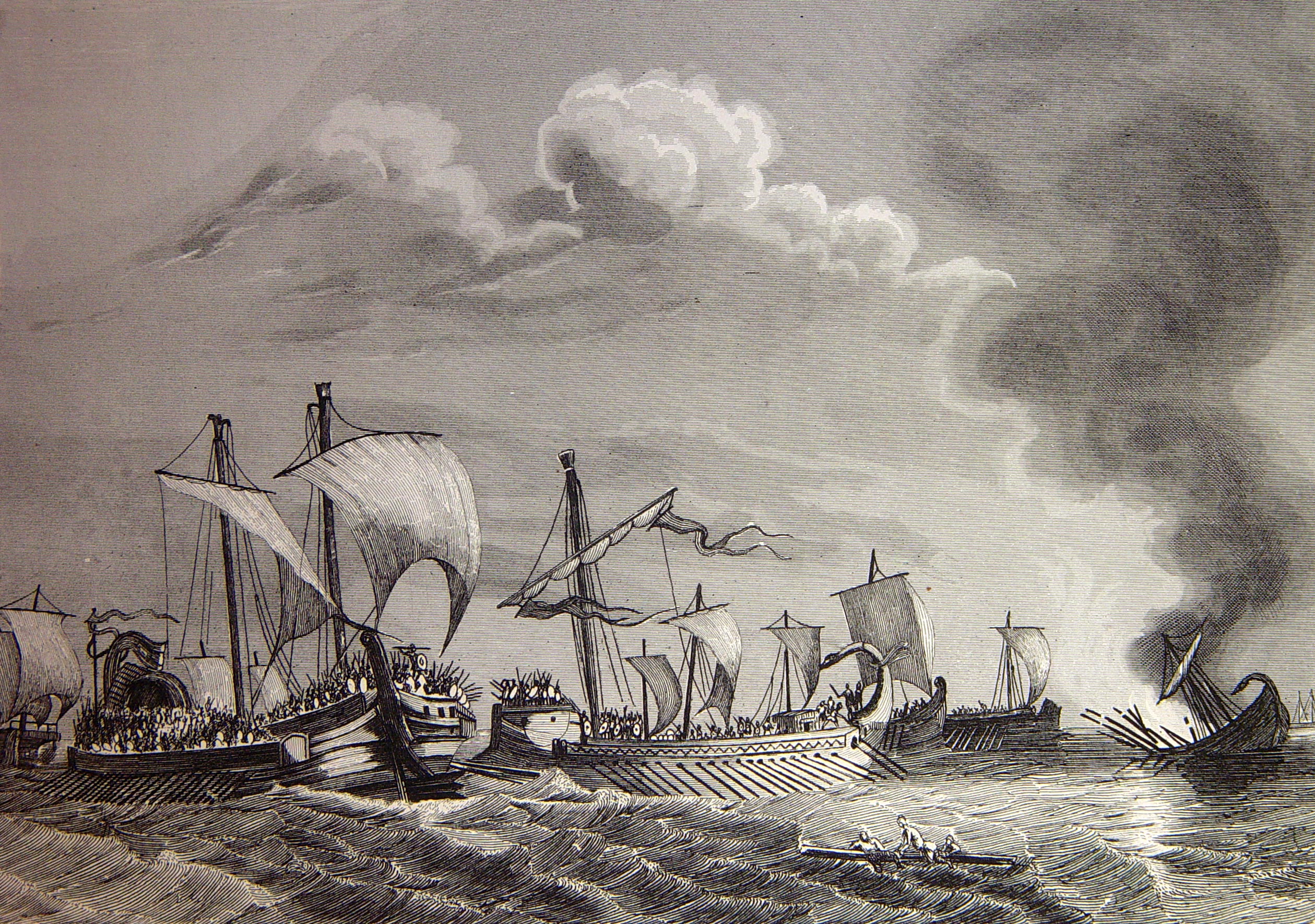
Battle of Ebro River
Two Massalian scout ships slipped away undetected from the Carthaginian anchorage and carried word north: the enemy fleet lay at the mouth of the Ebro, its crews scattered ashore foraging for food. It was the spring of 217 BC, and Gnaeus Cornelius Scipio Calvus was about to deliver one of the most decisive naval blows of the Second Punic War -- not through superior numbers, but through intelligence, timing, and the Carthaginians' own carelessness.
An Empire Divided by Water
The Ebro River was more than a geographic feature in the contest between Rome and Carthage. It was a treaty line, a boundary that Hannibal's crossing in 218 BC had shattered, plunging the western Mediterranean into a war that would reshape civilization. After Hannibal marched into Italy, his brother Hasdrubal Barca remained in Iberia to hold Carthaginian territory and prevent Roman reinforcements from reaching the peninsula. Gnaeus Scipio had established a Roman base at Tarraco, north of the Ebro, but Rome sent him almost no reinforcements. He was outnumbered on land. So he resolved to fight at sea, where a smaller force, well handled, could overcome a larger one caught unprepared.
Caught at Anchor
Hasdrubal launched a combined land-sea expedition northward in the spring of 217 BC. His deputy Himilco commanded the fleet: 40 quinqueremes sailing up the coast, beaching beside the army each night. But Himilco made a critical error. He posted no naval scouts. When the fleet anchored near the Ebro's estuary, the crews went ashore to forage -- the fleet carried no supply transports. A pair of Massalian ships spotted the Carthaginian vessels lying unguarded and raced to warn the Romans, who were positioned only ten miles to the north. Gnaeus manned his 35 quinqueremes with picked legionaries and sailed south to attack. Hasdrubal's land scouts detected the approaching Roman fleet and sent fire signals to warn their own ships, but it was too late. Crews scrambled back in disorder, some vessels putting to sea undermanned.
Rams and Grappling Hooks
The Romans formed two battle lines: 35 Roman ships in front, 20 allied Massalian vessels behind. The Massalians were skilled sailors whose seamanship neutralized the Carthaginians' advantage in maneuverability. As Himilco's ships emerged from the river mouth in ragged order, the Romans struck. They rammed and sank four vessels, boarded and captured two more. The remaining Carthaginian crews, demoralized by the chaos and the loss of their comrades, beached their ships and fled to the safety of Hasdrubal's army on shore. The Romans grappled 23 of the abandoned vessels and hauled them away. In a single afternoon, Carthage lost 29 ships -- nearly three-quarters of its Iberian fleet.
The Sea Turns Roman
The consequences rippled outward for years. Hasdrubal retreated to Cartagena, fearing seaborne raids on Carthaginian ports. He neither rebuilt his fleet nor called Carthage for replacements. When he dismissed the poorly performing Iberian crews, the Turdetani tribe revolted, forcing Carthage to send 4,000 infantry and 500 cavalry just to restore order. Hasdrubal spent all of 216 BC suppressing the rebellion instead of reinforcing Hannibal in Italy. Gnaeus Scipio had secured Roman supply lines, gained the freedom to raid Carthaginian territory at will, and ensured that Hannibal would fight in Italy without meaningful support from Iberia. At the place where the Ebro meets the Mediterranean, a single day's fighting had tilted the balance of a war that would decide the fate of the ancient world.
From the Air
Located at 40.72N, 0.86E at the mouth of the Ebro River on Spain's Mediterranean coast. The Ebro Delta is one of the largest river deltas in the western Mediterranean and a prominent visual landmark. Best viewed at 3,000-5,000 feet. The nearest airport is Reus (LERS), approximately 50 km to the north. The delta's distinctive fan shape and the river's course inland are clearly visible from altitude.