Battle of Edgehill
Jacob Astley, the Royalist sergeant major general, offered a prayer before leading his men down the slope of Edge Hill: "O Lord, Thou knowest how busy I must be this day. If I forget Thee, do not Thou forget me." Then he stood up and said, "March on, boys." It was Sunday, October 23, 1642, and most of the men who followed him into southern Warwickshire's rolling fields had never fought before. Across the hedgerows, Parliament's army was equally green. What followed was not the decisive battle either side wanted but a bloody, confused collision that proved one thing clearly: this war would not end quickly.
Two Armies Stumbling Toward Each Other
King Charles I had raised his standard at Nottingham in August, effectively declaring war on Parliament. Finding few recruits in the Parliamentarian-leaning Midlands, he moved to Shrewsbury, where Welsh and border recruits swelled his ranks. In October, he marched southeast toward London, hoping to force a decisive confrontation with Parliament's army under the Earl of Essex. Neither side had reliable intelligence. By October 22, the Royalist army was quartered near Edgcote, threatening Banbury, while Essex -- who had just reached Warwick Castle -- ordered an immediate march to relieve the garrison. That evening, clashes between outposts revealed how close the two forces actually were. The King ordered his army to muster atop the Edge Hill escarpment the next morning.
The Cavalry Problem
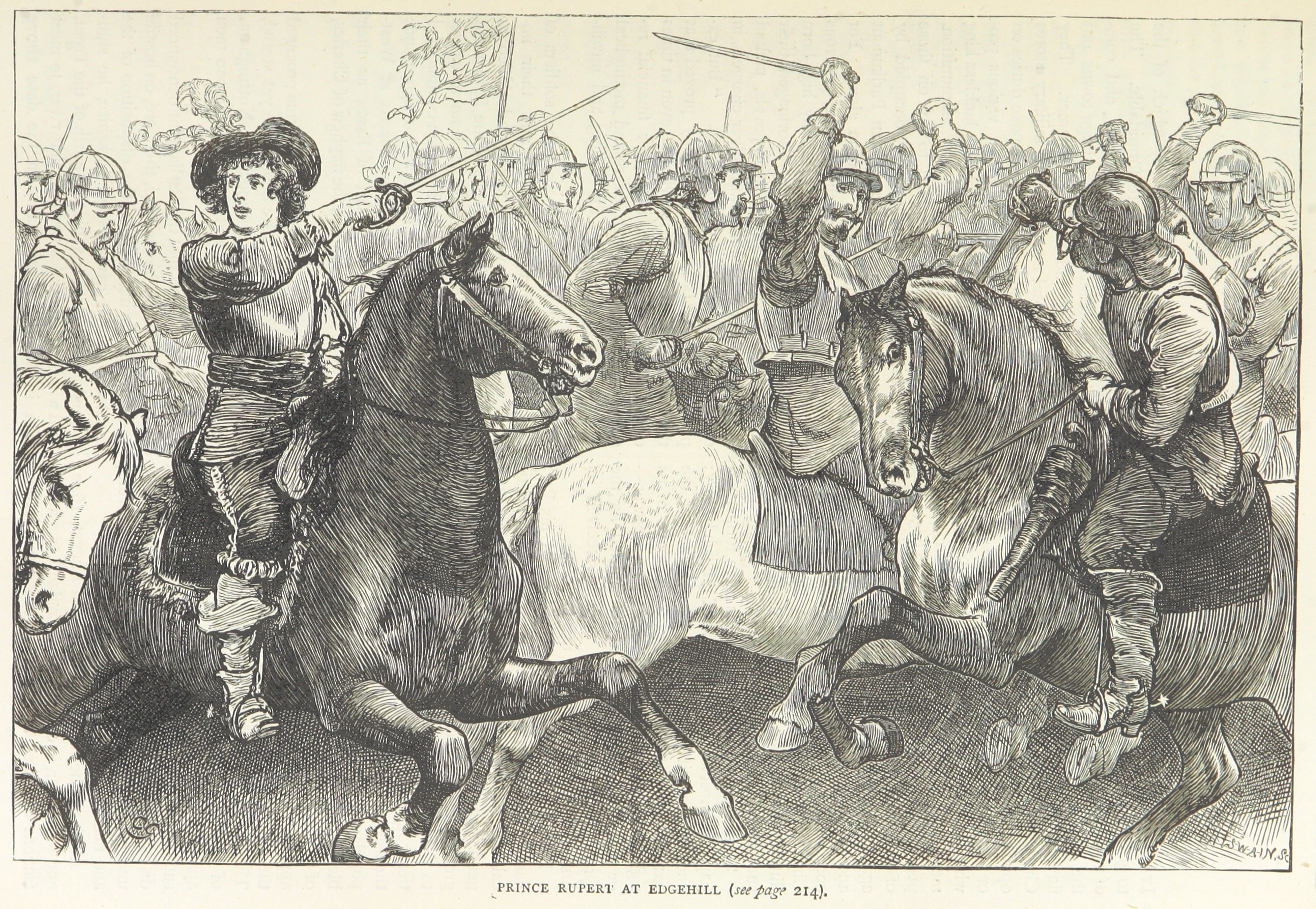
The battle's outcome turned on a fundamental imbalance. Prince Rupert of the Rhine commanded the Royalist cavalry -- gentlemen's sons accustomed to horses, trained to charge sword in hand for maximum shock. Parliament's horsemen, as Oliver Cromwell later wrote disparagingly, were "old decayed servingmen and tapsters" drilled in the Dutch style of firing pistols from the saddle. When Rupert's cavalry charged on the right flank around two o'clock, the Parliamentarian horse collapsed almost instantly. One troop under Faithful Fortescue defected on the spot. Rupert's men galloped jubilantly after the fleeing enemy all the way to Kineton, where they fell to looting the Parliamentarian baggage train instead of turning back to attack the exposed infantry. On the opposite flank, Wilmot's Royalist horse achieved a similar rout -- and made the same disastrous error, riding off the battlefield entirely.
Infantry in the Balance
With both wings of Royalist cavalry off chasing plunder, the battle's center became a desperate infantry fight. Many Royalist pikemen lacked armor and some musketeers had no swords; several hundred men carried nothing but clubs. Yet the Royalist infantry advanced under Patrick Ruthven in a Swedish chequerboard formation, pushing through confused Parliamentarian units. Then Parliament's hidden reserve struck. Two cavalry regiments under Stapleton and Balfour, concealed behind the infantry line, charged through gaps into the Royalist center. With no cavalry to oppose them, they shattered several foot regiments. Lord Lindsey, the original Royalist commander, fell mortally wounded. Sir Edmund Verney died defending the Royal Standard, which was briefly captured before Lieutenant Colonel Robert Welch recovered it by subterfuge. As darkness fell, the armies traded musket fire across a ditch, neither able to deliver a killing blow.
A Cold Night, A Long War
The survivors spent the night on the frozen battlefield. A hard frost set in -- contemporary accounts suggest the cold actually saved lives by congealing wounds that might otherwise have bled fatal. The next morning, both armies formed up but neither would restart the fight. Charles offered pardon terms; his herald was roughly turned away. Essex withdrew to Warwick Castle, abandoning seven guns. In the predawn hours of October 25, Rupert returned to attack the Parliamentarian baggage at Kineton, killing wounded soldiers sheltering in the village. The King continued toward London but found Essex's army, reinforced by London's Trained Bands and citizen volunteers, blocking his path at Turnham Green. Too weak to force another battle, Charles withdrew to Oxford, making it his capital for the rest of the war. The last known survivor of Edgehill, William Hiseland, went on to fight at Malplaquet sixty-seven years later. The war itself dragged on ruinously for four more years.
From the Air
Located at 52.14N, 1.48W in southern Warwickshire. Edge Hill is a prominent north-facing escarpment visible from the air, with the village of Radway at its base. The battlefield extends across open farmland between Edge Hill and Kineton to the northwest. Nearest airports: EGBW (Wellesbourne Mountford, 8nm E), EGBB (Birmingham, 30nm NW). Best viewed at 2,000-3,000 ft AGL to see the escarpment and the flat ground where the infantry clashed.