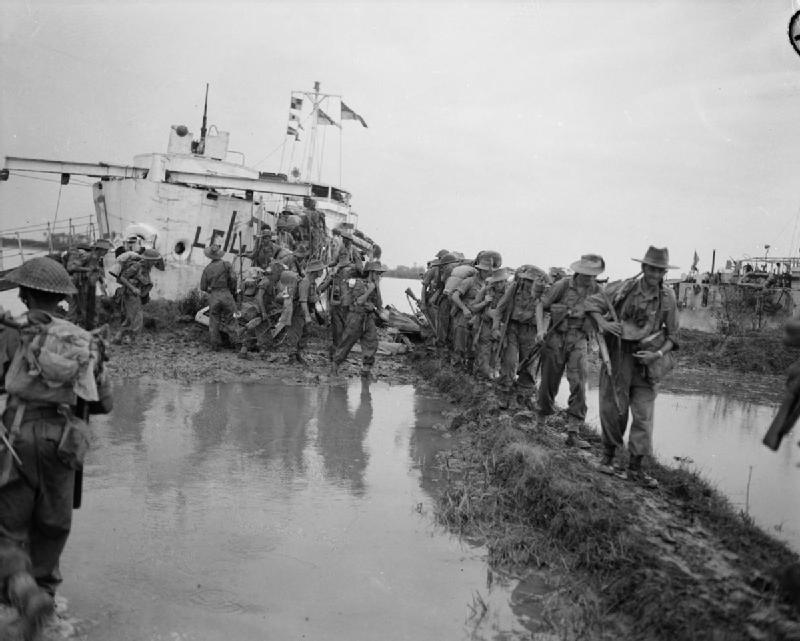
Battle of Elephant Point
Major Jack Newland's battalion did not officially exist. Cobbled together from two Gurkha parachute units in the middle of a divisional reorganization, with many officers on leave and one battalion about to transfer elsewhere, the composite force assembled in early April 1945 for a single mission: jump into the mouth of the Rangoon River and destroy a Japanese artillery battery at a point called Elephant Point. If they failed, the amphibious fleet sailing upriver to liberate Burma's capital could not pass. The monsoon was coming, and Rangoon had to fall before the rains made land operations impossible. Lord Mountbatten had set the deadline: the city must be in Allied hands by 5 May.
Operation Dracula's Knife Edge
By March 1945, the battles of Meiktila and Mandalay were winding down, and Allied commanders turned their attention south. At a conference in Monywa, Admiral Lord Mountbatten and General William Slim agreed that Rangoon must be taken before the monsoon season -- expected by June -- or the entire campaign would stall. The plan, codenamed Dracula, called for the 26th Indian Division to sail up the Rangoon River in an amphibious assault. But the river was laced with mines, both Japanese and British, and coastal gun positions commanded its banks. The battery at Elephant Point, on the river's west bank, posed the most dangerous obstacle. Geography shielded it from naval bombardment and airstrikes. Weather ruled out an early amphibious landing. The only option was a parachute drop, one day before the main assault, to seize the battery from the landward side.
A Battalion Stitched from Pieces
The 44th Indian Airborne Division received the assignment, but it had no intact unit available. Officers were scattered on leave, and the 3rd Gurkha Parachute Battalion was in the process of transferring to another brigade. Headquarters improvised. A composite battalion was formed: the headquarters company drew men from the 2nd and 3rd Gurkha Parachute Battalions, while each unit contributed two rifle companies. A mortar platoon and a machine gun platoon rounded out the formation. After assembling at Chaklala, the battalion trained, rehearsed at Midnapore over ten days, and then flew to Akyab on the Burmese coast -- roughly 200 miles north of Rangoon. A 200-strong reserve force joined them there. Forty C-47 Skytrains from the 1st and 2nd United States Air Commando Groups would carry them to the drop zone at Tawhai.
Orange Umbrellas and Friendly Bombs
At 02:30 on 1 May, a lone C-47 carrying a twenty-man pathfinder team lifted off for Rangoon. The rest of the battalion followed thirty minutes later in thirty-eight Dakotas, jumping over the drop zone at 05:45. The landing went smoothly -- with one exception that nearly unraveled the operation. Despite officers and soldiers wearing yellow recognition panels and carrying orange umbrellas to identify themselves as friendly forces, C Company was bombed and strafed by American aircraft providing close air support. The forward air controller attached to the battalion immediately halted all further bombing runs. Casualties from the friendly fire incident were significant, but the battalion pressed on. By 16:00, it had reached Elephant Point. Close-quarters fighting erupted around the Japanese bunkers guarding the battery. Flame-throwers cleared the positions. Approximately forty Japanese soldiers and gunners were killed. The battery was silenced.
High Tides and Liberation
After securing Elephant Point, the battalion dug in and waited. A relief force landed at nearby Thaunggon at 15:30, followed by a supply drop. In another tragic miscommunication, Gurkha sentries accidentally fired on the surgical team accompanying the relief force, wounding four medics. Night brought new difficulties: high tides submerged several trenches, forcing the battalion to higher ground. On 2 May, the 26th Indian Division sailed up the now-cleared Rangoon River and secured the capital. The composite battalion moved to Sadainghmut on 3 May, then transferred to Rangoon itself, where its soldiers conducted anti-looting patrols and hunted for Japanese stragglers hiding in the city. On 16 May, they boarded a ship for India and rejoined the 44th Indian Airborne Division. The Battle of Elephant Point had been the division's first major airborne operation -- carried out by a unit that had existed for barely six weeks.
From the Air
Elephant Point lies at approximately 16.45N, 96.32E at the mouth of the Rangoon River (Yangon River) in southern Myanmar. The point is visible where the river widens into the Gulf of Martaban. Modern Yangon lies roughly 30 kilometers upriver to the north. Mingaladon Airport (VYYY) serves the city. The river delta is flat and marshy, with extensive tidal zones. The approach from the south over the Gulf of Martaban provides the clearest view of the river mouth and the terrain the Gurkha paratroopers would have seen on their descent.