Battle of Elizabeth City
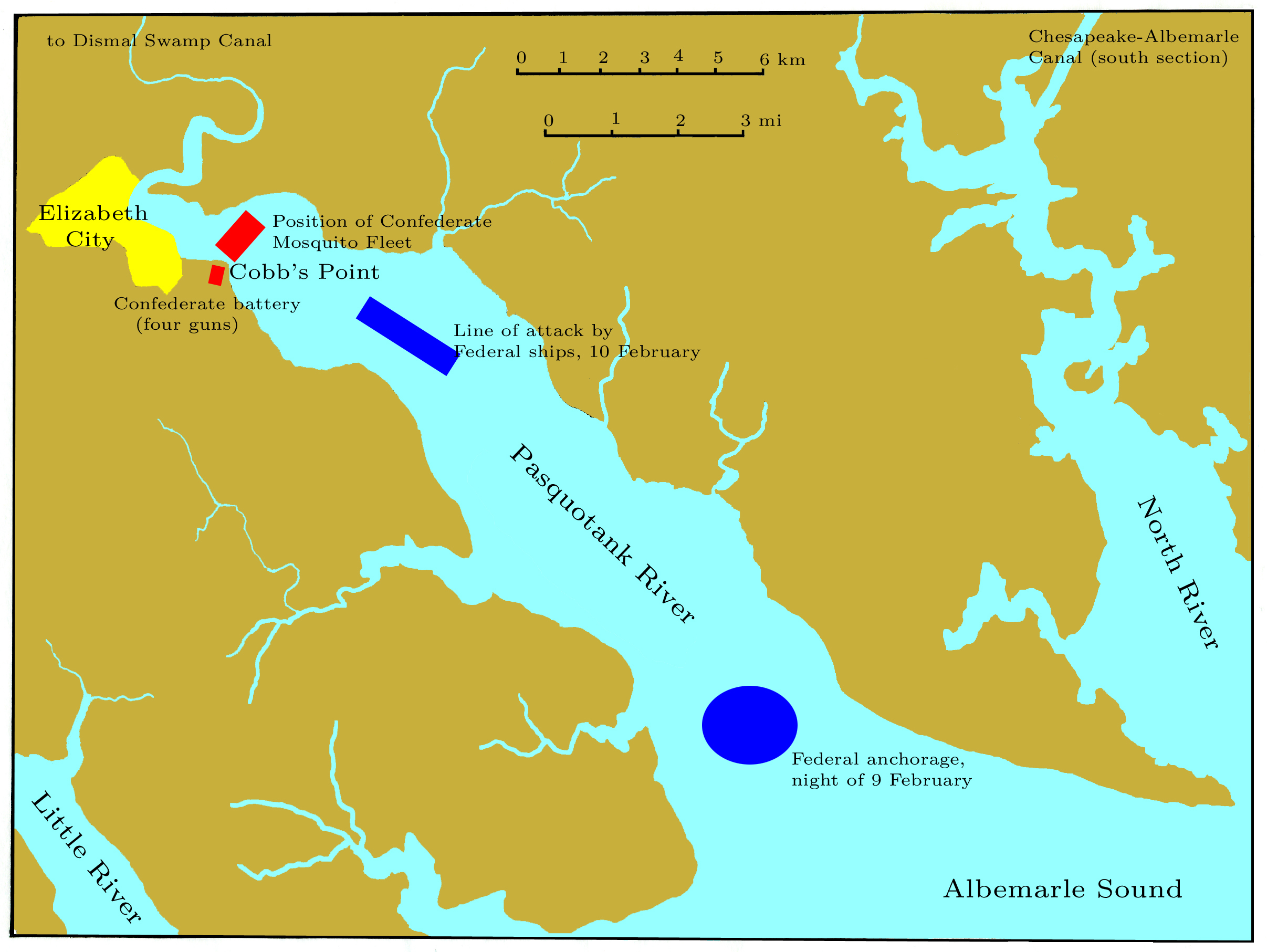
Flag Officer William F. Lynch counted his ammunition and did the math. Six ships. Eleven guns. Ten rounds apiece. At dawn on February 10, 1862, that was all that stood between the Union Navy and total control of Albemarle Sound. The Confederacy's so-called Mosquito Fleet -- a ragtag collection of converted tugboats, a captured Army transport, and a schooner pressed into service just four days earlier -- waited on the Pasquotank River near Elizabeth City, North Carolina, anchored beside a four-gun shore battery manned by seven militiamen and a single civilian. What followed was less a battle than an act of desperate defiance, a fleet fighting not to win but simply to avoid surrender.
Norfolk's Lifeline
The logic of the engagement traces back to geography and hunger. Elizabeth City sits where the Pasquotank River meets Albemarle Sound, flanked by two canals -- the Dismal Swamp Canal to the north and the Albemarle and Chesapeake Canal to the east. These waterways were arteries of survival for Confederate-held Norfolk, Virginia, funneling food and forage northward from the farms of North Carolina. As long as the sounds remained in Rebel hands, Norfolk could eat despite the Union blockade at the mouth of Chesapeake Bay. But on February 7-8, a joint operation under Major General Ambrose E. Burnside and Flag Officer Louis M. Goldsborough had seized Roanoke Island, sweeping aside the batteries that once shielded Albemarle Sound from Federal warships. Suddenly the only thing protecting Norfolk's supply route was Lynch's Mosquito Fleet.
A Fleet Running on Fumes
The Mosquito Fleet limped into Elizabeth City after the Battle of Roanoke Island with nearly empty magazines. Lynch sent Commander Thomas T. Hunter to Norfolk begging for ammunition; Hunter returned with enough powder and shot to supply only two ships. Lynch split the meager haul among all six. He sent CSS Raleigh up the Dismal Swamp Canal on the same errand, but she never made it back in time. CSS Forrest sat on the stocks, her screw damaged from striking a submerged obstacle during the earlier fight, unable to move under her own power. Lynch's flagship Sea Bird was a converted sidewheel steamer. Three vessels were former tugboats. CSS Fanny had been a U.S. Army transport before Confederate forces captured her near Cape Hatteras. The newest addition, schooner Black Warrior, had been pressed into naval service just four days before the battle, armed with two 32-pounder guns. Against this improvised squadron, Commander Stephen C. Rowan was bearing down with fourteen Union gunboats carrying 37 guns -- and orders to conserve ammunition by ramming and boarding.
Seven Militiamen and a Civilian
Lynch had anchored his fleet at Cobb's Point, where a shore battery of four guns was supposed to anchor his defense. He expected the Federals would try to reduce the battery first, buying time for his ships to maneuver. At dawn he went ashore to coordinate -- and found the battery staffed by seven militiamen and one civilian volunteer. He was forced to pull Lieutenant Commander William Harwar Parker and most of CSS Beaufort's crew off their ship to man the guns, leaving only a skeleton crew aboard to sail the vessel up the canal if things went badly. Even with Parker's sailors, only three of the four guns could be manned. When the Union fleet opened fire, the militiamen promptly deserted. Two guns were all that remained against fourteen warships.
Thirty Minutes of Chaos
The battle unraveled fast. Schooner Black Warrior, caught in the crossfire of the entire Union fleet as it swept past Cobb's Point, was abandoned and set ablaze by her crew. Fanny was run ashore and burned. A boarding party stormed CSS Ellis in hand-to-hand combat; her captain tried to blow her up, but a coal heaver discovered the demolition charges and revealed them to the boarders. Sea Bird attempted to flee but was run down and rammed to the bottom. Beaufort and Appomattox escaped into the Dismal Swamp Canal, though Appomattox proved too wide to pass through a lock and had to be burned. Forrest, still sitting immobile on the stocks, was torched along with an unnamed, half-finished gunboat. When the smoke cleared, only Beaufort and the absent Raleigh survived. The Union lost two men killed and seven wounded. The Confederates lost four killed, six wounded, and 34 captured. Quarter Gunner John Davis earned the Congressional Medal of Honor for his actions during the fight.
A Town Set Ablaze, A Sound Lost
Retreating Confederate troops, acting under orders from Brigadier General Henry A. Wise, set fires in Elizabeth City to deny the town to the enemy. About two blocks burned before Union sailors from the flotilla rushed ashore and managed to save the rest. Two days later, Edenton fell without bloodshed. The Albemarle and Chesapeake Canal was blocked at its entrance on the North River -- started by the retreating Rebels, finished by the advancing Federals. Confederate power on Albemarle Sound was broken. It would remain so for nearly the rest of the war, challenged only briefly by the ironclad CSS Albemarle in the summer of 1864. Norfolk, cut off from its North Carolina supply lines, grew increasingly worthless to the Confederate Army. By May 1862, the city was abandoned.
From the Air
The battle site lies on the Pasquotank River near Elizabeth City, NC at 36.274N, 76.142W. From the air, the wide mouth of the river where it meets Albemarle Sound is clearly visible. Cobb Point, site of the Confederate battery, marks the southeastern edge of town. The Dismal Swamp Canal runs northward toward Norfolk. Nearest airport is Elizabeth City Regional Airport / Coast Guard Air Station (KECG), directly adjacent to the city. Fly at 1,500-2,000 feet for a good view of the river narrows where the fleets clashed.