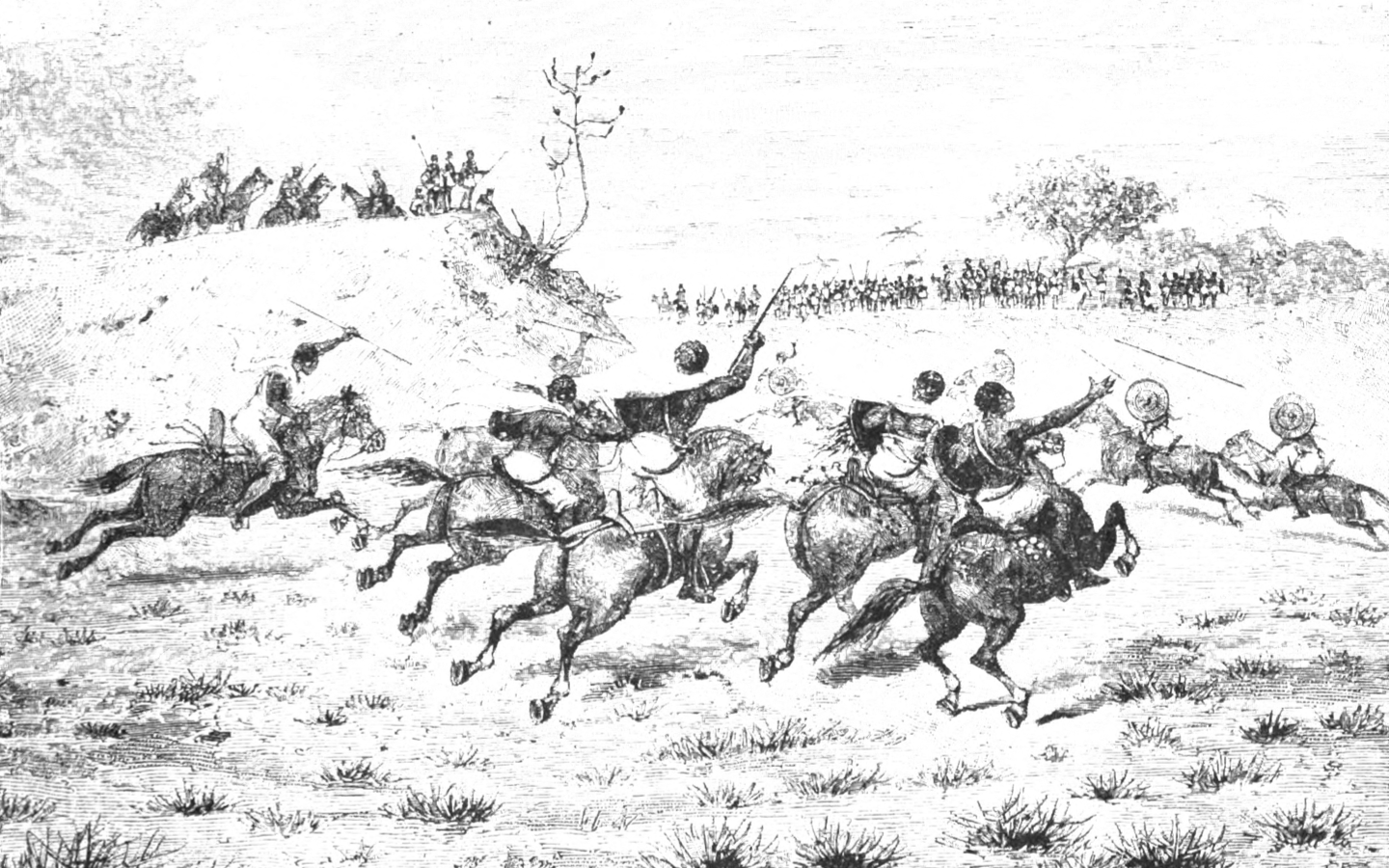
Battle of Embabo
Before the battle, Negus Tekle Haymanot of Gojjam made a boast: after he won, Ras Gobana Dacche, the great Shewan general, would carry his mitad — his baking tray — back to Gojjam like a servant. When Gobana later stood over the captured king in his own tent, he recalled those words precisely. "Gojjame, bring me the plate!" he called out in Amharic. It was June 6, 1882, near the banks of the Guder River, and a single day of fighting had settled a rivalry that had simmered for decades. The Battle of Embabo would prove to be one of three engagements — alongside Chelenqo and Adwa — that cemented Shewan supremacy over the rest of Ethiopia.
Gold, Trade, and Fertile Ground
The stakes at Embabo were not abstract. South of the kingdoms of Gojjam and Shewa, across the Abay River — the Ethiopian source of the Blue Nile — lay the fertile Gibe region and the gold deposits beyond it. Both kingdoms hungered for control of these resources, and for good reason: whoever held the south could fund dominance over the rest of Ethiopia. Gojjam had the earlier advantage. Since at least 1810, a large volume of luxury trade had flowed northward through Gojjam and its major market at Boso to the Red Sea coast, far exceeding what passed eastward through Shewa. Negus Bofo of Limmu-Ennarea maintained good relations with Gojjam's governors, and a surviving letter from his son Abba Bagibo to Dejazmach Goshu Zewde shows the two polities actively seeking alliance. Shewa, under the ambitious Negus Menelik, was the latecomer — but latecomers who are determined enough can change the map.
An Insult That Demanded Armies
The immediate cause of the battle was humiliation. Earlier in 1882, the Shewan general Ras Gobana Dacche had intercepted a Gojjame force led by Ras Darrasu, a deputy of Negus Tekle Haymanot, and forced him to surrender the tribute he was carrying back to his king. The insult was personal and political: a king's tribute seized by a rival's subordinate. Tekle Haymanot and Menelik exchanged furious words, and when words failed, both assembled their armies. They met at Embabo, near the Guder River, in what became less a strategic engagement than a test of will between two rulers who had staked their reputations on the outcome.
Kings Fighting as Common Soldiers
The battle opened at ten in the morning when Gojjame cannons fired at the Shewan lines. The artillery on both sides proved ineffective and quickly became inoperable. After an exchange of rifle volleys, the engagement devolved into what historian Harold G. Marcus called "a fierce day-long battle of hand-to-hand combat, with both kings participating as ordinary soldiers." That detail is striking: these were not commanders directing from hilltops but monarchs wading into the fighting alongside their men. By day's end, the Shewans held the field. Menelik awarded Ras Gobana the governorship of the contested Gibe region. But the most memorable moment came through an act of individual daring. According to Oromo tradition, an enslaved man named Sambato captured Tekle Haymanot without knowing who he was. Ras Mangasha Atikam recognized the prisoner, purchased him from Sambato for ten Maria Theresa thalers, and delivered him to Gobana's tent. Sambato received his freedom and was made a fitawrari — a military commander — for capturing the enemy king.
The Emperor's Compromise
Emperor Yohannes IV, overlord of both Menelik and Tekle Haymanot, was furious that his two vassals had turned on each other. He marched to Were Ilu, just inside Menelik's territory, and demanded the release of the captured king and his family. There, Yohannes imposed a settlement designed to weaken both rivals and strengthen himself. He stripped Tekle Haymanot of Agawmeder and took Wollo from Menelik. He ordered Menelik to surrender his captured weapons to Ras Alula Engida, the emperor's most trusted lieutenant. And he cemented the fragile peace with dynastic marriages, the most consequential of which joined Menelik to Taitu Betul, a noblewoman from the emperor's own domain. Taitu would become one of the most formidable empresses in Ethiopian history. Embabo's immediate outcome was Shewan control of the south, but its longer consequence was the chain of alliances and rivalries that would carry Menelik to the imperial throne and, eventually, to his celebrated victory over Italy at the Battle of Adwa in 1896.
From the Air
The battlefield of Embabo lies near the Guder River at approximately 9.73°N, 37.57°E, in the highlands of central Ethiopia west of Addis Ababa. The terrain is rolling highland plateau with scattered farmland. The Abay (Blue Nile) River cuts through the region to the north. The nearest major airport is Addis Ababa Bole International (HAAB), roughly 200 km to the southeast. No significant airstrips are in the immediate vicinity. Highland weather prevails, with monsoon rains from June through September and generally clear conditions during dry season.