Battle of Es Sinn
At dusk on 27 September 1915, two Indian sepoys and a havildar deserted from the Poona Division and crossed the lines to the Ottoman positions south of Kut-al-Amara. They carried with them the entire British battle plan. Colonel Nureddin, commanding the Ottoman Sixth Army, read it and refused to believe it. No commander would risk a night march through the marshes. He was wrong. By dawn the next day, British and Indian columns were slogging through the wetlands behind his trenches, and the Battle of Es Sinn was underway along the banks of the Tigris.
Oil, Empire, and a Dangerous Ambition
The Mesopotamian Campaign began as a limited operation to protect the oil pipeline at Abadan that fueled the Royal Navy. It grew into something far more reckless. The British government in London wanted the campaign kept small, but the Viceroy's government in Simla saw an opportunity to demonstrate imperial strength at a time when the Western Front had stalled and Gallipoli was deteriorating. Field commanders lobbied for permission to advance up the Tigris. Secretary of State for India Austen Chamberlain approved the advance but warned that no reinforcements would come from other theaters. Major-General Charles Townshend would have to win with what he had: 11,000 men, 28 artillery pieces, and a small flotilla of river gunboats. Opposing him, Nureddin commanded roughly 10,000 soldiers and 32 guns, many of them demoralized Arab conscripts.
A Plan That Survived Its Own Betrayal
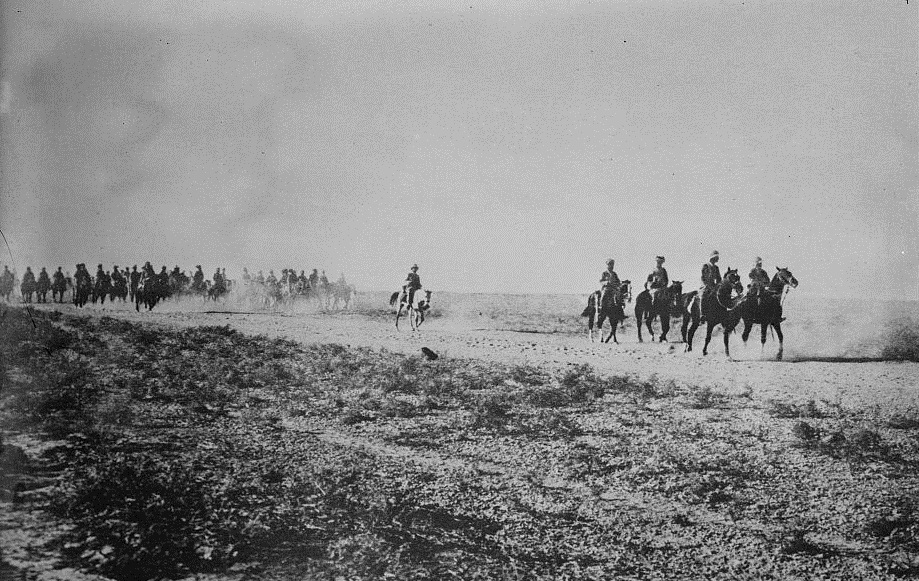
Townshend chose audacity. Rather than assault the Ottoman trenches at Es Sinn head-on, he devised an envelopment. Two columns would march through the night, threading between the Ataba and Suwaikiya marshes to strike the Ottoman rear. A third brigade would pin the defenders in place with a frontal demonstration. Cavalry would swing wide to cut off retreat. Everything depended on timing and darkness. The deserters handed the plan to Nureddin, but his conviction that no force would risk the marshes at night proved a fatal misjudgment. At 2 a.m. on 28 September, the columns stepped off into the desert. Column B, under Brigadier-General Hoghton, promptly got lost and blundered into the Suwaikiya marsh, losing an hour retracing its steps. Column A, under Brigadier General Delamain, reached its position on time and waited, exposed, for support that did not come.
Bayonets at Dawn
By 8:45 a.m., nearly three hours behind schedule and still without word from Hoghton, Delamain attacked alone. His force now faced more of the Ottoman line than planned. The 117th Mahrattas and a company of Bombay Sappers hit the northern end of the defenses and were torn apart. The Mahrattas lost every one of their British officers, and command fell to the battalion's Indian Viceroy's Commissioned Officers, who pressed the assault. The 2nd Dorsets struck the center and south, meeting fierce resistance. Meanwhile, Hoghton's column had stumbled into an undiscovered Ottoman redoubt near the marsh and was fighting its own battle. When both columns finally converged, they cleared the trench network at bayonet point. On the river, Lieutenant Commander Edgar Cookson steamed his gunboats through Ottoman fire toward Kut, only to find the channel blocked by sunken boats and steel cables. He climbed out to cut through them himself. Most of his crew were already wounded. A bullet killed him mid-effort. He was awarded the Victoria Cross posthumously.
Victory and Its Costs
By nightfall, the Ottoman 38th Division had abandoned its positions and retreated north toward Kut. Townshend's cavalry, positioned to intercept the retreat, failed to charge. The explanation was logistical rather than cowardly: the Sikh and Hindu cavalrymen could not eat food prepared in captured Muslim cooking pots due to dietary laws, and leaving behind their own equipment meant they could not feed themselves. The British entered Kut the next day. Townshend had won, but the cost exposed the campaign's fragility. The Poona Division had planned for a maximum casualty rate of six percent. The wounded overwhelmed the single hospital ship on the river. Many were loaded onto ammunition carts or laid atop supply boxes for the journey downstream. The division had only 330 animal-drawn carts to haul everything.
The Trap Upstream
General Nixon took the victory at Es Sinn as proof that Baghdad would fall easily. Townshend himself was more cautious. The three-sided debate between London, Simla, and the field command produced a fateful decision: Prime Minister Asquith approved the advance on Baghdad despite a military assessment warning that Nixon had only 9,000 combat troops and that up to 60,000 Ottoman reinforcements were expected by January. The advance led to the Battle of Ctesiphon, a costly draw, and then to Townshend's retreat back to the very town he had just captured. The Siege of Kut, which began in December 1915, would last 147 days and end in one of Britain's worst military surrenders of the war. The Es Sinn position, where Townshend's men had fought so hard, would become the forward line of the force that trapped them.
From the Air
Located at 32.51N, 45.82E, just south of Kut-al-Amara along the Tigris River in eastern Iraq. The battle site is on the left bank of the Tigris where marshland flanks the river. The distinctive U-bend of the Tigris at Kut is visible from altitude. Nearest airfield is the former FOB Delta / COB Delta near Kut (now closed). The landscape is flat alluvial plain with marsh features still visible from above.