Battle of Evesham
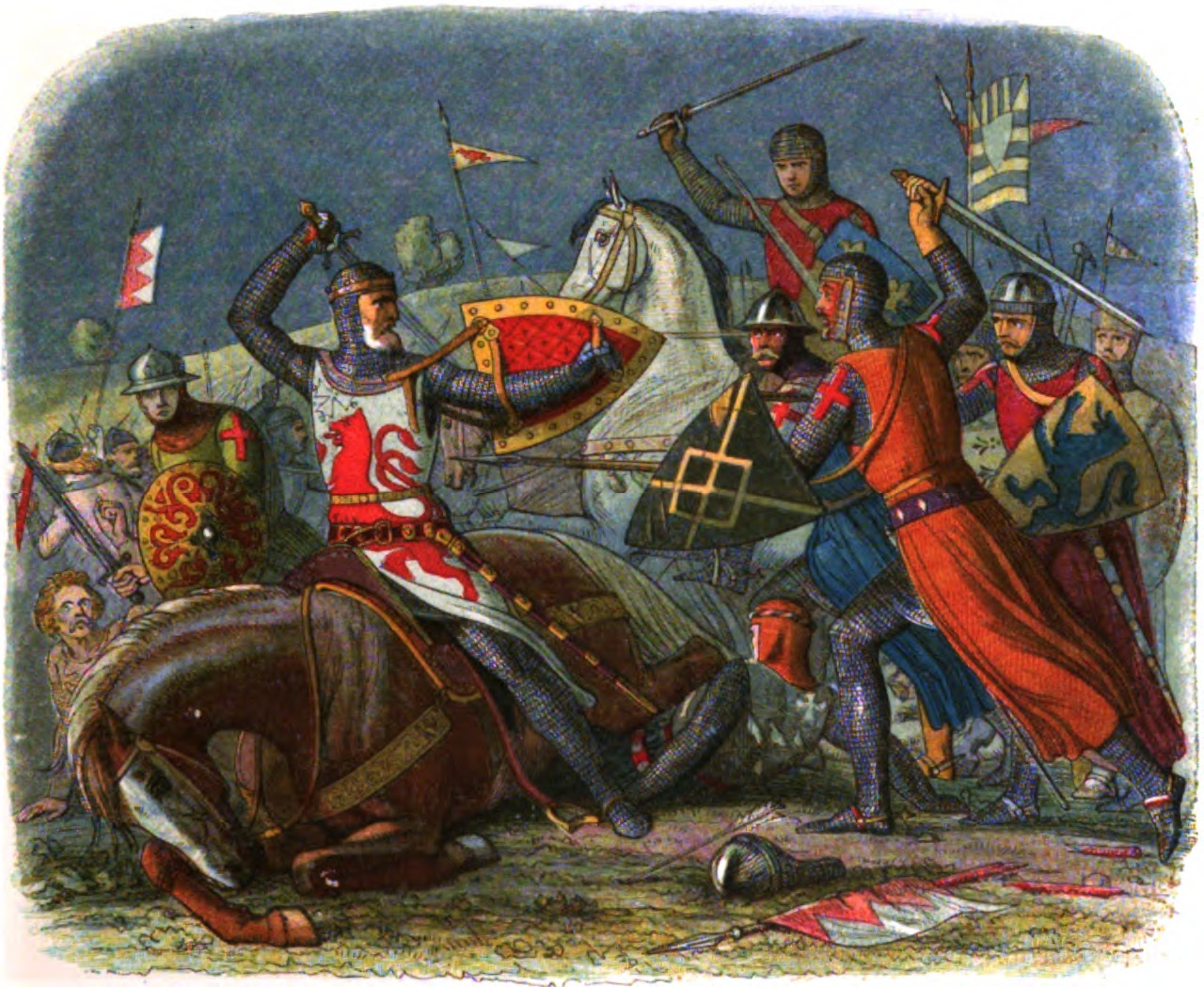
"The murder of Evesham, for battle it was none." The chronicler Robert of Gloucester left no room for euphemism. On the morning of August 4, 1265, Simon de Montfort, 6th Earl of Leicester -- the man who had forced a king to share power with his barons, who had summoned commoners to Parliament for the first time -- looked up at Green Hill north of Evesham and saw royal banners approaching through a thunderstorm. Some of those banners were his own, captured from his son's forces at Kenilworth and carried by Prince Edward's army as a deliberate deception. De Montfort recognized the trap immediately. "Our bodies are theirs," he reportedly said. "Our souls are God's."
A Revolutionary Cornered
De Montfort had won control of England's government a year earlier at the Battle of Lewes, capturing both King Henry III and Prince Edward. He held the king as a figurehead while governing through a council of barons -- a radical experiment in limiting royal authority. But his coalition was fracturing. In May 1265, Gilbert de Clare, Earl of Gloucester, defected to the royalists. With Gloucester's help, Prince Edward escaped captivity and began rallying forces. De Montfort allied with Llywelyn ap Gruffudd, the Prince of Wales, but the concessions he offered -- recognition of Llywelyn's title, permission to keep conquered territory -- cost him support at home. By midsummer, the Earl found himself in the west with a shrinking army, desperately trying to unite with reinforcements his son Simon the Younger was bringing from London.
The Prince's Gambit
Edward proved a far more capable strategist than anyone had expected from a 26-year-old prince. He seized Gloucester on June 29, cutting off de Montfort's eastward route. When Simon the Younger finally reached Kenilworth Castle, Edward struck first, catching his forces quartered carelessly outside the walls and scattering them. The prince then turned south, carrying the captured Montfortian banners. On August 4, he positioned his army -- roughly 10,000 men, twice de Montfort's strength -- across the only escape route from a loop of the River Avon where the Earl's forces were camped near Evesham. He blocked the bridge. The trap was complete.
Slaughter on Green Hill
De Montfort marched out of Evesham at eight in the morning as a thunderstorm broke overhead. The royalists held the high ground along Green Hill, Edward's forces on the left, Gloucester's on the right. Both armies wore crosses -- the baronial white, the royal red -- a practice de Montfort himself had introduced at Lewes. "They have not learned that for themselves, but were taught it by me," he said when he saw the royalist crosses. Outnumbered two to one, de Montfort attempted to punch through the center of the royalist line. The Welsh infantry provided by Llywelyn deserted almost immediately. What followed was not a battle but a killing. The royalists, bitter from their humiliation at Lewes, offered no quarter. Knights who tried to surrender were cut down. De Montfort's body was mutilated after death -- his head, hands, feet, and testicles severed. It was butchery that violated every convention of medieval warfare.
The Idea That Outlived the Man
The royalists were ruthless in victory. Parliament at Winchester that September disinherited everyone who had supported de Montfort. But the conflict did not end cleanly. Resistance smoldered across England, concentrated at the nearly impregnable Kenilworth Castle, where loyalists held out through a siege that began in the summer of 1266. Recognizing that force alone would not resolve the standoff, the royalists drafted the Dictum of Kenilworth -- a pragmatic document that allowed rebels to buy back their confiscated lands at prices scaled to their level of involvement. The defenders initially refused, but starvation and disease eventually broke their resolve. By 1267, the Dictum was accepted, and England entered a period of stability that lasted into the 1290s. De Montfort's experiment in parliamentary governance was crushed, but the idea he planted -- that a king's power should have limits -- proved harder to kill than the man himself.
From the Air
Located at 52.11N, 1.95W near the town of Evesham in Worcestershire, at a bend in the River Avon. Green Hill, where the royalist forces were positioned, is visible as rising ground north of the town. Nearest airports: EGBJ (Gloucestershire, 20nm SW), EGBB (Birmingham, 25nm N). Best viewed at 2,000-3,000 ft AGL to appreciate the river loop that trapped de Montfort's forces.