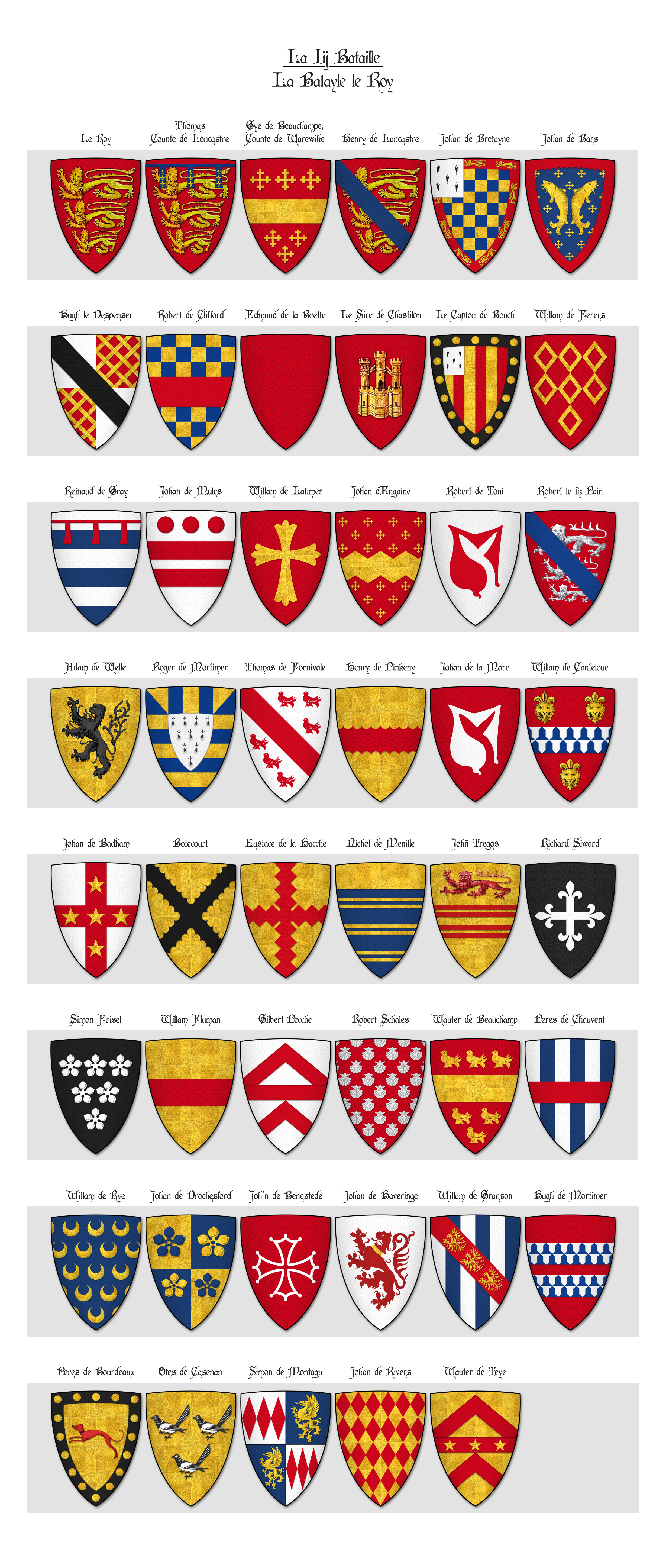
Battle of Falkirk
William Wallace had won the impossible. At Stirling Bridge in September 1297, his army of common Scots had destroyed an English force and killed its commander, Hugh de Cressingham, whose skin, according to Scottish tradition, was stripped and cut into souvenirs. Wallace was knighted, named Guardian of Scotland, and for a few months it seemed that a commoner with no royal blood might actually drive the English from his country. Then Edward I came north in person, and on 22 July 1298, at a place near Falkirk, the hammer fell.
The Hammer Marches
Edward I of England was not a man who tolerated rebellion. Known to history as the Hammer of the Scots, he had conquered Wales, expelled England's Jewish population, and built some of the most formidable castles in European history. When word reached him of Wallace's victory at Stirling Bridge and the subsequent Scottish raids into northern England, he cancelled his planned campaign in France and turned his full attention to Scotland. In the summer of 1298, Edward marched north with an army that dwarfed anything Wallace could muster, an overwhelming force of English and Welsh infantry supported by heavy cavalry and contingents of longbowmen. His supply lines were stretched and his Welsh troops mutinous, but Edward pressed forward, determined to bring Wallace to battle. Scottish scorched-earth tactics had left the countryside bare of food, and the English army was close to turning back when intelligence arrived that Wallace's forces were positioned near Falkirk, just thirteen miles away.
The Schiltrons Stand
Wallace chose his ground on rising land south of Callendar Wood, with the Glen Burn protecting his front. He organised his infantry into four schiltrons, dense circular formations of spearmen bristling with twelve-foot pikes, their outer ranks kneeling with spears braced against the ground. Between the schiltrons he placed his small force of archers. Behind them waited the Scottish cavalry, such as it was. The formation had worked brilliantly at Stirling Bridge, where terrain had funnelled the English into a killing ground. But Falkirk was different. The ground was more open, and Edward had brought longbowmen in numbers Wallace had not faced before. When the English cavalry charged the schiltrons, the spear rings held. The horsemen could not break in. For a brief moment, it seemed Wallace's tactics might prevail again.
Arrows and Abandonment
Then Edward changed his approach. Instead of feeding more cavalry into the spear walls, he brought up his longbowmen and crossbowmen and ordered them to pour arrows into the schiltrons from a distance the spearmen could not reach. The Scots had no answer. Their own archers were too few, and their cavalry, commanded by nobles whose loyalty to Wallace was never certain, withdrew from the field without engaging. Whether this was cowardice, treachery, or simple tactical judgment remains one of the most debated questions in Scottish history. Without cavalry to scatter the English archers or protect the schiltrons' flanks, the outcome was inevitable. The arrow storm tore gaps in the formations, and English cavalry poured through. Wallace's army disintegrated. The Guardian escaped the field, but his military reputation was destroyed. He resigned the guardianship shortly afterward.
The Lesson Learned at Bannockburn
Edward's victory at Falkirk did not end Scottish resistance. He occupied Stirling and raided as far as Perth and St Andrews, but he could not hold what he had taken and retreated to Carlisle by September. The conquest of Scotland would consume the rest of his reign and outlast him. Wallace spent years as a fugitive before his capture and execution in London in 1305. But the tactical lesson of Falkirk was not lost on the man who would ultimately secure Scottish independence. Robert the Bruce, who may have fought on the English side at Falkirk, understood that static schiltrons could be destroyed by archery. At Bannockburn in 1314, he used mobile, offensive schiltrons that advanced into the English line before the longbowmen could deploy, and sent his cavalry to scatter the archers. The defeat at Falkirk taught the Scots how to win. It just took sixteen years and a different king to apply the lesson.
From the Air
Located at 55.99N, 3.76W near the modern town of Falkirk in central Scotland. The exact battlefield site is debated, with proposed locations near Callendar Wood, the Central Retail Park area, and Mumrills. The Antonine Wall runs nearby. Nearest airports: Edinburgh (EGPH) approximately 22 nm east; Glasgow (EGPF) approximately 25 nm west. Best viewed at 2,000-3,000 ft AGL.