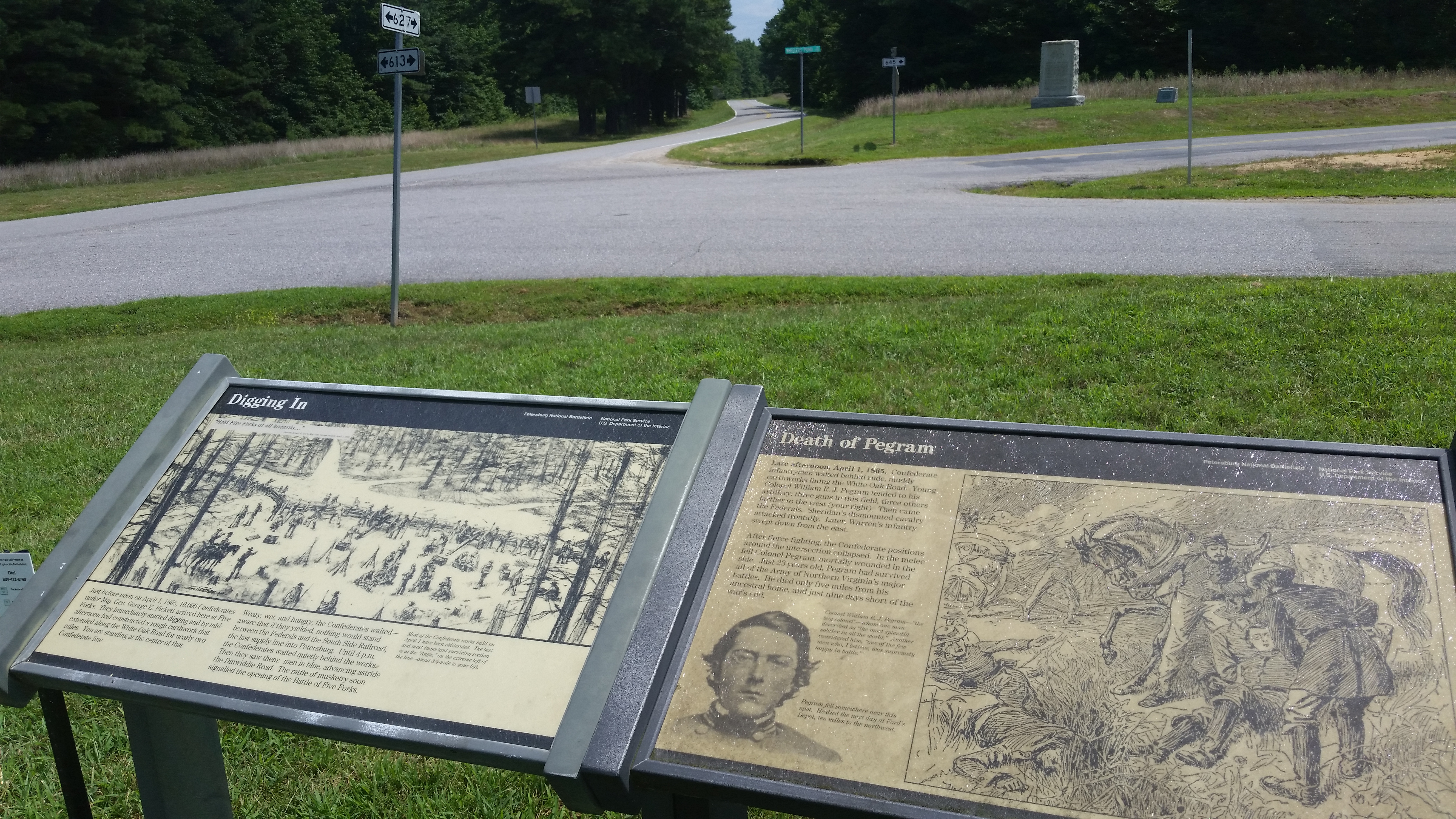
Battle of Five Forks
George Pickett and Fitzhugh Lee were eating shad. It was April 1, 1865, and the two Confederate generals had accepted an invitation to a riverside fish bake at Thomas Rosser's camp, well behind the lines at Five Forks, Virginia. An acoustic shadow -- a quirk of terrain and atmosphere -- swallowed the sound of gunfire from the south. Couriers sent to find them could not. While they dined, Philip Sheridan launched the assault that would shatter the Confederate left flank, capture thousands of prisoners, and set in motion the fall of Petersburg, the evacuation of Richmond, and the end of the Civil War. Abraham Lincoln, handed captured battle flags that evening, held them and said: 'Here is something material -- something I can see, feel and understand. This means victory. This is victory.'
The Crossroads That Mattered
Five Forks was a rural intersection in Dinwiddie County where five roads converged in the piney woods southwest of Petersburg. By the spring of 1865, it had become the hinge on which the entire Confederate position turned. Robert E. Lee's army held a thinning line of trenches stretching from Richmond to Petersburg, and the South Side Railroad -- his last supply artery -- ran just north of Five Forks. Lose the crossroads, and the railroad would be cut. Lose the railroad, and the army would starve. Lee entrusted the position to George Pickett with roughly 10,000 infantry and cavalry, ordering him to hold Five Forks at all hazards. Pickett built a line of earthworks along White Oak Road with a refused left flank angling back into the woods -- a strong position on paper, but one that depended on accurate intelligence and alert commanders.
Sheridan Unleashed
Philip Sheridan arrived at the front seething with aggressive energy. Ulysses Grant had given him clear instructions: turn the Confederate right, cut off the railroad, and force Lee into the open. Sheridan assembled a combined force of cavalry and Gouverneur Warren's V Corps -- about 12,000 infantry reduced from 15,000 by three days of hard marching and skirmishing. His plan was layered: George Custer would feint against the Confederate right with mounted troopers, Warren's infantry would strike the left flank, and Thomas Devin's dismounted cavalry would hit the entrenchments from the front once they heard Warren's guns. It was meant to be a single crushing blow, not a piecemeal affair. But the attack went sideways almost immediately. Warren's maps were wrong about where the Confederate flank actually bent back, sending two of his three divisions veering north of their target.
Chaos and Courage at the Angle
Romeyn Ayres's division, the leftmost of Warren's three, found the fight first. His men stumbled into accurate fire from Matt Ransom's brigade defending the angled return in the Confederate line and briefly faltered. Sheridan rode directly along the wavering battle line, shouting encouragement, calling for his battle flag. His color sergeant was killed. The men steadied. An officer in one of Ransom's regiments later wrote that the Union troops simply ran over them, crowding so close it became impossible to shoot. The color-sergeant of the 190th Pennsylvania Infantry planted the first Union flag on the Confederate works. Ayres's men captured the key angle, taking over a thousand prisoners and eight battle flags -- but at a cost that included Colonel Frederick Winthrop, mortally wounded, and Colonel Richard Bowerman, severely hurt. Meanwhile, Warren rode through the woods searching for his wayward divisions, eventually finding Crawford's men and personally leading them in a final charge that captured hundreds more Confederates.
A General's Reward
Pickett, rushing back from the shad bake, arrived to find his line collapsing from multiple directions. He pulled brigades from one sector to shore up another, but each new defensive stand dissolved under the weight of converging Union forces. Custer swung his mounted brigades around the Confederate right while Mackenzie's cavalry sealed off the escape route along White Oak Road. By nightfall, the Confederates had lost roughly 3,000 men -- about 600 killed and wounded and over 2,000 taken prisoner. Warren, who had rallied his scattered corps and led that final charge, received not commendation but humiliation: Sheridan, furious at the initial confusion, relieved him of command on the spot. A court of inquiry that convened in 1879 issued its verdict in November 1882 ruling the removal unjustified, but Warren had died three months earlier on August 8, 1882, never knowing his name had been cleared.
The Domino Falls
Colonel Horace Porter galloped to Grant's headquarters around 7:30 that evening with news that over 5,000 prisoners had been taken. Grant, calm as always, issued the order he had been waiting months to give: a general assault along the entire Petersburg line at dawn. The next morning, April 2, Union troops broke through the Confederate defenses. Lee evacuated Petersburg and Richmond that night, beginning the westward retreat that would end at Appomattox Court House one week later. Five Forks was the domino that toppled everything. Today the battlefield is preserved as part of Petersburg National Battlefield, its quiet woods and farm fields giving little hint of the afternoon when the Confederacy's grip on its capital finally broke -- all while two generals ate fish upstream.
From the Air
Located at 37.14N, 77.62W in Dinwiddie County, Virginia, southwest of Petersburg. The Five Forks intersection sits in wooded, gently rolling terrain. From altitude, look for the convergence of rural roads amid pine forests and farmland. The battlefield is part of Petersburg National Battlefield. Nearest airports include Dinwiddie County Airport (PTB) approximately 10 nm east, and Petersburg's airport facilities. Richmond International Airport (KRIC) lies roughly 40 nm northeast. White Oak Road and Ford's Road, key tactical features of the battle, are still visible as rural routes.