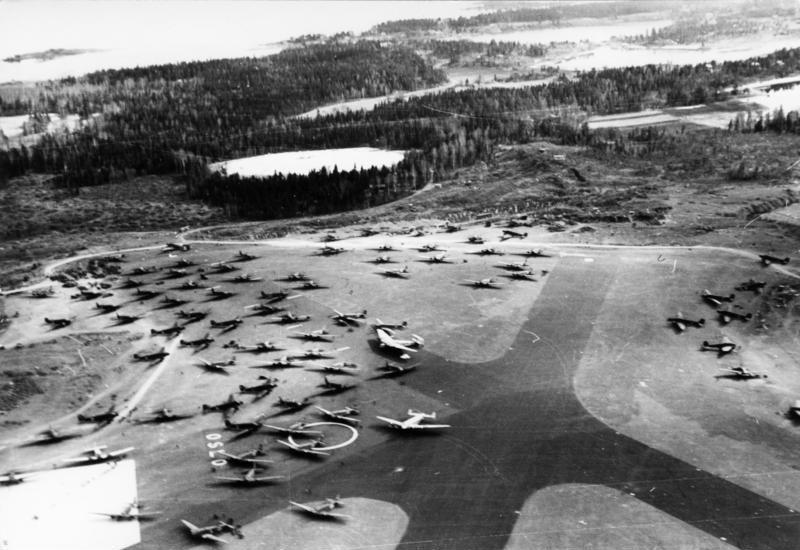
Battle of Fornebu
At five o'clock on the morning of April 9, 1940, Second Lieutenant Finn Thorsager climbed into the cockpit of a Gloster Gladiator biplane at Fornebu airfield outside Oslo. His wingman, Lieutenant Arve Braathen, could not follow. Engine trouble. For the next thirty minutes, Thorsager was the only Norwegian fighter pilot in the air over a capital that Germany was in the process of invading. Seven pilots would eventually take off that morning. They flew biplanes against a modern air force. They shot down four German aircraft and lost one of their own. Then they ran out of fuel.
The Morning Everything Changed
The German assault on Norway, Operation Weserubung, was already underway when the Fornebu pilots scrambled. A naval fleet led by the heavy cruiser Blucher had been dispatched up the Oslofjord to seize the capital and capture King Haakon VII. But the fleet never reached Oslo as planned. Oscarsborg Fortress, an aging coastal installation near Drobak that the Germans had dismissed as a training facility, opened fire and sank the Blucher. The flagship carried most of the troops and Gestapo agents intended to occupy the city. Its loss bought precious hours, allowing the king, the royal family, and the Norwegian government to flee the capital before German forces could seize them. The air battle at Fornebu was the second act of that desperate morning.
Biplanes Against the Luftwaffe
The Norwegian Army Air Service had been aware of German reconnaissance flights over Oslo in the weeks before the invasion. Norwegian fighters had attempted to intercept them, but the Gloster Gladiators, open-cockpit biplanes designed in the mid-1930s, could not catch the faster German aircraft. On April 9, the mismatch was no longer theoretical. The seven Norwegian pilots who took off from Fornebu flew against Luftwaffe formations that vastly outnumbered them and operated modern, enclosed-cockpit fighters and bombers. Despite the odds, the Norwegians engaged. Four German planes fell. One Norwegian aircraft was lost. But fuel ran low, and one by one the Norwegian pilots were forced to land. Fornebu airfield fell to the Germans, and with it, Oslo's air defense.
An Open City
With the airfield captured and no fighters left to defend it, Oslo was declared an open city. The capital surrendered fully to the German forces. The speed of the collapse was devastating, but the delay caused by Oscarsborg and the resistance at Fornebu had achieved something crucial: the Norwegian government had escaped. King Haakon VII refused to abdicate or accept a puppet government under Vidkun Quisling, and his flight from Oslo preserved the legitimacy of Norwegian sovereignty throughout five years of occupation. Without those hours gained by an obsolete fortress and seven biplane pilots, the political history of occupied Norway might have unfolded very differently.
From Fornebu to Little Norway
The pilots who flew that morning did not surrender with their capital. All of the Norwegian airmen eventually made their way to the United Kingdom, and later to a training camp in Canada called Little Norway. There they joined the Norwegian force-in-exile, forming the nucleus of what would become the Royal Norwegian Air Force. The men who had scrambled in obsolete biplanes over a frozen April airfield spent the rest of the war flying modern Allied aircraft. Fornebu airfield itself served as Oslo's commercial airport for decades after the war, closing in 1998 when operations moved to the new Gardermoen airport. The site has been redeveloped, but the events of that April morning endure in Norwegian military history as a moment when a handful of pilots did what they could with what they had.
From the Air
Fornebu (59.88N, 10.62E) was Oslo's primary airport until 1998, located on a peninsula southwest of the city center on the Oslofjord. The former airfield site has been redeveloped into a residential and commercial district. Oslo Gardermoen Airport (ENGM) is now the primary airport, 47km north of the city. From above, the Fornebu peninsula is identifiable between the Lysaker River outlet and the Oslofjord shoreline. Oscarsborg Fortress, which sank the Blucher that same morning, is visible in the Oslofjord narrows near Drobak approximately 30km south.