Battle of Fort Beauséjour
The fort was not finished. Its commander was embezzling construction funds. Its priest had diverted labor to an irrigation project. And its most trusted officer was secretly selling maps and battle plans to the enemy. By the time 2,400 British soldiers appeared on the marshlands of the Isthmus of Chignecto in June 1755, Fort Beausejour was already defeated from within. The siege that followed lasted just two weeks, but its consequences -- the end of French military power in mainland Acadia and the deportation of an entire people -- would echo for centuries.
A Narrow Neck of Land
The Isthmus of Chignecto was the strategic pivot of northeastern North America. This narrow strip of land connecting present-day Nova Scotia to New Brunswick was the only overland route between Quebec and the fortress of Louisbourg during winter months, when ice closed the sea lanes. The French built Fort Beausejour on the western side of the Missaguash River in 1751; the British answered with Fort Lawrence on the eastern bank. Between them, Acadian families farmed both sides of the river, caught in a tightening vise between two empires that each demanded their loyalty. The Acadians declared themselves neutral, a position that neither side accepted. France's Louis XV encouraged them to migrate westward toward Beausejour. The British demanded an oath of allegiance. Abbe Le Loutre, the fort's priest and a representative of the French government, threatened Acadians with spiritual and physical punishment if they ventured into English territory.
The Spy in the Fort
Thomas Pichon was not a soldier. He was an educated man posted to Fort Beausejour who felt undervalued by his superiors -- Commander Louis Du Pont Duchambon de Vergor and the domineering priest Le Loutre. When a food-poisoning epidemic struck the fort, Pichon crossed to Fort Lawrence to consult with the British surgeon and found himself treated with a respect he had never received from the French. Over the following year, he provided Captain George Scott with detailed maps, garrison strengths, and defense plans. Pichon later claimed he spied out of conviction that Britain was the superior nation, but historians suspect simpler motives: money and resentment. After the siege, Pichon reinvented himself as Thomas Tyrell, a loyal British subject. He spent his later years regretting the betrayal. His intelligence, combined with information from Acadian informants, gave the British a remarkably detailed picture of a fort riddled with dysfunction.
Thirteen Days in June
Lieutenant-Colonel Robert Monckton's expedition sailed from Boston on May 22, 1755, with 2,000 men recruited largely from Massachusetts. They reached Fort Lawrence on June 2, where 400 additional troops joined them. On June 4, the force began its advance toward Beausejour. Vergor issued a call to arms among the surrounding Acadians, who responded reluctantly -- some asked the French governor to formally threaten them so they could claim coercion if the British won. With roughly a thousand defenders, Vergor sent pleas for reinforcement to Quebec, Louisbourg, and settlements along the Saint John River. On June 14, word arrived that the British navy had blockaded Louisbourg, cutting off any hope of relief. Vergor tried to keep the news secret, but his valet -- whose wife was having an affair with the commander -- overheard and spread it through the garrison. Morale collapsed entirely. On June 16, a British shell struck the officers' mess, killing several French officers and one English prisoner named Hay, the only British casualty of the entire siege. The white flag went up that evening. Beausejour fell at 7:30 p.m.
The Deportation Begins
The capitulation terms included protections for Acadians who had participated in the defense, but Governor Charles Lawrence had no intention of honoring neutrality claims. The British discovered that several Acadians had taken up arms at Beausejour, confirming what Lawrence had long suspected: the Acadian community, despite its professed neutrality, posed a military risk in alliance with the Mi'kmaq and the French. With the fall of the fort, the Acadians lost their last overland escape route and had already surrendered their weapons. They were, as one historian put it, "at the mercy of their British overlords." On July 31, 1755, Lawrence ordered the forcible removal of the Acadian population from Nova Scotia -- the Grand Derangement, a deportation that scattered roughly 11,500 people across the Atlantic seaboard, the Caribbean, and Europe. Fort Beausejour, renamed Fort Cumberland by the British, became a staging point for the expulsion it had made possible.
What the Earthworks Remember
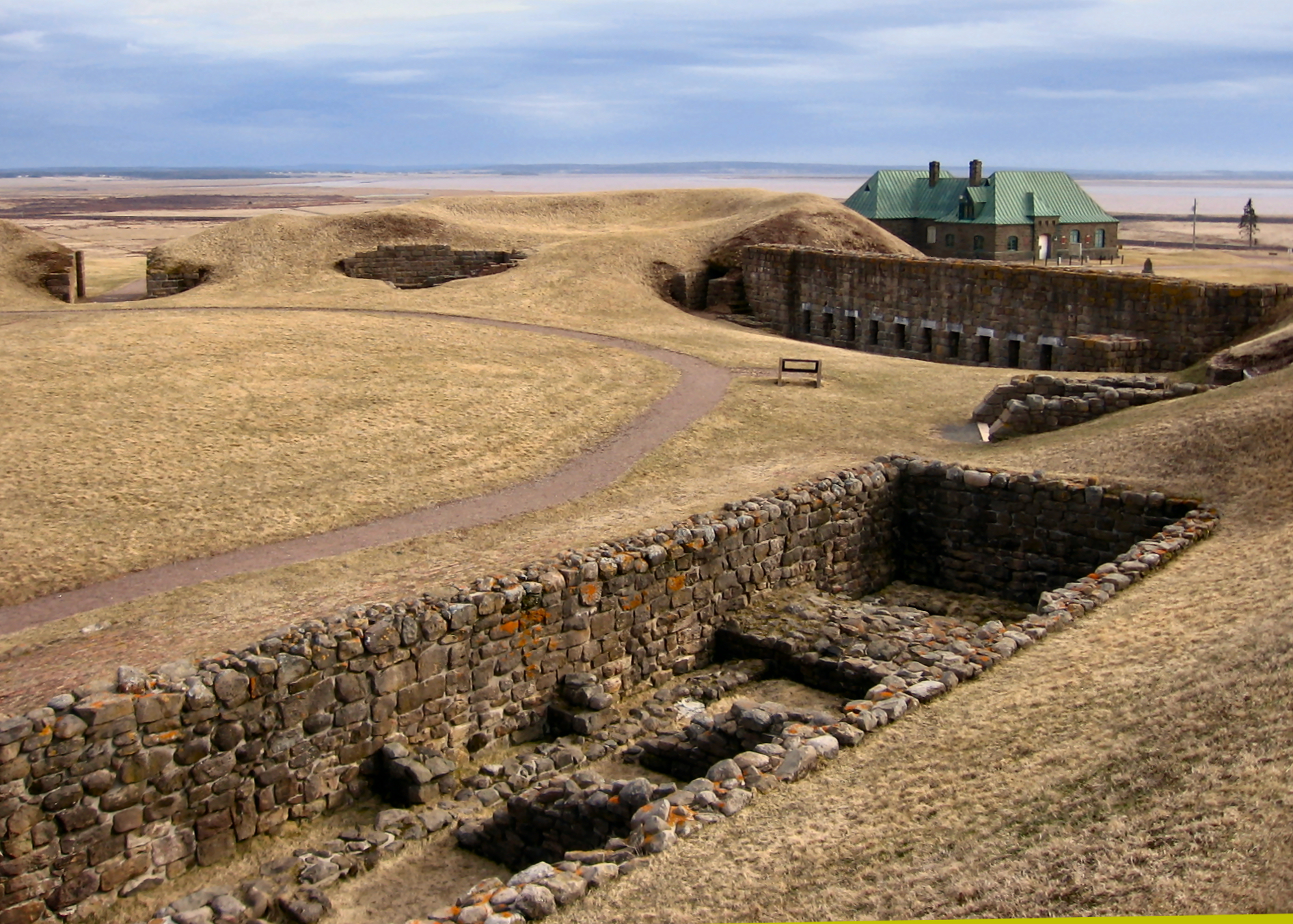
The fort saw one more significant action: the Battle of Fort Cumberland in 1776, when American Revolution sympathizers attempted to seize it. Today, the earthworks of Fort Beausejour stand as a National Historic Site on a ridge overlooking the Cumberland Basin and the marshlands of the isthmus. The grassy ramparts and foundation outlines are modest -- the fort was never grand -- but they mark one of the most consequential sites in Canadian history. Here, the decisions of a corrupt commander, a zealous priest, a disgruntled spy, and an ambitious governor converged to end French military power in mainland Acadia and set in motion the dispersal of a people who would spend generations finding their way home.
From the Air
Located at 45.87°N, 64.29°W on the Isthmus of Chignecto, near Aulac, New Brunswick. The fort's earthworks are visible on a ridge overlooking Cumberland Basin and the Tantramar Marshes. Nearest airports: Greater Moncton (CYQM) approximately 25 nm east, Amherst (CCQ3) nearby. The narrow isthmus connecting Nova Scotia to New Brunswick is clearly visible from altitude, with the Missaguash River and marshlands defining the landscape. Best viewed at 2,000-4,000 feet AGL to appreciate the strategic position between the two provinces.