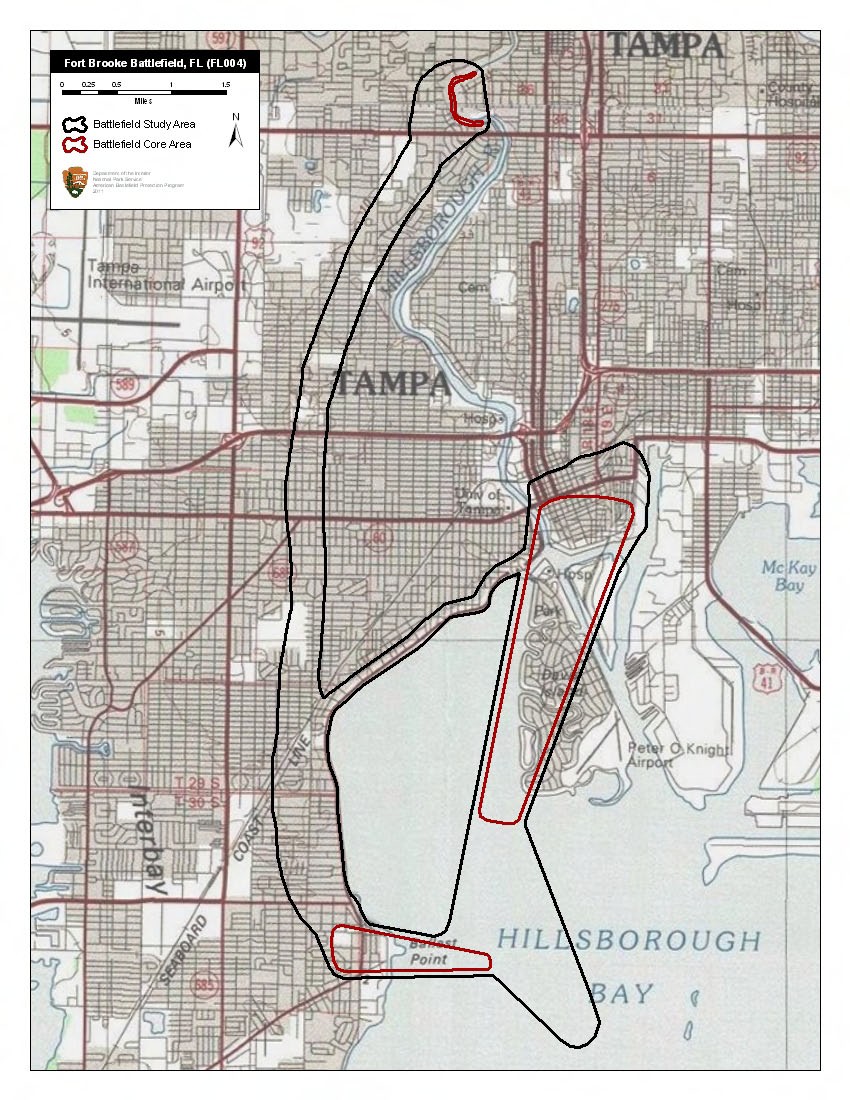
Battle of Fort Brooke
The gunships opened fire on the morning of October 16, 1863, their shells arcing toward Fort Brooke from just beyond the reach of its cannons. To the small Confederate garrison defending Tampa, it looked like another naval bombardment, the kind of blunt-force attack they had already repelled once before. But the shelling was a feint. While the defenders kept their eyes on Tampa Bay, a hundred Union soldiers were slipping ashore at Ballast Point, about to begin a 14-mile march through dense Florida wilderness toward a prize hidden upstream on the Hillsborough River.
A Cattle Port Under Siege
Before the Civil War, Tampa was a small but strategically useful port. Ranchers and farmers from the interior of central Florida shipped cattle and crops through its harbor, and when the Confederacy formed, that supply chain became a lifeline. Fast blockade runners based in Tampa slipped out past Union Navy patrols to deliver cattle and cotton to Spanish Cuba, returning with gold and desperately needed goods. The Union's Anaconda Plan aimed to strangle the Confederacy by blockading its entire coastline, and by 1862, Union warships patrolling the mouth of Tampa Bay had throttled most legitimate shipping. But the blockade runners kept finding ways through. Among the most successful were the steamship Scottish Chief and the sloop Kate Dale, both operating out of a shipyard on the Hillsborough River well upstream of the fort.
The First Shots at Tampa
The Union had tested Tampa's defenses once before. In June 1862, the gunboat USS Sagamore steamed into Tampa Bay and demanded Fort Brooke's surrender. The Confederate garrison refused, and the Sagamore fired several volleys at the town. The fort answered with its own guns, and after about 24 hours of inconclusive exchange, the gunboat withdrew. Neither side suffered damage or casualties, making the whole affair something of a draw. But the Union learned exactly what it needed: the maximum range of the Confederate artillery guarding Tampa Bay. That intelligence would prove decisive the following year, when the Navy returned not to attack the fort directly but to use it as a distraction.
The Overland March
On October 16, 1863, the Union gunships USS Tahoma and USS Adela sailed into Tampa Bay and began a slow, deliberate bombardment of Fort Brooke, carefully positioning themselves just beyond the range of the fort's batteries. The bombardment was theater. The real strike force came ashore at Ballast Point, near the present-day intersection of Bayshore Boulevard and Gandy Boulevard, under the command of Acting Master T.R. Harris. Roughly a hundred Union troops disembarked and marched 14 miles north through heavily wooded terrain, passing through areas that would one day become the Tampa neighborhoods of Palma Ceia, West Tampa, and Seminole Heights. Their destination was the Jean Street Shipyard on the Hillsborough River, near what is now Sligh Avenue.
Fire on the River
The raiding party reached the shipyard on October 18 and moved fast. They seized and burned the Scottish Chief and the Kate Dale along with other vessels moored at the dock. The destruction was thorough. The Kate Dale sank near her mooring and her remains still lie at the bottom of the Hillsborough River near the current site of ZooTampa at Lowry Park. With their mission accomplished, the Union troops turned back toward Ballast Point, but the Confederates had caught on. A sharp engagement erupted as the raiding party attempted to board their small boats and row back to the waiting gunships. Covering fire from the Tahoma and Adela, directed at Confederate positions on shore, allowed the Union soldiers to reach the ships, though they suffered 16 casualties in the retreat.
A War Won at the Docks
The Battle of Fort Brooke was classified as a minor engagement, but its consequences were anything but minor. The destruction of the Scottish Chief and the Kate Dale effectively ended blockade running out of Tampa for the remainder of the war. Shipping from the port came to a virtual halt, severing the supply chain that had connected central Florida's farms and ranches to Confederate markets in Cuba. The local economy, already strained by the blockade, was crippled. Today, downtown Tampa has been built over nearly every trace of the battlefield. Fort Brooke itself is long gone, its site now covered by modern development. But the Hillsborough River still winds through the city, and somewhere beneath its waters, the bones of the Kate Dale remain, a sunken relic of the night the Union came not with cannons but with matches.
From the Air
Located at 28.00N, 82.47W in downtown Tampa along the Hillsborough River. The fort's historical location is in the modern downtown waterfront area near the Tampa Convention Center. The Hillsborough River, where the blockade runners were burned, is clearly visible winding north through the city. Ballast Point, where Union troops landed, is visible at the southern end of Bayshore Boulevard along Hillsborough Bay. Nearest airports: KTPA (Tampa International Airport), approximately 5 nm northwest; KTPF (Peter O. Knight Airport) on Davis Islands, roughly 2 nm south. Tampa Bay provides strong visual orientation.