Battle of Fort Necessity
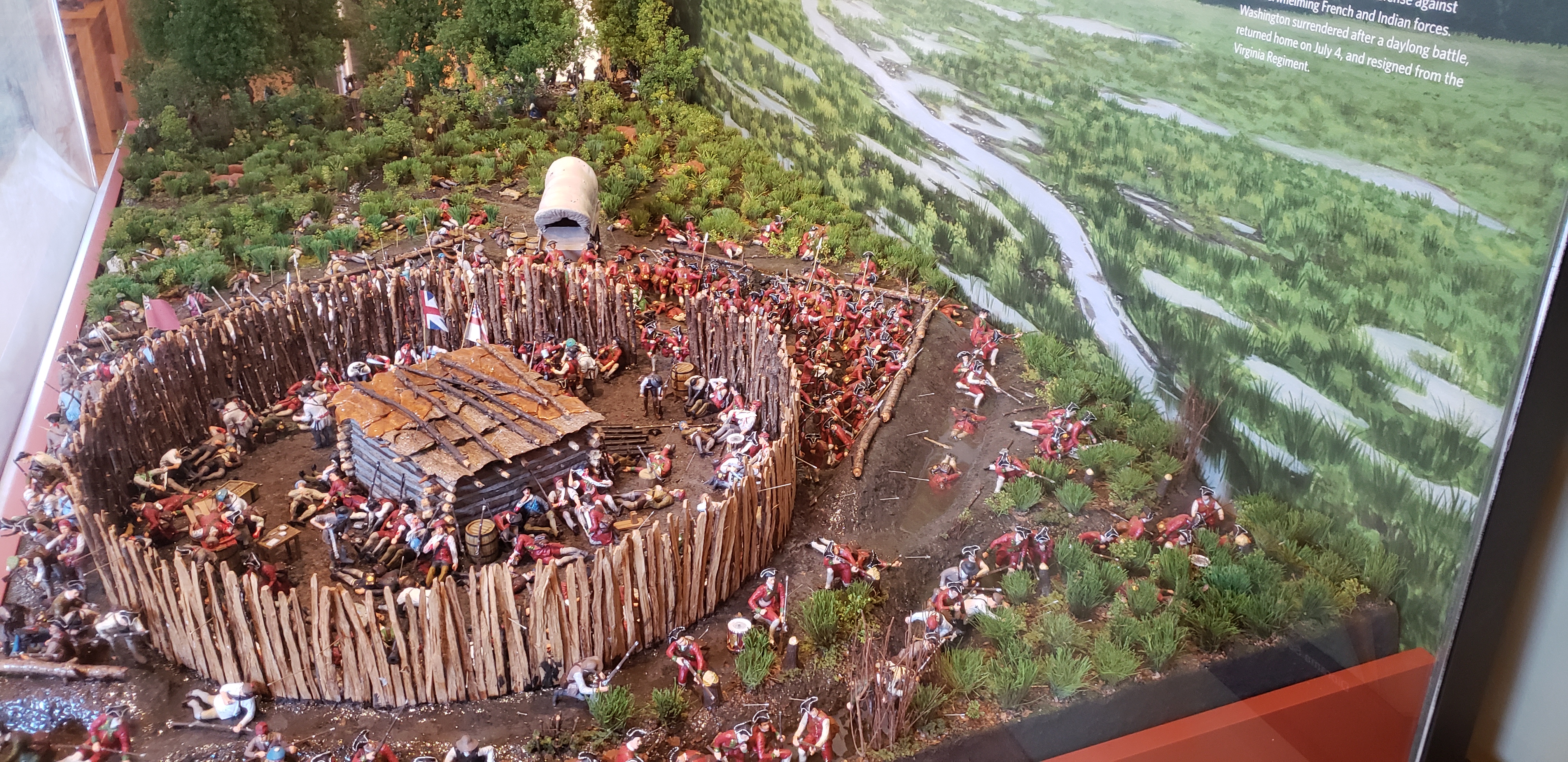
George Washington's military career began with a murder and ended -- temporarily -- with a drunken surrender in the rain. On July 3, 1754, at a hastily built stockade on an alpine meadow in the Laurel Highlands of western Pennsylvania, the 22-year-old Virginia militia colonel fought the engagement that would spiral from a frontier skirmish into the Seven Years' War, a conflict that eventually engulfed Europe, the Caribbean, India, and the Philippines. Washington could not have known any of that as his men huddled behind sodden breastworks, their gunpowder wet and useless, while French and Canadian troops poured fire from the tree line less than 100 yards away. What he did know was that he was losing.
An Invitation to Start a War
The trouble began with competing empires. France controlled the Ohio Country through a network of waterways and Native alliances despite having fewer than 90,000 colonists in all of New France. The British colonies held 1.5 million subjects eager to push west over the Appalachians. In 1753, the French began building fortifications in the Ohio Country. Virginia's governor, Robert Dinwiddie, sent young Washington to deliver a letter demanding the French leave. They politely refused. Dinwiddie then issued orders that historian Fred Anderson would later describe as "an invitation to start a war" -- Washington was to raise a militia, march to the frontier, and use force if necessary. By April 1754, Washington had gathered 186 men and begun hacking a road through the wilderness toward the Forks of the Ohio, where the French were building Fort Duquesne on the site of present-day Pittsburgh.
Blood at Jumonville Glen
The first shots came on May 28. Washington, acting on intelligence from Tanacharison, a Mingo chief known as the Half King, led 40 soldiers through the dark forest to an encampment of 35 French troops under Joseph Coulon de Villiers de Jumonville. The French had been sent with a diplomatic summons ordering Washington to leave French territory. Washington attacked at dawn. The skirmish lasted about 15 minutes, killing 10 to 12 Frenchmen and wounding two more. Then Tanacharison walked up to the wounded Jumonville, crushed his skull with a tomahawk, and washed his hands in the dead man's brains. Whether this was an assassination of a diplomatic envoy or a legitimate military engagement became the central dispute. France called it murder. The consequences would be global.
A Fort in the Wrong Place
Expecting retaliation, Washington fell back to an alpine meadow he called the Great Meadows and built Fort Necessity -- a circular palisade barely large enough for his men. The location was poor. The surrounding woods pressed in within musket range, and the low-lying ground meant the defensive trenches would flood in rain. On June 28, roughly 600 French soldiers and 100 Native warriors left Fort Duquesne under Louis Coulon de Villiers -- the slain Jumonville's older brother, burning for revenge. Washington's men abandoned their supplies to reach Fort Necessity ahead of the advancing force, arriving on July 1 with an exhausted and hungry garrison.
Surrender in the Rain
The battle on July 3 was a miserable affair. The French and Canadians spread through the woods and kept up a relentless fire on the exposed fort. Washington's men shot back but aimed too high, and their swivel cannon was equally ineffective. Then the rain came -- heavy, soaking rain that turned trenches into streams and rendered gunpowder useless. By evening, Washington could not fight. He sent his translator, Jacob Van Braam, to negotiate. The French terms were generous: the Virginians could leave with their arms and colors. But the surrender document, written in French, contained a phrase Van Braam translated loosely. Washington signed it without realizing he had admitted to the "assassination" of Jumonville. Meanwhile, against his orders, the garrison had broken into the fort's liquor supply and gotten drunk. On July 4, 1754, Washington marched his men out with drums beating and flags flying -- the last dignified moment in a campaign of catastrophic errors.
The Meadow That Started a World War
Washington expected a rebuke from Governor Dinwiddie. Instead, the Virginia House of Burgesses gave him a vote of thanks and blamed the defeat on poor supplies and lack of colonial cooperation. The real consequences played out on a far larger stage. Britain sent Major General Edward Braddock to finish what Washington had started; Braddock's expedition ended in disaster near Fort Duquesne in 1755. France dispatched reinforcements to Canada. Naval engagements followed. By spring 1756, France and Britain formally declared war, triggering the Seven Years' War across multiple continents. The battlefield where it all began is preserved today as Fort Necessity National Battlefield, a quiet clearing in the Laurel Highlands where the reconstructed stockade sits on the same meadow where a future president learned the hardest lessons of command.
From the Air
Fort Necessity National Battlefield is located at 39.814N, 79.587W in Fayette County, Pennsylvania, on an alpine meadow in the Laurel Highlands of the Allegheny Mountains at approximately 2,000 feet elevation. The nearest airport is Connellsville Airport (KVVS), roughly 18 nautical miles to the northwest, and Morgantown Municipal Airport (KMGW) about 25 nautical miles to the south. The meadow clearing is visible from the air surrounded by dense forest. Ohiopyle State Park and Fallingwater are nearby to the north. The terrain features the parallel ridges of the Alleghenies -- dramatic from the air on clear days. Best viewed at 2,000-4,000 feet AGL.