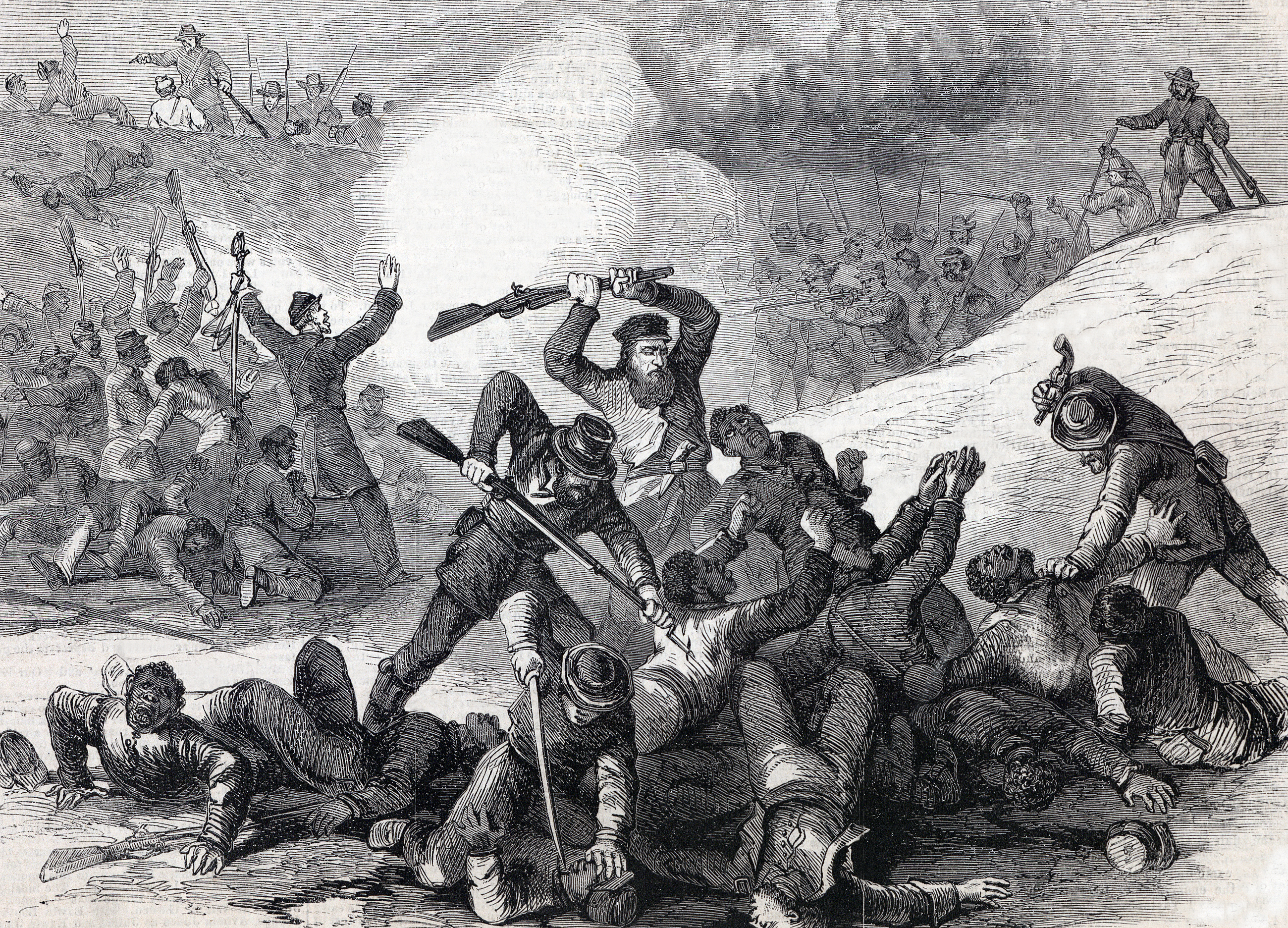
Battle of Fort Pillow
The surrender demand arrived at 3:30 in the afternoon. "Should my demand be refused," Nathan Bedford Forrest wrote to the Union garrison at Fort Pillow, "I cannot be responsible for the fate of your command." Major William Bradford, hiding the fact that his commanding officer was already dead from a sharpshooter's bullet, sent back five words: "I will not surrender." Within the hour, Confederate troops stormed the earthworks on the Mississippi River bluff, and what followed -- the killing of Union soldiers, many of them Black, after they had thrown down their arms -- sent shockwaves through the nation and hardened the resolve of every Black regiment in the Union army.
A Fort on a Bluff
Fort Pillow sat on a high bluff overlooking the Mississippi River, roughly 40 miles north of Memphis. Confederate Brigadier General Gideon Johnson Pillow had built it in early 1862 to guard the river approach to the city. When Union forces took it in June of that year, they turned it to the same purpose in reverse. The fortifications formed a semicircle of three earthen entrenchments, with a thick parapet surrounded by a ditch. Six artillery pieces pointed outward. The USS New Era, a Navy gunboat under Captain James Marshall, patrolled the river below. The design looked formidable on paper, but it carried a fatal flaw: the parapet was so wide that gunners could not depress their barrels enough to fire on attackers once they reached the base of the walls. And the high ground surrounding the fort gave sharpshooters clear lines of fire down into the garrison.
Forrest's Raid
Fort Pillow was not Forrest's main objective. In mid-March 1864, the Confederate cavalry commander had launched a month-long raid through West Tennessee and Kentucky with 7,000 troopers, targeting Union supply depots and fortifications from Paducah south to Memphis. At Paducah on March 25, Forrest had bluffed the Union commander with a threat of no quarter but failed to take the fort. By early April, he had reduced his force to roughly 2,500 men and turned his attention to Fort Pillow. He wrote on April 4 that the garrison had horses and supplies his command needed. The Union force there numbered about 600 men, split almost evenly between Black and white troops. The Black soldiers belonged to the 6th U.S. Regiment Colored Heavy Artillery and a section of the 2nd Colored Light Artillery. Many were formerly enslaved people who knew that capture by Confederates meant, at best, a return to slavery.
The Walls Come Down
Forrest arrived at Fort Pillow on the morning of April 12 to find that General Chalmers had already encircled the position. A stray bullet killed Forrest's horse -- the first of three he would lose that day. He deployed sharpshooters on the high ground, and their fire made the interior of the fort a killing zone. A bullet to the chest killed Major Lionel Booth, the garrison commander, and Bradford took over. By late morning, Confederates held two rows of barracks near the fort's southern end, pouring fire into the defenders from close range. After Forrest's surrender demand was refused, the assault came fast. The first wave of attackers entered the ditch and crouched while the second wave stepped on their backs to reach a ledge on the embankment. Those men then hauled the first wave up behind them. When they went over the top, they fired into the massed defenders for the first time. The garrison broke and ran for the river landing, expecting the New Era to cover their retreat with grapeshot and canister. The gunboat never fired. Its crew had sealed the gun ports under sharpshooter fire.
No Quarter
What happened next is documented in Union survivor testimony, Confederate letters home, and the report of the Joint Committee on the Conduct of the War, which investigated immediately. Surviving garrison members said that most of their men threw down their arms and surrendered, only to be shot or bayoneted by attackers who shouted "No quarter! No quarter!" Soldiers who reached the river were picked off in the water by sharpshooters on the bluff. Others drowned trying to escape. Confederate Sergeant Achilles Clark wrote to his sisters two days later describing the killing. Military historian David Eicher called Fort Pillow "one of the bleakest, saddest events of American military history." The news reached major newspapers -- The New York Times, the Chicago Tribune, the Cincinnati Gazette -- by April 16, carried by telegraph from Cairo, Illinois, where the steamer Platte Valley had docked with survivors bound for the hospital at Mound City.
Remember Fort Pillow
The massacre transformed the war's moral landscape. "Remember Fort Pillow" became a rallying cry for Black Union troops, who fought with intensified determination at battles throughout the rest of the conflict. President Lincoln brought the committee's findings before his cabinet on May 3, 1864, weighing whether to order formal retaliation. The Confederacy had already passed legislation in May 1863 declaring that captured Black soldiers would be turned over to state authorities for prosecution under state laws -- effectively threatening re-enslavement or execution. Fort Pillow made the stakes of that policy impossible to ignore. The site is now Fort Pillow State Historic Park, set on the same high bluff above the Mississippi. The earthworks remain visible. The river still curves below, wide and slow, carrying the same current that soldiers tried to swim through on that April afternoon 160 years ago.
From the Air
Located at 35.63N, 89.85W on the Mississippi River in Lauderdale County, Tennessee, approximately 40nm north of Memphis. Fort Pillow State Historic Park occupies a high bluff on the eastern bank of the Mississippi -- the bluff and river bend are clearly visible from the air. The earthwork fortifications are still traceable in the terrain. Nearby airports: KMEM (Memphis International, 40nm south), KDYR (Dyersburg Regional, 25nm northeast), KUCY (Everett-Stewart Regional at Union City, 40nm north). Best viewed at 2,000-3,000 ft AGL. The Mississippi River bends prominently at this point, and the town of Henning, Tennessee lies a few miles inland to the east.