Battle of Fort Sanders
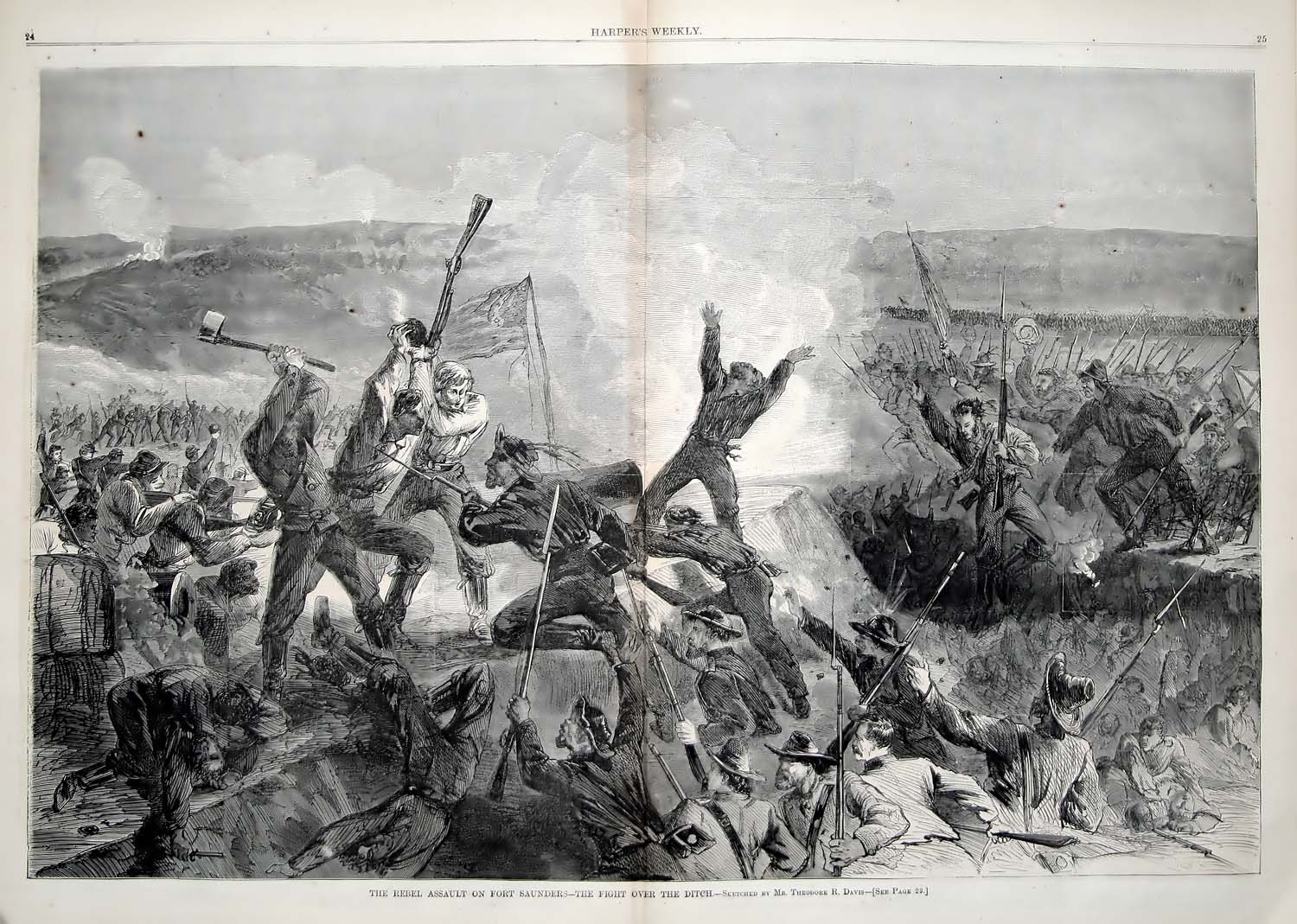
James Longstreet made his decision based on what he saw through field glasses: a Union soldier walking casually across the ditch surrounding Fort Sanders. The ditch could not be deep, he reasoned. His men could cross it easily. What Longstreet failed to notice was the plank the soldier walked upon. That small miscalculation, on the morning of November 29, 1863, would send hundreds of Confederate troops into a killing ground from which many would never emerge. In just twenty minutes of fighting outside this earthen fortification on the western edge of Knoxville, Tennessee, the Confederacy suffered one of its most devastating and disproportionate defeats of the entire war.
A Region Divided Against Itself
East Tennessee was Confederate territory that did not want to be Confederate. Unlike the plantation-heavy western and central portions of the state, East Tennessee's population consisted largely of yeoman farmers with few enslaved people and little connection to the economic engine of plantation slavery. The region held such fierce pro-Union sentiment that Tennessee furnished more volunteers for the Union Army than all other Confederate states combined, with the majority coming from these mountain communities. When Ambrose Burnside's Union forces occupied Knoxville in September 1863, the local populace offered little resistance. The terrain itself was another matter entirely -- rugged mountain roads fiercely defended by Confederate forces made the march to Knoxville a punishing ordeal for the Federal troops.
The Fort on the Hill
Union Captain Orlando M. Poe, Burnside's chief engineer, oversaw the construction of formidable earthworks around Knoxville. Fort Sanders rose just west of downtown, a salient in the defensive line that surrounded three sides of the city, originally called Fort Loudon before being renamed for Brigadier General William P. Sanders, who was mortally wounded in a skirmish on November 18, 1863. The fort was a masterwork of field engineering. Its earthen walls rose above the surrounding plateau, protected by a ditch that was wide and deep, with an almost vertical wall above it. Inside waited twelve cannons and 440 men of the 79th New York Infantry. It looked modest from a distance. Up close, it was a deathtrap for any attacking force.
Twenty Minutes of Annihilation
Longstreet, sent by Braxton Bragg to prevent Burnside from reinforcing the Union effort at Chattanooga, laid siege to Knoxville beginning November 17. He chose Fort Sanders as his breakthrough point and assembled three infantry brigades for the assault. They crept to within 120-150 yards of the fort during a night of freezing rain and snow, then attacked at dawn. The result was catastrophic. Soldiers who reached the ditch found not the shallow trench Longstreet had imagined but a deep, steep-walled trap. Without scaling ladders -- Longstreet had believed footholds could simply be dug into the walls -- the Confederates were pinned inside the ditch, exposed to withering fire from above. The entire assault, from the opening artillery bombardment to the Confederate retreat, lasted roughly forty minutes. Poe later wrote that he knew of no case in military history where a storming party had been so nearly annihilated. The Confederates suffered 813 casualties: 129 killed, 458 wounded, and 226 missing. Union losses inside the fort totaled about 13 men.
Flags of Truce and Frozen Dead
After the failed assault, Burnside extended a humanitarian gesture that the Confederates deeply appreciated: a flag of truce to allow recovery of the dead and wounded. Union details pulled bodies from the blood-stained ditch on blankets, carrying them halfway across no-man's-land for delivery. Many of the dead had stiffened in the cold, and Federal soldiers temporarily propped them against the sides of the ditch. Ninety-six bodies were recovered, mostly from inside the ditch, along with slightly more wounded, for a total of 197 men returned. Among the dead were high-ranking officers including Colonel Solon Z. Ruff and Kennon McElroy. About 250 prisoners and three battle flags remained in Union hands.
Where Victorian Homes Stand on Hallowed Ground
Longstreet withdrew from Knoxville on December 4, heading northeast toward Rogersville. His failure, combined with the Confederate defeat at Chattanooga four days earlier, secured much of East Tennessee for the Union for the remainder of the war. Three decades later, the Fort Sanders area filled with Victorian homes, many of which still stand on streets where soldiers bled. Some were incorporated into the 1982 World's Fair grounds. A hospital built in 1919 unearthed battle artifacts during its construction. Author James Agee, who grew up nearby, ended his novel A Death in the Family with a scene set overlooking the fort's ruins. Today the neighborhood houses University of Tennessee students in divided Victorian apartments, while the American Battlefield Trust works to preserve what remains of the ground where Longstreet's miscalculation turned a ditch into a grave.
From the Air
Located at 35.96°N, 83.93°W, just west of downtown Knoxville, Tennessee. The fort site is near the University of Tennessee campus, in the Fort Sanders neighborhood. From altitude, look for the cluster of Victorian-era buildings and the Fort Sanders Regional Medical Center adjacent to the UT campus. McGhee Tyson Airport (KTYS) lies approximately 12nm to the south. Downtown Knoxville's skyline and the Tennessee River are prominent landmarks for orientation. The Great Smoky Mountains rise to the southeast.