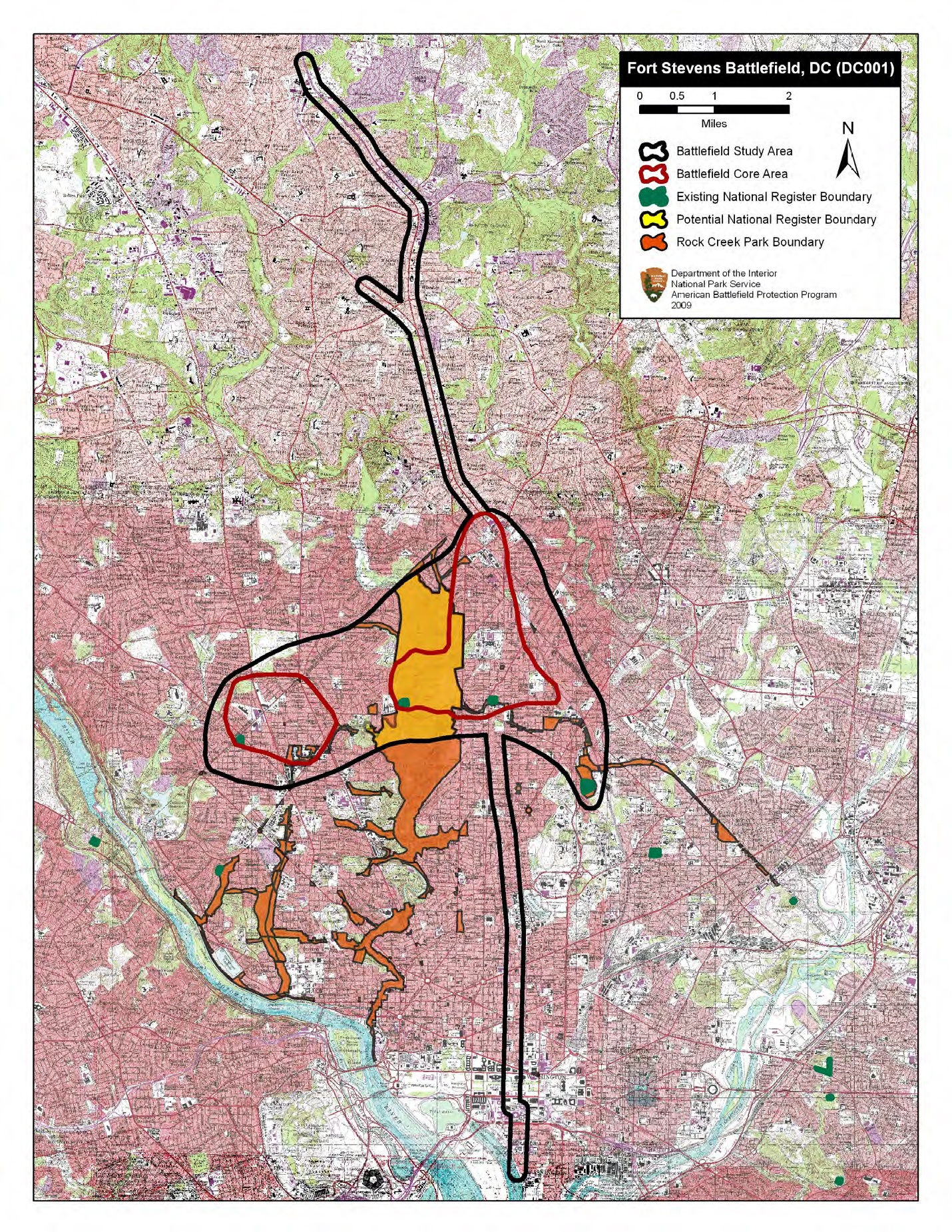
Battle of Fort Stevens
Abraham Lincoln stood on the parapet of Fort Stevens, tall and unmistakable in his stovepipe hat, as Confederate musket balls cracked through the July air. A Union surgeon standing beside the president crumpled, wounded. An officer -- possibly Captain Oliver Wendell Holmes Jr., future Supreme Court justice -- barked at the commander-in-chief to get down. It was July 1864, and the Civil War had come to the doorstep of the nation's capital. The Battle of Fort Stevens remains the only time in American history that a sitting president came under direct enemy fire during combat.
A Gambit Born of Desperation
By the summer of 1864, the Confederacy was being squeezed. Ulysses S. Grant's forces pressed Robert E. Lee's Army of Northern Virginia around Richmond, and the Union's grip tightened by the week. Lee needed a diversion. He dispatched Lieutenant General Jubal Early with the Second Corps on a daring mission: march north through the Shenandoah Valley, cross into Maryland, and threaten Washington itself. The hope was elegant in its simplicity -- force Grant to peel away troops to defend the capital, relieving the pressure on Richmond. Early moved fast, clearing Federal forces from the valley after the Battle of Lynchburg on June 18, crossing into Maryland on July 5, and turning east toward Washington. On July 9, at the Battle of Monocacy near Frederick, Maryland, Early's veterans scattered a smaller Union force under Major General Lew Wallace. The road to Washington lay open. But that fight at Monocacy cost Early a full day -- a delay that would prove decisive.
A Capital in the Crosshairs
Washington baked in a brutal heat wave -- 47 days without rain, temperatures well above 100 degrees. Members of Congress fled the city. President Lincoln stayed, though a steamer waited on the Potomac to evacuate his family if the worst came. On paper, the capital's defenses were formidable: 31,000 troops, 1,000 artillery pieces, and 160 fortifications ringing the city. The reality was far grimmer. Grant's engineering officer, General John G. Barnard, calculated that only about 9,600 troops were actually fit for duty -- raw recruits, walking wounded, and exhausted veterans. Early's approaching force of roughly 10,000 men effectively matched the usable defenders. The capital was far more vulnerable than anyone wanted to admit, and refugees from surrounding counties were already streaming through the city gates.
Whiskey, Heat, and a Lost Opportunity
Early's troops arrived at the breastworks of Fort Stevens around noon on July 11, exhausted from their long march through stifling heat. But it was not just fatigue that slowed the Confederates. Many soldiers had looted the Silver Spring mansion of Montgomery Blair, son of the town's founder, and discovered barrels of whiskey in the basement. A significant number of Early's men were too drunk to fight that morning. Meanwhile, steamships carrying the Union's VI and XIX Corps -- veteran reinforcements dispatched by Grant -- began docking in Southeast Washington at almost the exact moment Early's scouts reached the fort. The window for a Confederate assault was closing fast. Skirmishing began around 3 p.m. on July 11, with Confederate forces probing Union lines. By 5 p.m., cavalry clashed and artillery from the fort shelled buildings where Confederate sharpshooters had taken cover. The fighting continued into the evening, but Early had lost his best chance.
The President Under Fire
Lincoln rode out to Fort Stevens to observe the fighting -- an extraordinary act for a wartime head of state. Standing on the parapet in full view of Confederate marksmen, the president watched the skirmishing unfold. When a surgeon beside him was hit, Lincoln was ordered to take cover. The skirmishing continued into July 12, when Early concluded that Washington could not be taken without catastrophic losses. A final Union counterattack that afternoon, led by the VI Corps brigade of Daniel Bidwell, drove Confederate sharpshooters from their positions at a cost of over 300 Union casualties. That evening, Early withdrew. He later remarked to an officer, "Major, we didn't take Washington, but we scared Abe Lincoln like hell." The Confederates retreated through Montgomery County, crossing the Potomac on July 13 at White's Ferry into Virginia, taking their plundered supplies with them.
Hallowed Ground in the Suburbs
Fort Stevens stands today near 13th Street NW in the Brightwood neighborhood, maintained by the National Park Service as part of the Civil War Defenses of Washington. It is the only surviving portion of the battlefield -- the rest was developed after 1925. Two weeks after the fighting, the Battleground National Cemetery was established nearby at 6625 Georgia Avenue NW, where 40 Union soldiers killed in the battle rest. Seventeen Confederate dead were buried at Grace Episcopal Church in Silver Spring, at the intersection of Georgia Avenue and Grace Church Road, interred through the efforts of the Reverend James B. Avirett. The site where Lincoln stood under fire is now surrounded by residential streets and neighborhood shops, a quiet corner of Northwest Washington that gives little hint of the July afternoon when the fate of the capital hung in the balance.
From the Air
Fort Stevens sits at 38.964°N, 77.029°W in the Brightwood neighborhood of Northwest Washington, D.C. From the air, look for the rectangular park along 13th Street NW between Rittenhouse and Quackenbos Streets. The Battleground National Cemetery is visible about a half-mile south on Georgia Avenue NW. Nearby airports include Ronald Reagan Washington National (KDCA, 7 nm south) and College Park Airport (KCGS, 8 nm northeast). Best viewed at 2,000-3,000 ft AGL. The ring of Civil War fortification sites around D.C. is discernible as a chain of small parks.