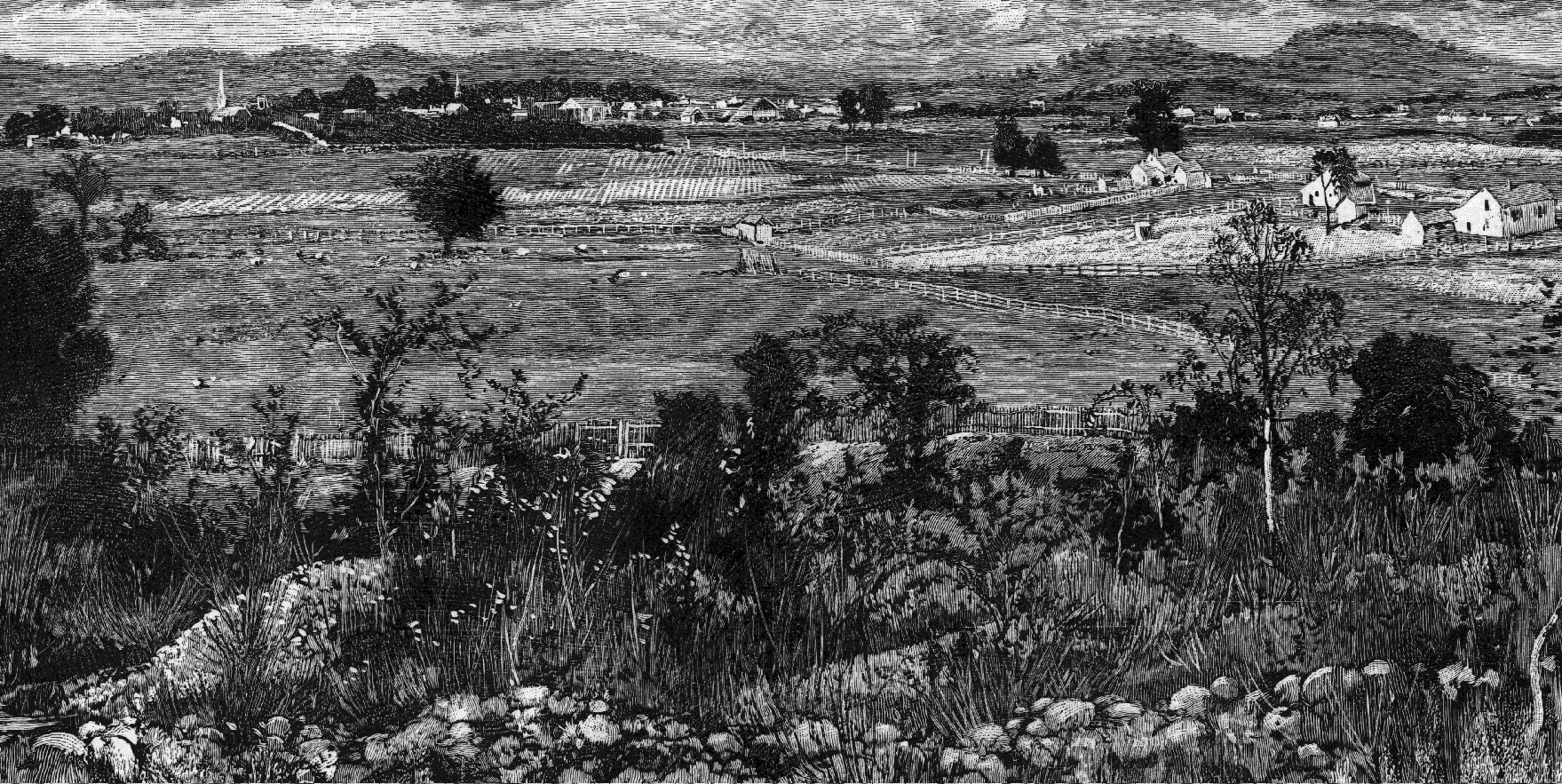
Battle of Franklin
Patrick Cleburne studied the Union fortifications through his field glasses and knew what lay ahead. Turning to Brigadier General Daniel Govan, he said quietly, "Well, Govan, if we are to die, let us die like men." Within hours, Cleburne -- widely considered the finest division commander on either side of the war -- lay dead on a field south of Franklin, Tennessee, one of six Confederate generals killed on the afternoon of November 30, 1864. The Battle of Franklin lasted barely five hours, but it inflicted wounds on the Confederate Army of Tennessee from which it never recovered. Fourteen generals fell as casualties. Fifty-five regimental commanders went down. An entire army's leadership was gutted in a single twilight assault that veterans would remember as the most savage close-quarters combat they ever witnessed.
A Plan Scripted in Never-Never Land
The road to Franklin began with desperation. After losing Atlanta to Sherman, Confederate Lieutenant General John Bell Hood -- physically battered by wounds that had cost him the use of an arm and a leg -- conceived an audacious plan: march north into Tennessee, defeat scattered Union forces before they could concentrate, seize Nashville, press on into Kentucky, and eventually link up with Robert E. Lee in Virginia. Historian James M. McPherson called this scheme "scripted in never-never land." Hood's 39,000 men would face 60,000 Union troops in Tennessee. Yet Hood marched north from Florence, Alabama, on November 21, moving fast enough to nearly catch the Union forces by surprise. At Spring Hill on November 29, he had a golden opportunity to cut off and destroy Major General John Schofield's retreating columns. Through a bewildering series of command failures, the Confederates let the entire Union force slip past them in the darkness.
Sunset at Four-Thirty
Hood's army arrived on Winstead Hill, two miles south of Franklin, around 1:00 PM on November 30. Schofield's men had been fortifying since dawn, their backs to the Harpeth River while engineers frantically rebuilt bridges for their planned withdrawal to Nashville. Hood ordered a frontal assault despite the protests of his generals. Forrest argued he could flank the enemy within an hour if given infantry support. Cheatham told Hood plainly, "I do not like the looks of this fight." But Hood was done with maneuver. Sunset would come at 4:34 PM. At 4:00, nearly 20,000 Confederates stepped off across two miles of open ground with almost no artillery support, advancing toward earthworks bristling with defenders, some armed with sixteen-shot Henry repeating rifles that could fire thirty rounds per minute.
The Breach at the Carter House
The initial Confederate wave overran two exposed Union brigades, and the fleeing Federal soldiers stampeded back toward their own lines with Confederates on their heels, shouting "Go into the works with them!" At the Columbia Pike, where a gap had been left in the Union defenses for wagon traffic, the Confederates punched through. For a few desperate minutes, they held a fifty-yard breach in the center of the Federal line, right at the Carter House. What followed was combat so ferocious that veterans who had fought since Shiloh said they had never seen anything like it. Men fought with bayonets, rifle butts, entrenching tools, axes, and picks. Colonel Emerson Opdycke, who had ignored his superior's orders and kept his brigade in reserve, launched a furious counterattack that sealed the breach. Officers fought hand-to-hand alongside their men. Arthur MacArthur, shot from his horse, ran a Confederate officer through with his sword. Opdycke emptied his pistol, used it as a club until it broke, then grabbed a musket and kept swinging.
The Generals Who Fell
The toll on Confederate leadership was staggering. Six generals killed outright: Cleburne, John Adams, Hiram Granbury, States Rights Gist, Otho Strahl, and John C. Carter, who lingered until December 10. Seven more were wounded; one was captured. Fifty-five regimental commanders were casualties. Brigadier General John Adams died trying to rally his men by galloping his horse directly onto the Union earthworks; both rider and horse were shot dead as Adams reached for a Federal battle flag. Major General William Loring, watching his brigade falter, shouted "Great God! Do I command cowards?" and sat motionless on his horse in full view of Federal guns for over a minute, somehow emerging unscathed. Among the dead was also Tod Carter, a Confederate soldier wounded just a few hundred yards from the family home he had left three years earlier. Found by his family after the battle, he died the next morning.
A House Full of Bullet Holes
Schofield withdrew across the Harpeth that night and reached Nashville. Hood, with an army now reduced to 26,500 men, followed him there and was crushed by George Thomas on December 15-16, retreating to Mississippi with barely 20,000 men. The Army of Tennessee never fought effectively again. Today in Franklin, the Carter House still stands at the center of where the Union line held. Its walls are riddled with hundreds of bullet holes. Carnton Plantation, which served as the largest field hospital after the battle, is also open to visitors. Adjacent to it lies the McGavock Confederate Cemetery, where 1,481 Southern soldiers are buried. The spot where Cleburne fell was covered until 2005 by a Pizza Hut -- since demolished and replaced by Cleburne Park, part of a growing effort to reclaim and preserve the ground where an army destroyed itself in a single autumn twilight.
From the Air
Located at 35.92°N, 86.87°W, in Franklin, Tennessee, about 18 miles south of Nashville. The battlefield is largely absorbed into the modern city, but the Carter House and Carnton Plantation are visible landmarks. Winstead Hill, where Hood watched the assault, rises two miles south of the town center. The Harpeth River curves around the northern edge of the old battlefield. Nashville International Airport (KBNA) is approximately 20nm to the northeast. The terrain is gently rolling with no major elevation changes -- the open ground the Confederates crossed is still identifiable from altitude.