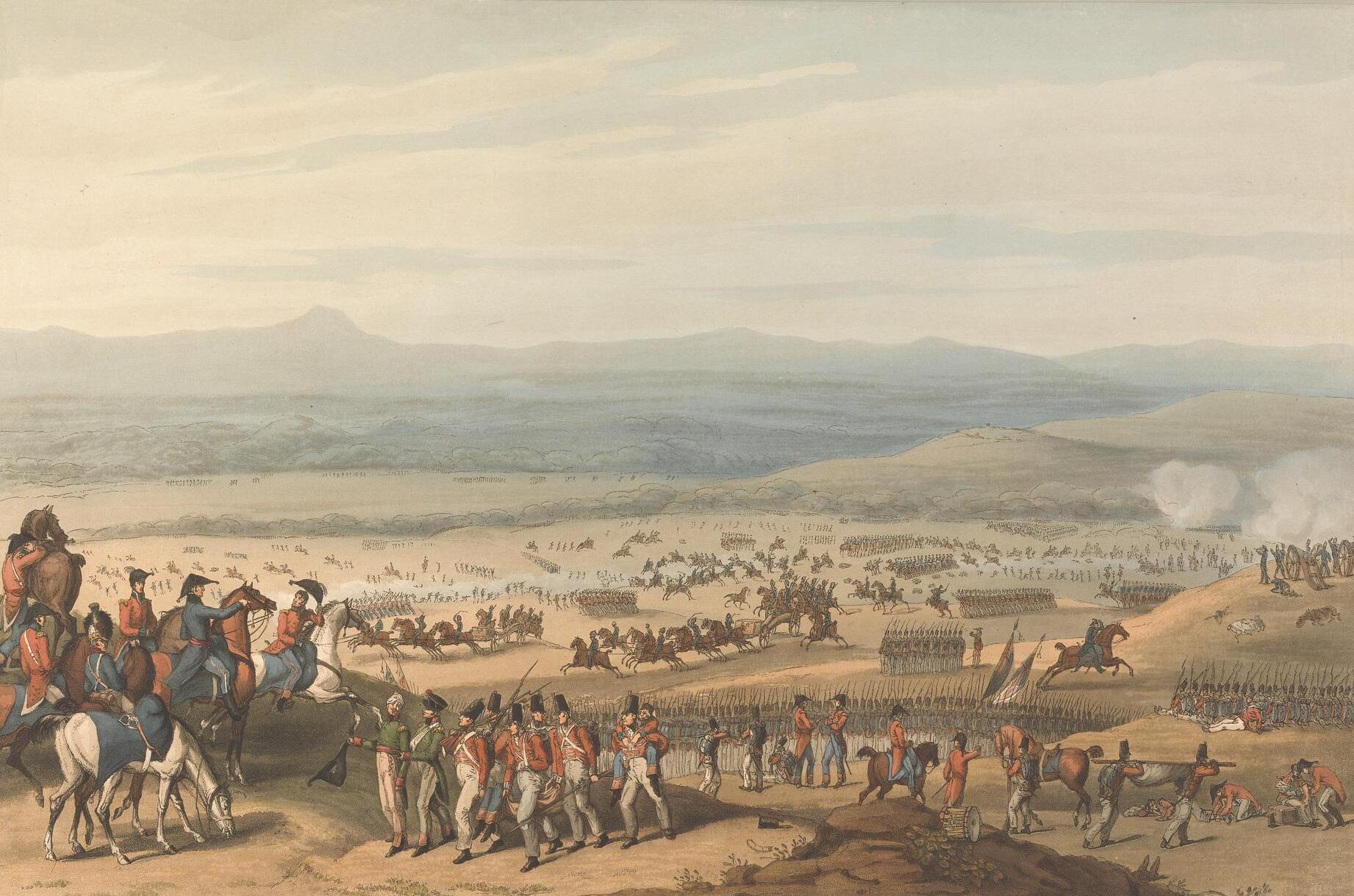
Battle of Fuentes de Onoro
"If Boney had been there, we should have been beat." Wellington's own assessment of Fuentes de Onoro was not the boast of a victorious general but the frank admission of a man who understood how close he had come to disaster. Over three days in May 1811, on the Spanish frontier near Almeida, his 36,000 Anglo-Portuguese troops fought off 47,000 French soldiers in a battle shaped as much by betrayal among the French high command as by British courage. The engagement is even inscribed on the Arc de Triomphe in Paris -- listed, erroneously, as a French victory.
The Stakes at Almeida
By spring 1811, Wellington had driven Massena's battered Army of Portugal back from Lisbon after its miserable winter outside the Lines of Torres Vedras. With Portugal secured, Wellington turned to recapturing the fortified frontier cities that controlled the invasion corridors between Portugal and Spain. Almeida, its French garrison blockaded, was the immediate objective. Massena, determined to relieve his trapped men, reformed his army and marched west with a significant advantage in both infantry and cavalry. Wellington chose to make his stand at the village of Fuentes de Onoro, where a chain of heights overlooked the gorge of the Dos Casas River. It was a gamble: to cover all approaches to Almeida, he had to leave his own line of retreat exposed. He accepted the risk because he knew the French had only a few days' supplies while his own stocks were deeper.
Streets Turned Red
The first day's fighting, 3 May, was a brutal village brawl. Massena threw Ferey's and Marchand's infantry divisions into the barricaded streets of Fuentes de Onoro, where low stone walls gave the British defenders natural cover while funneling the French attackers into killing zones. The redcoats of the 1st and 3rd Divisions were driven back under enormous pressure before men of the 71st Highland Light Infantry led a countercharge that reclaimed the lost ground. By sunset, the village remained in British hands, the French having suffered 650 casualties to 250 British. Both armies spent 4 May licking their wounds, but a French reconnaissance revealed that Wellington's right flank, near the hamlet of Poco Velho, was dangerously weak.
Treachery and Lost Opportunity
Dawn on 5 May brought Massena's masterstroke: a heavy cavalry and infantry assault on Wellington's exposed right flank. The 7th Division was nearly overwhelmed before the elite Light Division executed a textbook fighting withdrawal, leapfrogging backward under mutual cover of cavalry charges and infantry squares. It was during this crisis that Massena spotted his chance to deliver a decisive blow. He dispatched an aide to bring forward 800 Imperial Guard cavalry held in reserve. The aide galloped to General Lepic, the Guard's second-in-command, who flatly refused. He would take orders only from Marshal Bessieres, the Guard's commander. Bessieres, in a staggering display of indifference, was elsewhere inspecting ditches the army had crossed days earlier. By the time anyone found him, the moment had passed. Massena, watching his aide return without a single horseman following, could only rage at the opportunity lost to internal politics.
The Village Holds
Massena still believed he could win by taking Fuentes de Onoro itself. Fresh columns of grenadiers from d'Erlon's IX Corps surged into the village, their bearskin hats causing the British to mistake them for the feared Imperial Guard. The attack overran most of the village before Wellington launched his counterattack, spearheaded by the 88th Connaught Rangers and Portuguese Cacadores. Fighting devolved into hand-to-hand combat in the narrow streets. A party of 100 French grenadiers, trapped and surrounded, was killed to a man. By sunset, French companies had been reduced to 40 percent strength, and their artillery ammunition was running dangerously low. Massena paraded his army before the British position for three more days, then withdrew to Ciudad Rodrigo.
An Honest Reckoning
Wellington did not claim Fuentes de Onoro as a victory. French losses ranged from 2,200 to 2,800 against roughly 1,800 Anglo-Portuguese casualties, but the outcome felt more like survival than triumph. The aftermath brought its own frustrations: two nights after Massena withdrew, the 1,400-man French garrison of Almeida slipped through the British lines in darkness, most escaping when their pursuers stumbled into an ambush. Wellington was furious. Massena, meanwhile, was recalled to Paris by Napoleon, setting off with a vast fortune looted from the Peninsula. The old marshal complained that Wellington "had not left him one black hair on his body -- he had turned grey all over." Wellington's troops, for their part, voluntarily raised money to compensate the villagers of Fuentes de Onoro for the destruction of their homes. It was a small gesture of decency after three days of carnage.
From the Air
Located at 40.58N, 6.82W on the Spanish-Portuguese border, in the province of Salamanca. The village sits along the Dos Casas River gorge with heights to the west. Nearest airports include Salamanca (LESA) approximately 100 km east. The terrain is rolling plateau at roughly 700 m elevation with sparse vegetation. The frontier fortress town of Almeida is visible approximately 20 km to the west in Portugal.