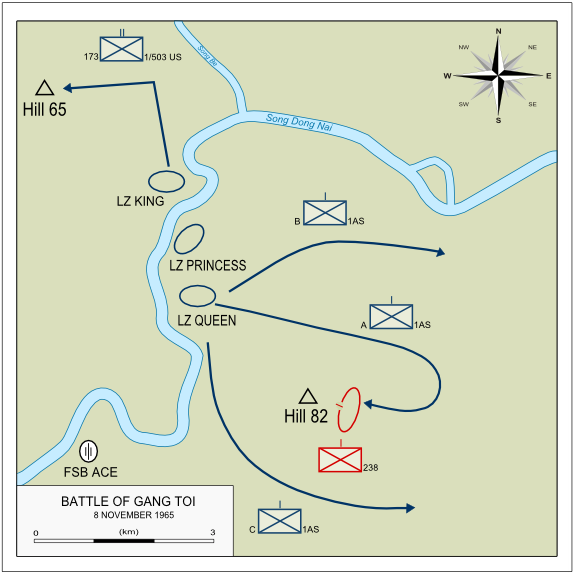
Battle of Gang Toi
For forty-two years, Private Richard Parker and Private Peter Gillson lay in a shallow weapon pit on a jungle hilltop in Bien Hoa Province, buried by the Viet Cong soldiers who had killed them. Their comrades in A Company, 1st Battalion, Royal Australian Regiment never stopped wanting to go back. On 8 November 1965, in the Gang Toi Hills north of Saigon, Australia fought its first set-piece battle of the Vietnam War. It was fierce, costly, and ended with a withdrawal that left two men behind -- a fact that haunted the survivors for decades.
New Troops in an Old War
By mid-1965, the situation in South Vietnam was deteriorating rapidly. The Army of the Republic of Vietnam had suffered successive defeats, Saigon itself was threatened, and General William Westmoreland was requesting ever more troops. Australia's initial commitment had been modest -- a small advisory team sent in 1963 to train South Vietnamese forces. But in June 1965, the government dispatched the 1st Battalion, Royal Australian Regiment, some 1,400 regular soldiers, to join the US 173rd Airborne Brigade at Bien Hoa. Unlike later Australian units that included conscripts, 1 RAR was entirely professional. Attached to American forces, they adopted the new doctrine of airmobile operations: helicopter insertion, artillery support from fire bases, rapid extraction. It was a style of warfare the battalion would test under fire at Gang Toi.
Into the Swamps of War Zone D
Operation Hump -- named to mark the halfway point of the 173rd Airborne Brigade's tour -- launched on 5 November 1965. The plan was straightforward: insert 1 RAR south of the Dong Nai River and the American 1st Battalion, 503rd Infantry to the northwest, then sweep through a suspected Viet Cong stronghold. The operation started badly. A large VC force was spotted near the Australian landing zone, forcing D Company under Captain Peter Rothwell to divert to an alternate site. Once on the ground, 1 RAR's companies dispersed to search their sectors individually -- a decision that would maximize ground covered but limit their ability to concentrate firepower if trouble found them. For two days the Australians patrolled through leech-infested swamps and dense jungle, encountering scattered contacts. Documents recovered from dead VC scouts revealed plans for attacks on bases near Bien Hoa. Something large was nearby.
Fifteen Metres from the Bunkers
On the morning of 8 November, with the operation winding down and extraction planned for the following day, A Company under Major John Healy set out on a compass bearing across the Gang Toi plateau. A lone VC scout was spotted shadowing them and shot. The Australians uncovered a company-sized camp of dugouts, then pushed uphill in single file toward the hilltop. At 16:30, the lead section of 1 Platoon crested the ridge and walked into a storm of machine-gun fire from concealed bunkers. Five men fell in the first minute. Private Richard Parker dropped directly in front of the enemy position, exposed and beyond reach. Behind the shattered lead platoon, 3 Platoon under Second Lieutenant Clive Williams swung left and advanced to within fifteen metres of the bunkers before being stopped by interlocking fields of fire. Machine-gunner Peter Gillson was hit as he tried to maneuver around a tree root; two VC rushed forward to seize his M60, but Gillson killed them both at point-blank range before collapsing. Sergeant Colin Fawcett crawled forward under heavy fire to reach him, found no pulse, and tried three times to drag the body free. Each attempt was driven back. Fawcett was later awarded the Military Medal.
The Weight of Withdrawal
With two platoons pinned down and the remaining rifle companies kilometres away, Healy had no reinforcements to call upon. The artillery, positioned on the far side of the plateau, was firing blind -- Captain Bruce Murphy, a New Zealand forward observer, had to walk the rounds onto target by sound alone, knowing a slight miscalculation would drop shells on his own men. His calm precision under persistent rifle fire earned him the Military Cross. By 18:30, after more than two hours of fighting, darkness was closing in. Healy ordered the withdrawal. Carrying their wounded, the Australians broke contact under the cover of artillery fire. Parker and Gillson stayed where they fell. Lieutenant Colonel Brumfield, the battalion commander, immediately began planning a return operation to recover the bodies and destroy the bunker system. But across the Dong Nai River, the American 1/503rd had walked into their own catastrophic ambush -- 49 killed, 83 wounded in close-quarters fighting that included hand-to-hand combat with bayonets. Every available helicopter was needed for casualty evacuation. The planned return to Gang Toi was cancelled. It was never conducted.
Forty-Two Years to Come Home
The Battle of Gang Toi cost A Company two missing and six wounded against at least six VC killed, one wounded, and five captured. The numbers were modest by Vietnam War standards, but the human weight was not. The men of 1 RAR carried the knowledge that they had left comrades behind -- soldiers whose bodies were wedged in tree roots and weapon pits on a hilltop they were never allowed to revisit. In 2007, Jim Bourke, a veteran who had been decorated with the Medal of Gallantry, led a team of volunteers back to the Gang Toi Hills. They found Parker and Gillson together in a weapon pit, buried hastily by the VC the day after the battle. With the cooperation of the Australian and Vietnamese governments, the remains were returned to Australia for burial. More than four decades after the fighting, the two soldiers finally came home.
From the Air
Located at 11.06N, 106.97E in the Gang Toi Hills, northern Bien Hoa Province (now Dong Nai Province), approximately 40 km north-northeast of Ho Chi Minh City. The terrain is dense jungle-covered hills rising above river valleys. Bien Hoa Air Base (VVBH) is approximately 20 km to the south. The Dong Nai River is a major visual landmark running through the area. From altitude, the Gang Toi plateau is visible as a forested ridge system amid agricultural lowlands.