Battle of Gawok
Prince Diponegoro blamed the loss on a woman. In his memoirs, the Babad Dipanegara, written years after the war's end, the Javanese rebel prince attributed his defeat at Gawok partly to divine punishment for a sexual encounter with a Chinese prisoner shortly before the battle. Whatever spiritual framework he imposed on the events, the military facts were blunt: on the morning of October 15, 1826, Diponegoro's army was routed outside Surakarta, and the Java War pivoted from open rebellion to guerrilla survival. The battle lasted only hours. Its consequences lasted years.
A Prince on the March
By mid-1826, Diponegoro's rebellion against Dutch colonial rule was at its high-water mark. His forces had won a string of victories north of Yogyakarta, and the prince had captured the town of Delanggu, linking up with another rebel army under the religious leader Kyai Maja. Their combined force set its sights on Surakarta -- the headquarters of General Hendrik Merkus de Kock and the center of Dutch military power in Central Java. But momentum stalled. After taking Delanggu, Diponegoro hesitated, troubled by the stiff resistance he had encountered there. Kyai Maja pushed for an immediate assault; Diponegoro held back. Three weeks of inaction followed, a pause that cost the rebels dearly. The Dutch used the lull to recall scattered columns from Yogyakarta and Surakarta, assembling a concentrated force. Reinforcements arrived from the Netherlands. By the time Diponegoro encamped at the village of Gawok, roughly 13 kilometers west-southwest of Surakarta, the window of easy opportunity had closed.
Before Dawn at Baki
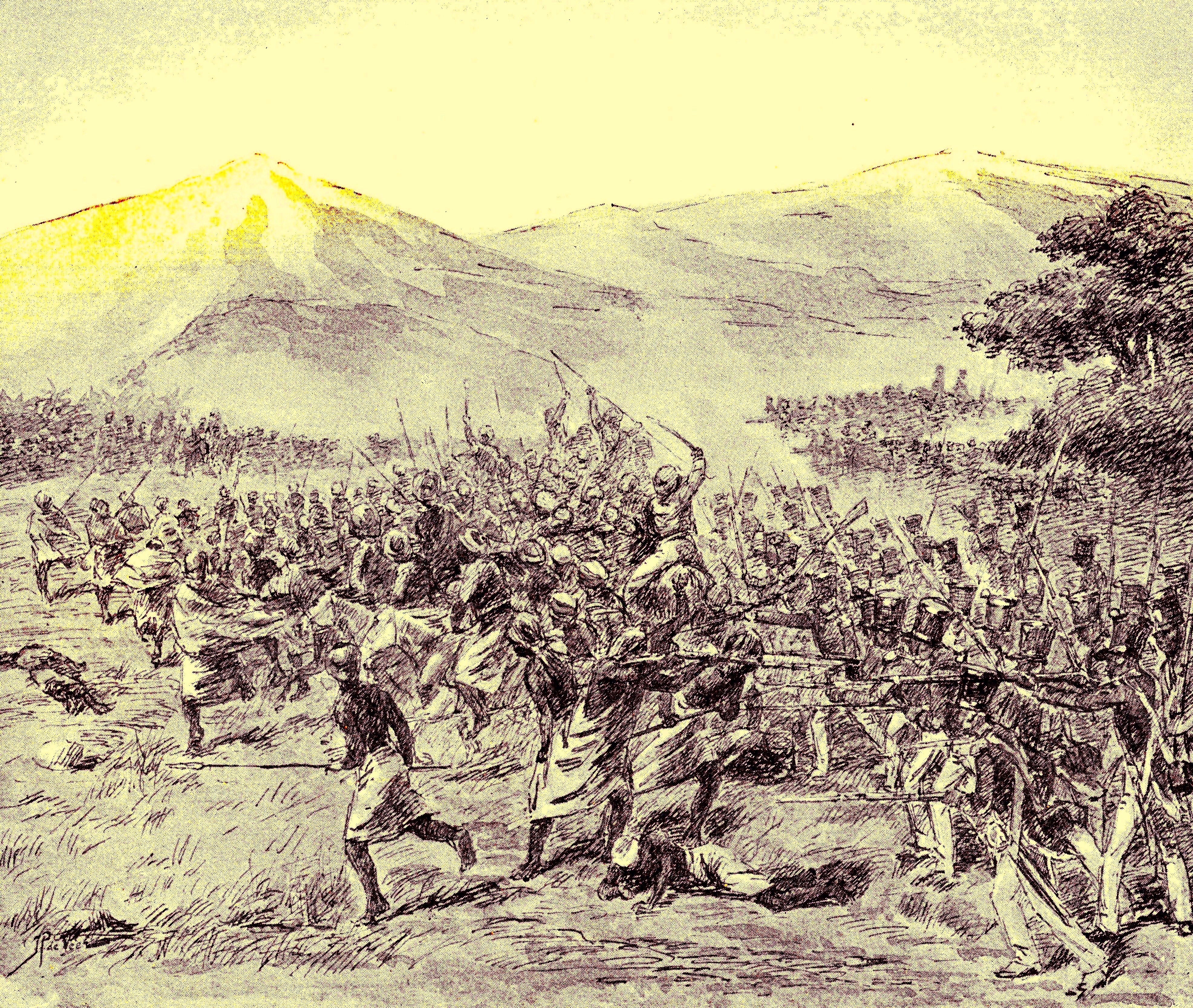
The armies were mismatched in numbers, though not in the way that guaranteed victory. Diponegoro's force at Gawok numbered around 4,000 by Dutch estimates, though one colonial account inflated the figure to 25,000 or 30,000 -- a likely exaggeration. The Dutch had assembled roughly 1,000 troops from two recalled columns, reinforced by 300 men from the Sunanate of Surakarta, 150 from the local Dutch garrison, and additional soldiers from Javanese leaders loyal to the colonial government. Fighting erupted at four in the morning on October 15th, when one Dutch column stumbled into Diponegoro's forces near the hamlet of Baki. The other column, under Major Le Bron de Vexela, received a signal for reinforcements and force-marched to the battlefield, arriving around 7:30 AM. Le Bron ordered a charge by a company of Ambonese troops -- soldiers from the eastern Indonesian island recruited into colonial service -- that pushed the rebels back. A general attack followed. When Diponegoro's men attempted a counter-charge, Mangkunegaran troops repelled it, and the rebel lines collapsed.
The Prince Falls From His Horse
Diponegoro fought in the thick of it and nearly died. He was shot at least twice: once above the chest, where the bullet bounced off, and once in the right hand, where it fragmented. Cannonball shrapnel struck him as well, knocking him from his horse. Dutch accounts claimed they left the field with virtually no Javanese opposition remaining. The rebel losses were devastating -- not just in numbers but in composition. The core of Diponegoro's army, the experienced fighters who had carried the rebellion from victory to victory across central Java, was destroyed in a single morning. The prince himself had to be carried from the battlefield on a stretcher, and he would rarely lead from the front again.
Blame and Fracture
Defeat has many authors. In the aftermath of Gawok, Diponegoro's coalition splintered along its natural fault lines. The aristocratic supporters -- Javanese nobility who had rallied to the prince's banner -- blamed the santri, the devoutly religious faction, for the disaster. Kyai Maja bore particular scorn for having advocated the offensive that led to the battle. The recriminations ran deep enough to weaken the already damaged movement from within. Diponegoro's own explanation, confided to his memoir, reached for the metaphysical rather than the tactical: he saw his lapse with the Chinese prisoner as a moral failing that invited divine retribution. Whether this was genuine belief or a way of processing the unbearable, it reflected a worldview in which warfare and spiritual purity were inseparable -- a worldview that the Dutch, with their columns and their Ambonese mercenaries and their artillery, did not share.
From Battlefield to Jungle
Gawok ended the Java War as an open contest. Having lost their numerical superiority and their most experienced fighters, the rebels could no longer mass armies and attack fortified positions. The war continued for nearly four more years, but as guerrilla warfare -- ambushes, raids, and retreats through the forested interior of Java. The Dutch responded with a methodical system of fortified outposts, the stelsel benteng, that gradually constricted the rebels' freedom of movement. Diponegoro was finally captured through deception in 1830, lured to a negotiation at Magelang and arrested. He spent the remaining 25 years of his life in exile. Today, the village of Gawok sits quietly west of Surakarta, absorbed into the suburban sprawl of one of Java's major cities. No monument marks the field where a pre-dawn battle broke the back of a rebellion, though Diponegoro himself became a national hero of Indonesia -- honored not for winning, but for resisting.
From the Air
The Battle of Gawok took place near 7.60S, 110.75E, approximately 13 km west-southwest of central Surakarta (Solo), Central Java. From the air, the area is now developed suburban landscape in the greater Solo metropolitan area. The nearest major airport is Adisumarmo International Airport (ICAO: WARQ), roughly 10 km northwest of Surakarta. The village of Baki, where fighting began, lies between Gawok and the city. At lower altitudes, the flat Javanese plains surrounding Surakarta are visible, with the volcanic peaks of Merapi and Merbabu rising to the west and northwest.