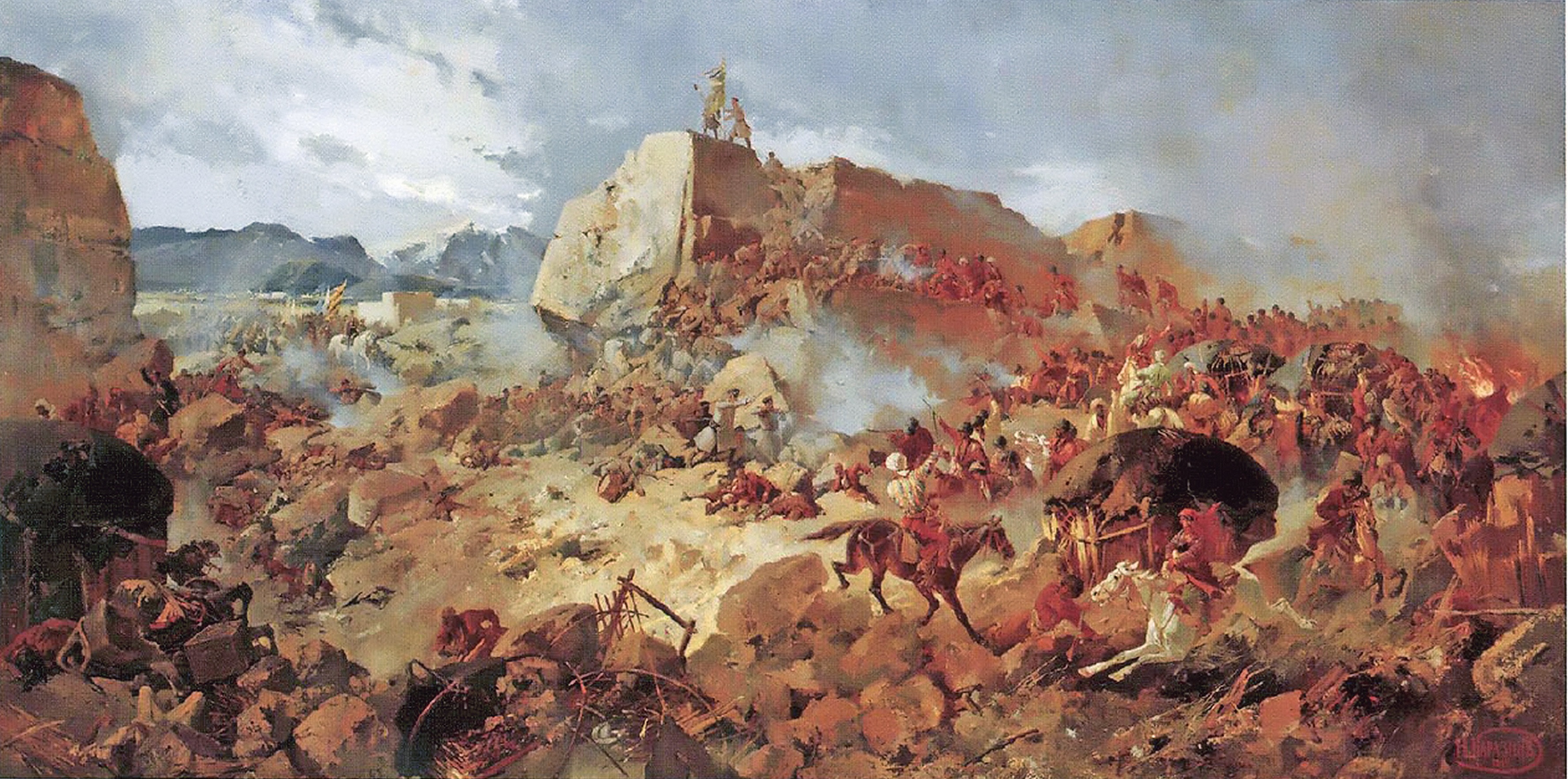
Battle of Geok Tepe: The Fall of the Blue Hill
Skobelev's official report contains a sentence that reads like an accountant's summary of annihilation: "After the capture of the fortress, 6,500 bodies were buried inside it. During the pursuit 8,000 were killed." Those fourteen thousand dead were mostly Teke Turkmens -- men, women, and children -- cut down by Russian cavalry as they fled across the desert from a fortress called Geok Tepe, the Blue Hill. The siege that ended on January 24, 1881, lasted less than a month. Its consequences lasted forever. It gave the Russian Empire control of what is now Turkmenistan and nearly completed the conquest of Central Asia. In Turkmenistan today, the date is observed as a national day of mourning.
An Oasis Surrounded by Nothing
The Akhal Oasis stretches along the northern edge of the Kopet Dagh mountains in southern Turkmenistan, a ribbon of irrigated farmland sustained by streams flowing down from the peaks. In 1880, this was the heartland of the Teke Turkmens, a nomadic and agricultural people who had already beaten back one Russian invasion in 1879. That earlier defeat had embarrassed the empire. General Lomakin's hastily organized column -- Lazarev, the original commander, had died of cholera en route -- had advanced too quickly, outrun its supplies, and been repulsed at the very same fortress. Russia does not accept such outcomes. In March 1880, General Mikhail Skobelev, one of the empire's most aggressive and capable commanders, was given charge of the Trans-Caspian region with clear orders: take Geok Tepe, whatever the cost.
The Slow Advance
Skobelev understood that the desert itself was the enemy. Several hundred kilometers of semi-arid wasteland separated the Caspian coast from the oasis, and an army cannot fight if it cannot eat. He chose the fortress at Bami, on the north side of the Kopet Dagh, as his forward base and began a methodical buildup that consumed most of the year. Camels carried the supplies. Thousands of them died along the route, their carcasses marking the path like milestones. By December, Skobelev had assembled roughly 4,000 infantry, 750 cavalry, artillery batteries, rockets, machine guns, and heliographs for signaling across the empty landscape. On December 27, Aleksey Kuropatkin arrived with five additional companies after a remarkable forced march across the desert from Khiva. The army was ready.
Siege in the Desert
The fortress was formidable. Mud walls eighteen feet thick and ten feet high enclosed more than a square mile of ground. A dry ditch four feet deep ringed the exterior. Inside sheltered an estimated 40,000 Teke, including families -- the entire community had gathered behind the walls. Skobelev occupied the nearby village of Yanghi-Kala on January 1, 1881, cutting off the fortress's water supply. He chose the southeast corner as his point of attack. Over the following days, his engineers dug approach trenches in the classic European siege tradition, first parallel at 700 yards, then closer. The Teke fought back hard. Sorties on January 9, 11, and 16 inflicted casualties and forced Skobelev to reposition his camp twice. General Petrushevich was killed leading an assault on a small outwork. But the Russians held enough men to maintain siege lines on the southeast, even as the Teke moved freely through the unguarded northern walls.
Twenty-Six Hundred Pounds of Powder
On January 18, Russian sappers began tunneling beneath the southeastern wall. Two days later, artillery blasted a breach in the southern face, but the Teke repaired it overnight. By January 23, the mine shaft was complete, packed with 2,600 pounds of black powder. At seven o'clock the next morning, every Russian gun opened fire. At 11:20, the mine detonated. The explosion tore a gap 140 feet wide in the fortress wall. Kuropatkin led eleven and a half companies through the breach. A simultaneous assault on the southern wall stalled -- the breach there was too narrow -- but reserves with scaling ladders eventually forced their way over. The two assault groups linked up inside the walls. On the western side, another column scaled the fortifications. By afternoon, the Teke were streaming over the north wall in retreat. Russian cavalry pursued them for sixteen kilometers across open ground. Nightfall was the only thing that stopped the killing.
A Mourning That Endures
Skobelev reported 59 Russians killed and 304 wounded in the final assault. Teke losses were estimated at 20,000 people -- the dead inside the fortress, the dead in the pursuit, and those described in his own report as killed persons "of both sexes." The Russians had massacred all Turkmen males who failed to escape, sparing roughly 5,000 women and children. They freed about 600 Persian slaves found inside the walls. Six days later, Russian forces occupied Ashgabat without resistance. Skobelev was quietly removed from command, likely because even the imperial government found the scale of civilian slaughter difficult to justify. On May 6, 1881, Transcaspia was declared an oblast of the Russian Empire. In the 1990s, independent Turkmenistan built a mosque at the site to honor the defenders. The resistance at Geok Tepe is remembered not as a defeat but as a statement -- that the Teke fought, that they refused to yield, and that their sacrifice matters to the nation that eventually emerged from the empire that destroyed them.
From the Air
Located at 38.16°N, 57.97°E in the Akhal region of Turkmenistan, along the northern edge of the Kopet Dagh mountain range. The site sits in the Akhal Oasis, a narrow strip of irrigated land between mountains and desert. The Saparmyrat Hajji Mosque, built in the 1990s to commemorate the battle, is a prominent landmark with its blue dome and four 63-meter minarets visible from altitude. Ashgabat, the capital, lies approximately 45 km to the southeast. Nearest major airport is Ashgabat International (UTAA). Best viewed at 3,000-5,000 feet AGL; the contrast between the green oasis and surrounding desert terrain makes the area easy to identify.