Battle of Gergovia
Julius Caesar lost here. That single fact has echoed through two millennia of French history, turning a hilltop plateau near Clermont-Ferrand into a national symbol. In 52 BC, the Arverni chieftain Vercingetorix lured Caesar's legions into an assault on Gergovia, his people's fortified capital, and then crushed them with a cavalry charge that sent Rome's finest soldiers fleeing downhill. It was one of the few clear defeats Caesar suffered during his eight-year conquest of Gaul, and he knew it stung enough to minimize his losses when he wrote about it afterward.
The Trap on the Plateau
Gergovia occupied a natural fortress: a plateau standing 360 meters above the surrounding plain, 1,500 meters long by 700 meters wide, with a single approach that a small body of troops could hold against an army. Vercingetorix exploited every advantage of the terrain. After Caesar besieged and captured Avaricum to resupply his forces, the Roman general sent his top legate Titus Labienus north with four legions to keep the northern Gauls from interfering, then marched toward Gergovia with the remainder. Vercingetorix anticipated the move, crossed the Allier River and began mirroring Caesar's march along the opposite bank, systematically destroying bridges to prevent a crossing.
Miscommunication and Rout
Caesar managed to cross the river through a ruse, but the assault on Gergovia went badly wrong. Miscommunication among Roman units turned what was meant to be a limited engagement into a chaotic uphill charge against prepared Gallic positions. When the noise of the fighting alerted Vercingetorix, he led a cavalry counterattack that shattered the Roman lines. Warriors dismounted and joined the infantry in pressing the advantage. Caesar's own account records 46 centurions and 700 legionaries killed, but modern historians regard these figures with skepticism. Given that 20,000 to 40,000 allied soldiers were deployed and the battle was described as a rout, the actual losses were likely far higher — Caesar had every reason to minimize a defeat in his own memoirs.
From Defeat to Decisive Victory
Caesar retreated northeast toward Aedui territory, and Vercingetorix pursued, intent on destroying the Roman army entirely. After linking up with Labienus's returning corps at Agedincum, Caesar confronted Vercingetorix's forces at the Battle of the Vingeanne and won. He then chased the Gallic leader to Alesia, where a massive siege ended in Vercingetorix's surrender and the effective conquest of Gaul. Gergovia itself remained an influential stronghold for decades under Roman control, but by AD 10-20 the local capital shifted to Augustonemetum — the settlement that would eventually become Clermont-Ferrand.
A Victory That Still Matters
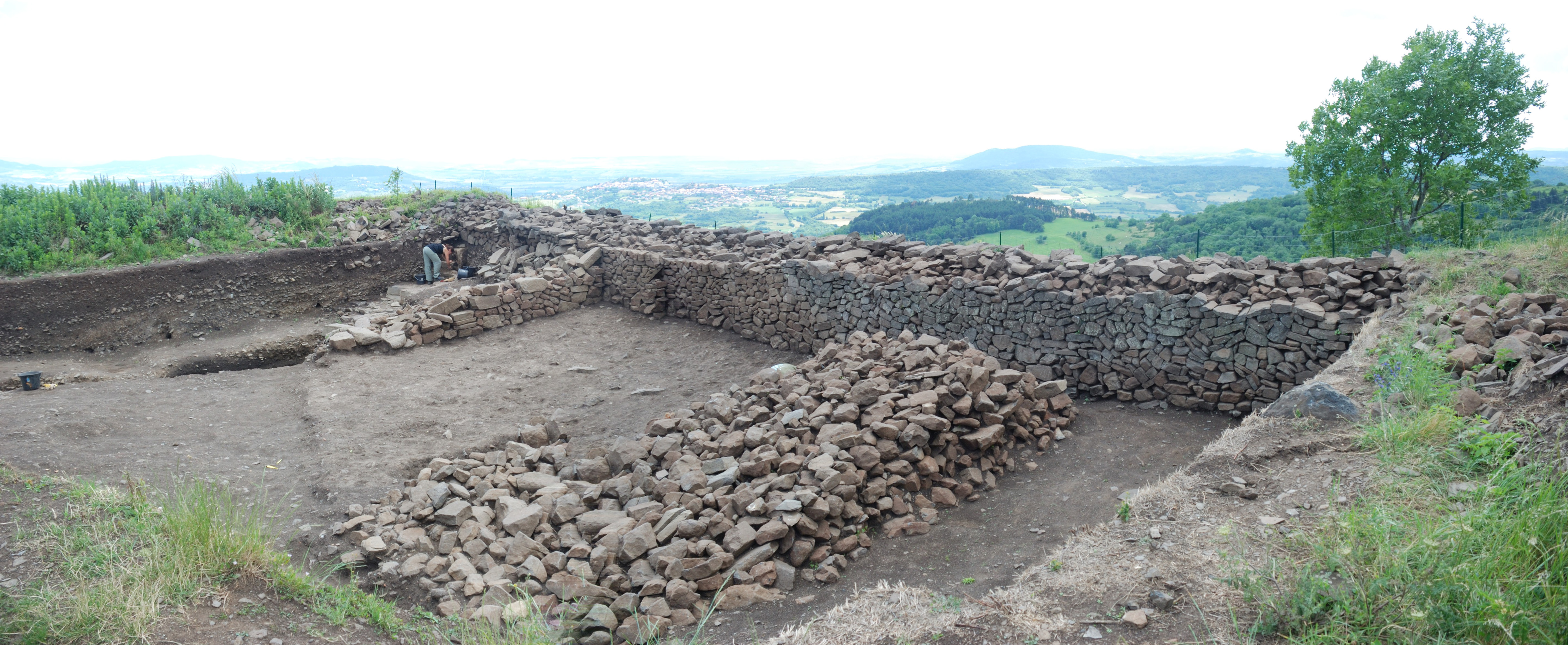
The site, identified with the village of Gergovie in the commune of La Roche-Blanche, retains walls and earthworks from the pre-Roman Iron Age. Emperor Napoleon III, a patron of archaeology, funded research into France's Gallic past, including excavations at Gergovia and Alesia. An archaeological museum now occupies the plateau, presenting recent finds alongside the story of the battle. In French popular culture, the Astérix comic series — which has sold more than 380 million copies worldwide — directly references Gergovia in Asterix and the Chieftain's Shield. For the French, Gergovia is not merely ancient history. It is proof that Rome could be beaten, that Gaul had heroes of its own, and that the ground beneath modern Auvergne once shook with the charge of cavalry that turned an empire's best general around.
From the Air
Located at 45.71°N, 3.13°E on a prominent plateau near La Roche-Blanche, about 7 km south of Clermont-Ferrand. The Gergovia plateau is clearly visible from the air, rising 360m above the surrounding plain. Clermont-Ferrand Auvergne Airport (LFLC) is the nearest field. The plateau's flat top and steep sides are distinctive terrain features. Recommend viewing at 3,000-6,000 ft AGL for best appreciation of the defensive terrain that shaped the battle.