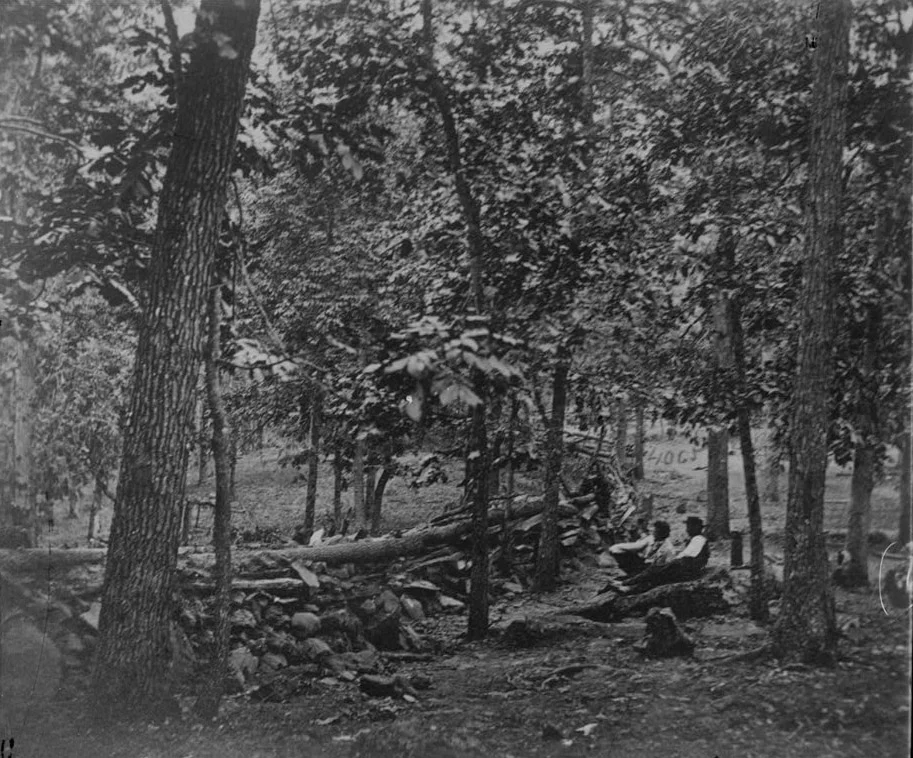

Battle of Gettysburg
On the morning of July 1, 1863, a Confederate infantry brigade marching toward Gettysburg in search of shoes collided with Union cavalry on Chambersburg Pike. Neither army had planned to fight here. Within hours, 170,000 men were converging on a small Pennsylvania crossroads town of 2,400 people, and the collision that would become the bloodiest battle in American history was underway. By the time it ended three days later, roughly 50,000 men lay dead, wounded, or missing across fields and hillsides that today look much as they did then — which is both a tribute to preservation and a quiet kind of haunting.
The Accidental Battle
Robert E. Lee had brought the Army of Northern Virginia north for the second time, flush with confidence from his victory at Chancellorsville two months earlier. His plan was to fight a decisive battle on Union soil — threatening Harrisburg, Philadelphia, perhaps even Washington — and break Northern will to continue the war. What he hadn't planned was fighting without intelligence. J.E.B. Stuart's cavalry, his eyes and ears, had ridden off on a raid around the Union army and lost contact for over a week.
George Gordon Meade had commanded the Union's Army of the Potomac for exactly three days when the battle began. He was the fifth man to hold the job in less than a year. Neither general chose Gettysburg. Both committed to it once contact was made, and the geography dictated the rest: the Union infantry fell back through town to Cemetery Hill, Seminary Ridge, and the high ground that runs south toward two rocky hills called the Round Tops. The Confederates occupied the parallel ridge to the west. Between them lay a mile of open farmland.
The Second Day: Little Round Top
July 2 brought some of the war's most ferocious fighting. Lee ordered James Longstreet to attack the Union left flank, and the resulting assault swept through a peach orchard, a wheat field, and a tangle of boulders called Devil's Den before nearly capturing the undefended summit of Little Round Top — the anchor of the entire Union line. Had the Confederates taken it, they could have placed artillery to enfilade the Union positions along Cemetery Ridge for two miles.
Colonel Joshua Lawrence Chamberlain's 20th Maine, running out of ammunition after ninety minutes of fighting, fixed bayonets and charged downhill into the advancing Alabama troops. It was one of those small decisions — made by an exhausted former rhetoric professor from Brunswick, Maine — that changed the shape of a battle and, with it, the war. The Union held Little Round Top. Attacks on both flanks cost Lee roughly 9,000 casualties without breaking the line.
Pickett's Charge
On the afternoon of July 3, after a two-hour artillery bombardment that overshot most of its targets, roughly 12,500 Confederate soldiers stepped from the tree line on Seminary Ridge and walked three-quarters of a mile across open ground toward the center of the Union line on Cemetery Ridge. The formation was a mile wide. Union artillery switched from long-fuse shells to canister — tin cans packed with iron balls that turned cannons into enormous shotguns — and the infantry behind stone walls poured in rifle fire.
Some Confederates reached the wall. Brigadier General Lewis Armistead led perhaps 200 men over the stone fence at a point now called the "high-water mark of the Confederacy" before being mortally wounded. Within an hour, half of the attacking force was killed, wounded, or captured. Lee rode among the survivors as they staggered back. "It is all my fault," he told them. Nearly a third of his general officers were casualties. The Army of Northern Virginia would never again mount a major offensive.
The Town That Became a Hospital
The battle left the town of Gettysburg with 22,000 wounded soldiers — Union and Confederate — in an area whose entire population was 2,400. Every church, barn, and public building became a hospital. The July heat accelerated decomposition among the roughly 8,000 dead, and the stench carried for miles. Over 3,000 horse carcasses had to be collected and burned in great pyres, leaving greasy black smoke hanging over the valley for days.
The only documented civilian death was twenty-year-old Ginnie Wade, killed by a stray bullet that passed through two doors while she was kneading bread in her sister's kitchen on Baltimore Street. The townspeople had huddled in cellars during three days of fighting. They emerged to a landscape that barely resembled what they had known.
272 Words
Four and a half months later, Abraham Lincoln traveled to Gettysburg for the dedication of the Soldiers' National Cemetery. The main speaker, Edward Everett, delivered a two-hour oration that was well received and is now forgotten. Lincoln spoke for about two minutes. His 272 words did not describe the battle. They did not name a single soldier. What they did was redefine the war — and, implicitly, the nation — as a test of whether a government "of the people, by the people, for the people" could endure.
The Gettysburg National Military Park preserves 6,000 acres of the battlefield, including 1,320 monuments, markers, and memorials — more commemorative works than any other battlefield on earth. The terrain has been maintained to approximate its 1863 appearance: the fields are open, the orchards replanted, the stone walls repaired. On a quiet morning, standing on Cemetery Ridge and looking west toward the tree line where Pickett's men emerged, the distance seems impossibly, cruelly short.
From the Air
Located at 39.81°N, 77.23°W in Adams County, Pennsylvania. The battlefield sprawls south and west of the town of Gettysburg, with Seminary Ridge and Cemetery Ridge running roughly parallel north-south, separated by about a mile of open ground. From the air, the preserved farmland and monument-dotted ridgelines are clearly distinguishable from the surrounding development. Look for the Pennsylvania Memorial — the largest monument on the field — on Hancock Avenue, and the distinctive rocky outcrops of Devil's Den and Little Round Top at the southern end. Nearest airport: Gettysburg Regional (W05), immediately west of the battlefield. Harrisburg International (KMDT) is 40 nm northeast. Recommended viewing altitude: 2,000-3,000 ft AGL. The low, parallel ridgelines that defined the battle are most apparent at this height.
Nearby Stories
- Antietam National Battlefield 9.5 km away
- Carlisle Indian Industrial School 14 km away
- Johns Hopkins University 25 km away
- Antietam: The Day America Lost 23,000 Men 39 km away
- Howard County, Maryland 39 km away
- Baltimore Memorial Stadium 54 km away
- Molly Maguires Region 79 km away
- The Johnstown Flood: The Dam That Killed 2,209 People 96 km away