Battle of Glasgow, Missouri
Before surrendering on October 15, 1864, Colonel Chester Harding Jr. ordered his men to do one last thing: burn every ration they could reach. Fifty thousand Union rations went up in flames in Glasgow's City Hall. The fire jumped to neighboring buildings, causing $130,000 in damage. If the Confederates wanted Glasgow, they would get it hungry. The Battle of Glasgow was a sideshow to Sterling Price's desperate Missouri Expedition, a supply raid sent to arm the recruits who had been joining Price's column unarmed. It succeeded -- 1,200 weapons changed hands that day -- but the weapons would not save Price from the catastrophe waiting at Westport eight days later.
Unarmed Recruits and a Rumored Gunboat
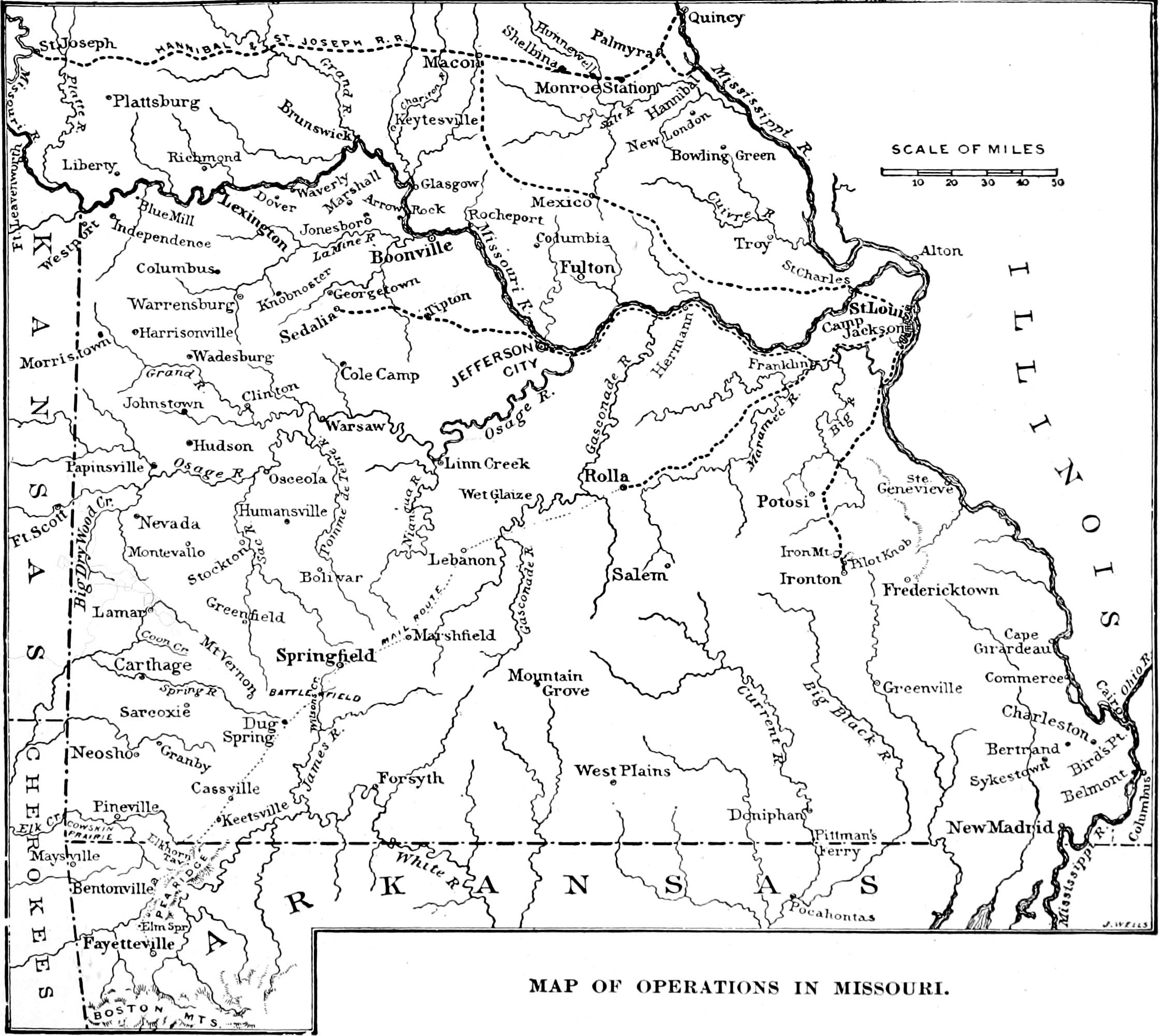
By mid-October 1864, Price's Confederate column had been moving west along the Missouri River for weeks. After a costly failure at Pilot Knob in late September, Price had bypassed both St. Louis and Jefferson City. His army found a warmer reception in the pro-Confederate Boonslick region, where volunteers flocked to his banner -- but many had no weapons. Late on October 12, Price learned that the Union garrison at Glasgow, across the Missouri River north of Boonville, held a substantial weapons cache. He dispatched Brigadier General John B. Clark Jr. with about 1,800 men on a raid to seize it. Clark and Colonel Sidney D. Jackman were chosen because they were local residents who knew the country. After crossing the Missouri by ferry at Arrow Rock on October 14, Clark heard rumors that Glasgow's garrison possessed a 'tin-clad boat.' He requested more artillery from Price. In reality, the Union vessel West Wind was neither tin-clad nor armed -- just a stranded commercial steamer whose draft was too deep for the falling river.
Artillery Across the River
Price sent Brigadier General Joseph O. Shelby with 125 cavalrymen and part of Collins's Missouri Battery to the western bank of the Missouri, directly opposite Glasgow. The river was narrow enough for artillery to fire effectively across it. Colonel Harding, commanding between 550 and 800 Union troops including armed civilians, had no artillery at all. Glasgow's hilltop position gave defenders an advantage, but the Union fortifications were unfinished -- two incomplete works holding about 40 men each, connected by makeshift defenses. At 5:00 a.m. on October 15, Collins's Battery opened fire from across the river, targeting the West Wind, visible campfires, and exposed streets. A prominent pro-Confederate clergyman, William Goff Caples, was killed by one of the first artillery rounds -- friendly fire from the guns meant to liberate him.
House to House Through Glasgow
Clark's main force arrived late, delayed an hour crossing the Missouri River. By 7:00 a.m. his men were on the field, with Jackman's brigade near the river and the bulk of the force extending right. Clark sent a surrender demand to Harding using civilian messengers -- so unconventional that Harding was confused and refused. The main assault forced its way across Greggs Creek around 8:00 a.m., though the Union defenders fought hard. Outflanked on both ends of their line, Harding's men fell back into Glasgow proper. Confederate artillery from across the river now found better targets among the town's streets. Shelby ordered men in a small boat to seize the West Wind, hoping to use it as a ferry. They reached the steamboat but found its engines had been sabotaged. Meanwhile, the 10th Missouri Cavalry's attempt to strike from the north was blocked by Missouri State Militia troops. Fighting devolved into house-to-house combat. Clark described the distance between the opposing lines as 'short.' After a council of war, Harding surrendered at 1:30 p.m.
The Price of a Week's Advantage
The haul was significant: 1,200 weapons, 1,000 uniform overcoats, and 150 horses. Harding's men were paroled and escorted to Union lines on the Lamine River -- the escort needed to protect them from guerrillas, not Confederates. Between 8 and 11 Union soldiers were killed and roughly 32 wounded, though historian Mark A. Lause believes militia losses were underreported and actual wounded numbered closer to four dozen. About 650 Union soldiers were captured. Clark rejoined Price the next day, and the combined force continued west toward Kansas City. But the weapons captured at Glasgow could not alter the strategic picture. On October 23, Price's army was decisively beaten at the Battle of Westport. Defeats at Mine Creek, Marais des Cygnes, and Marmiton River followed in rapid succession. The retreat continued through Arkansas, the Indian Territory, and finally to Texas. The campaign destroyed more than two-thirds of Price's army. In Glasgow, 15 homes and a church were damaged. Confederate soldiers burned the West Wind on October 16 or 17. In 1921, the steamer's remains were pulled from the riverbed as a navigation hazard, and during World War II, an engine retrieved in a scrap drive was rumored to be hers.
From the Air
Located at 39.24N, 92.84W on a hilltop overlooking the Missouri River in Howard County, Missouri. Glasgow is visible from altitude as a small river town on a prominent bluff. The Missouri River bend here and the town's elevated position are distinctive landmarks. Nearest airports include Columbia Regional Airport (KCOU, roughly 40nm east) and Marshall Memorial Municipal Airport (KMHL, roughly 25nm west). Recommended viewing altitude: 3,000-5,000 ft AGL. The river crossing at Arrow Rock, used by Clark's column, is visible to the southwest.