Battle of Gonzales
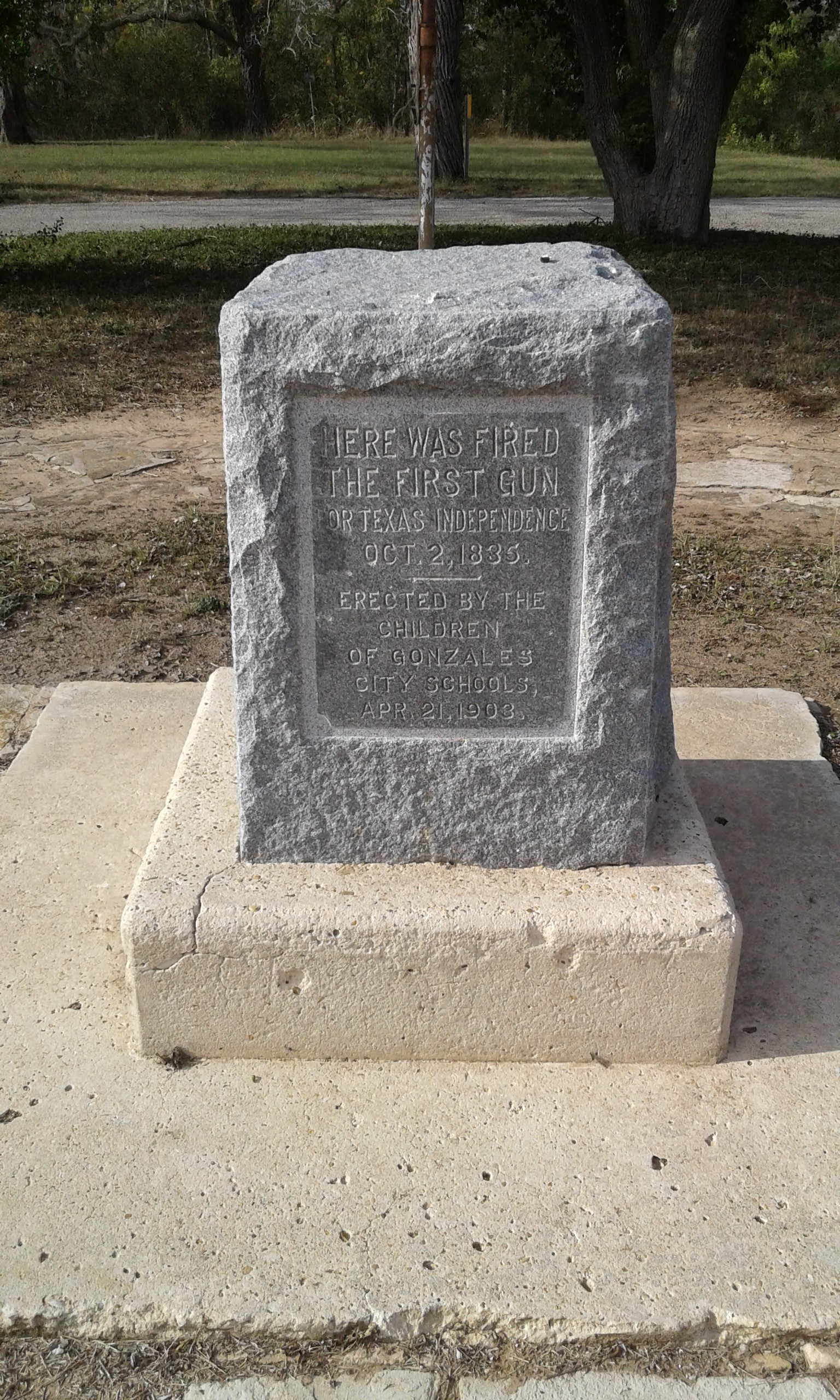
"Come and Take It." Four words, painted hastily in black on a white cotton banner beside the crude image of a cannon and a lone star, became the battle cry of a revolution. On the morning of October 2, 1835, a group of Texian settlers near Gonzales aimed a borrowed six-pounder loaded with scrap iron at a detachment of Mexican dragoons and fired the shot that ignited the Texas Revolution. The cannon itself was almost laughable -- a small bronze piece described by one local as being "good for little more than starting horse races" -- but the principle behind it was deadly serious. When the Mexican government demanded its return, the people of Gonzales answered with gunpowder and defiance.
A Cannon Worth Fighting For
The story begins with a simple loan. In 1831, Mexican authorities provided the settlers of Gonzales with a small bronze cannon to defend against raids by Comanche and other Native peoples along the Guadalupe River. It was a practical arrangement, unremarkable at the time. But by 1835, General Antonio Lopez de Santa Anna had dissolved the Mexican Constitution of 1824 and centralized power, alarming Anglo-Texan colonists who had settled under its protections. When Colonel Domingo de Ugartechea, the military commander in San Antonio de Bexar, sent Lieutenant Francisco de Castaneda with roughly 100 dragoons to retrieve the cannon, the request landed on a community already primed for confrontation. The alcalde of Gonzales, Andrew Ponton, stalled for time. Citizens buried the cannon in George W. Davis's peach orchard and sent riders to neighboring settlements along the Colorado River, calling for armed volunteers.
Eighteen Men at the River
When Castaneda's soldiers arrived at the Guadalupe River crossing on September 29, they found the ferry on the opposite bank and the ford blocked. A group of just 18 armed militiamen stood between the Mexican troops and the town. Castaneda, under orders to avoid provoking conflict, camped nearby to wait. Over the next three days, reinforcements streamed into Gonzales from surrounding settlements. By October 1, the Texian force had swelled to approximately 150 men. They elected Colonel John Henry Moore to command and organized themselves into a fighting unit. A committee of women and officers hastily stitched together their battle flag -- a rectangle of white cotton bearing the black image of the disputed cannon, a five-pointed star, and the words that would echo through Texas history: "Come and Take It."
The Shot That Started a Revolution
Under the cover of thick fog on the morning of October 2, the Texians crossed the river and advanced on the Mexican camp. The settlers had dug up their cannon, mounted it on improvised ox-cart wheels, and loaded it with chains, scrap iron, and whatever metal they could find. When the fog lifted enough for the two sides to see each other, Mexican sentries fired first. The Texians responded with their makeshift artillery. Castaneda, who had no desire for a fight, rode out under a white flag to negotiate, but the Texians refused to back down. After a brief and largely ineffective exchange of fire, the Mexican lieutenant withdrew his men toward San Antonio. Two Mexican soldiers were killed. The only Texian casualty was a man who suffered a bloody nose when bucked from his horse.
The Cannon's Mysterious Afterlife
The battle itself was, as historian William C. Davis characterized it, "an inconsequential skirmish in which one side did not try to fight." But the symbolism was enormous. The Texians had taken an armed stand against the Mexican army, and there was no going back. Gonzales became a rallying point for resistance, and by the end of the year, Texian forces had driven all Mexican troops from Texas. The fate of the famous cannon, however, remains one of the revolution's enduring mysteries. According to blacksmith Noah Smithwick, writing in the 1890s, the cannon was abandoned when its ox-cart axles began to smoke during a march to San Antonio. He reported it was buried near a creek outside Gonzales. A small iron cannon surfaced during a flood in 1936, and in 1979 Dr. Patrick Wagner purchased it, believing it matched Smithwick's account. The Smithsonian verified it as a period swivel gun, though historian Thomas Ricks Lindley disputes the identification, noting that Castaneda reported two cannons in Texian hands -- the bronze loaner and a smaller iron piece.
Legacy on the Guadalupe
Today, Gonzales wears its revolutionary heritage openly. Nine Texas historical markers commemorate locations connected to the prelude and battle, and the town hosts a "Come and Take It" celebration every October. The Gonzales Memorial Museum displays a cannon that may have participated in the fight. The phrase itself has transcended its origins, becoming one of the most recognized symbols in Texas culture -- a declaration of independence etched into the state's identity long before the siege of the Alamo or the victory at San Jacinto. Standing on the banks of the Guadalupe, it is easy to picture the fog-shrouded morning when a handful of settlers with a borrowed cannon and a homemade flag dared an empire to cross the river.
From the Air
Located at 29.44N, 97.52W along the Guadalupe River in south-central Texas. The town of Gonzales is visible from altitude with its grid street pattern and the river winding through. The nearest major airport is Austin-Bergstrom International (KAUS), approximately 56 nm north-northeast. Recommend viewing at 3,000-5,000 ft AGL for river and town context. The Guadalupe River is the primary visual landmark, running roughly east-west through the area.