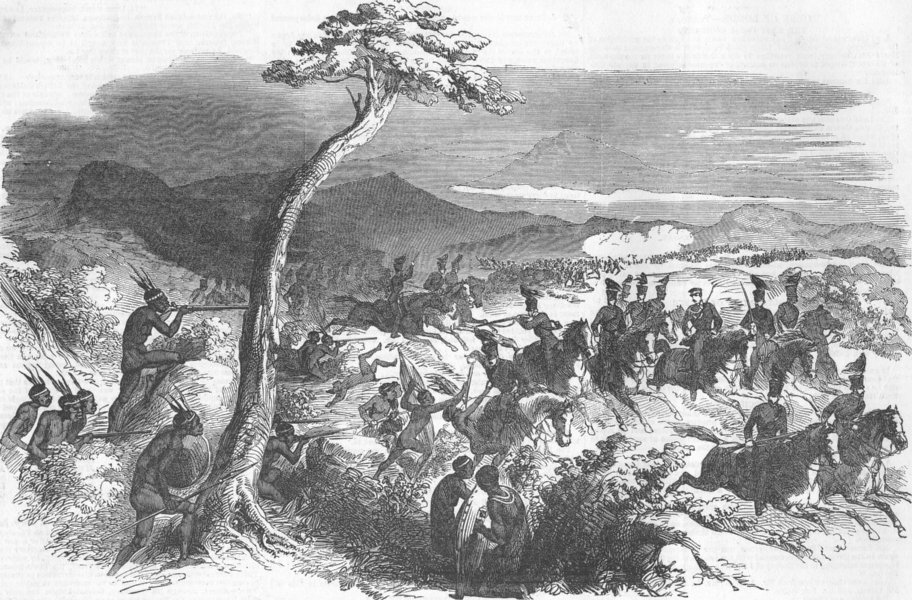
Battle of Grahamstown
The bullets would turn to water. That was the promise Makhanda, the Xhosa prophet, made to the warriors gathering for the assault on Grahamstown in April 1819. He had reason to believe the gods were on their side. The British under Colonel Thomas Brereton had just seized 23,000 head of cattle from the AmaNdlambe Xhosa, an act of plunder so brazen that it united Xhosa chieftainships that had rarely fought together. Makhanda urged them to drive the British from Xhosaland once and for all. What followed was one of the largest and most determined indigenous attacks on a colonial settlement in southern African history.
A Prophet's Call to Arms
Makhanda was not a chief in the conventional sense but a spiritual leader whose authority derived from his role as a prophet and war doctor among the Xhosa. When Brereton's forces stripped the AmaNdlambe of their vast herds, Makhanda saw both a practical crisis and a spiritual one. Cattle were the foundation of Xhosa society, and their wholesale seizure was an existential threat. He advised the paramount chief Ndlambe that divine forces would support an attack on the British garrison at Grahamstown, the frontier settlement that had become the forward post of colonial expansion into Xhosa territory. Makhanda's promise that British bullets would turn to water was not mere rhetoric. It reflected a deeply held spiritual conviction about the righteousness of the Xhosa cause and the power of ancestral protection in a war that, from the Xhosa perspective, was fought in defense of homeland and survival.
Six Thousand Against Three Hundred
On 22 April 1819, a force of approximately 6,000 Xhosa warriors, some sources say as many as 10,000, advanced on Grahamstown in broad daylight. They were commanded by Dushane, Ndlambe's warrior son, with Makhanda providing spiritual leadership. Women and children accompanied the army, prepared to settle in the town once the British were driven out. This was no mere raid: it was an attempt to reclaim and reoccupy territory the Xhosa considered rightfully theirs. In an extraordinary detail, the Xhosa had actually warned Colonel Willshire, the garrison commander, of their intention to attack. Whether this reflected confidence, cultural convention around the declaration of hostilities, or an attempt at psychological intimidation, it meant the 350-man British garrison had time to prepare defenses. What followed was a collision between overwhelming numbers and concentrated firepower.
The Fight for Egazini
The Xhosa assault was fierce and sustained. Wave after wave of warriors pressed toward the settlement, armed primarily with assegais and shields against British muskets and artillery. The garrison's ammunition began to run dangerously low as the fighting ground on. At the critical moment, a group of Khoekhoe marksmen led by Jan Boesak joined the defense and helped stabilize the British position. The Khoekhoe involvement added a painful complexity to the battle: they were themselves an indigenous people with their own fraught history of dispossession by European colonists, yet here they fought alongside the British against the Xhosa. Colonial frontier warfare rarely sorted into clean categories of oppressor and oppressed. By the time the fighting ended, approximately 1,000 Xhosa warriors lay dead. The bullets had not turned to water. But the courage of the men who charged into that fire, believing they would, speaks to the depth of their commitment to defending their land.
Makhanda's Surrender
The Fifth Xhosa War continued for several months after Grahamstown, and the Xhosa suffered further heavy losses as British forces pressed their advantage. The colonial authorities fixated on Makhanda as the primary instigator, pursuing him relentlessly. Makhanda eventually surrendered voluntarily, believing that giving himself up would end the conflict and spare his people further suffering. He was taken captive and imprisoned on Robben Island, the same rock in Table Bay that would later hold Nelson Mandela. Makhanda drowned while attempting to escape the island, but his legacy endured in Xhosa memory as a leader who had dared to challenge colonial power directly. The town of Grahamstown itself was officially renamed Makhanda in 2018, an acknowledgment that the prophet's cause carried a moral weight that outlasted his military defeat.
The Place of Blood
The battlefield is still called Egazini, the Place of Blood, in the Xhosa language. In 2001, a monument was erected there to honor the fallen Xhosa warriors, a formal recognition nearly two centuries late. From the air, the Eastern Cape landscape around Makhanda (formerly Grahamstown) rolls in green and brown hills, the kind of open frontier country where two worlds collided. The town sits at the intersection of histories that South Africa continues to reckon with: the Xhosa Wars that dispossessed the original inhabitants, the settlers who built a colonial outpost, the Khoekhoe communities caught between competing powers, and the prophets and leaders who resisted with everything they had. Egazini is not a comfortable monument. It marks a place where people fought and died over land that had been taken, in a war that was one of nine fought between the Xhosa and colonial forces over the span of a century. That the town now bears Makhanda's name is a measure of how deeply the story continues to matter.
From the Air
Coordinates: 33.31°S, 26.53°E, in the Eastern Cape province of South Africa. The town of Makhanda (formerly Grahamstown) sits in rolling hill country along the frontier zone where Xhosa and colonial territories met. From 5,000 feet AGL, the settlement is visible in the valley with surrounding ridgelines. Nearest airports: Port Elizabeth (FAPE), approximately 65 nm to the southwest; East London (FAEL), about 60 nm to the northeast. The region has moderate rainfall and generally good visibility.