Battle of Grand Gulf
Seven ironclads against thirteen guns. On the morning of April 29, 1863, Admiral David Dixon Porter lined up his warships on the Mississippi River and aimed them squarely at two Confederate forts perched on the bluffs of Grand Gulf, Mississippi. For nearly six hours, eighty-one Union cannons hammered the earthworks while roughly 10,000 infantrymen waited on transports behind a spit of land called Point Coffee, ready to storm ashore the moment the guns fell silent. The guns never fell silent. What happened next -- Grant's decision to cross the river elsewhere -- set in motion the largest American amphibious landing before World War II, and opened the road to Vicksburg.
The Fortress on the Bluffs
Grand Gulf occupied a commanding position along the Mississippi River south of Vicksburg, and the Confederates knew its value. Brigadier General John S. Bowen arrived in early March 1863 with orders to rebuild fortifications that Union troops had previously destroyed. Using soldiers and enslaved laborers, Bowen constructed two strongpoints: Fort Cobun, mounted on a tall bluff called Point of Rock with four heavy cannons including an 8-inch Dahlgren gun, and Fort Wade downstream, armed with a massive 100-pounder Blakely rifle. Between the forts ran two rows of rifle pits connected by a covered passageway, manned by Missouri infantry. By late April, some 4,200 Confederate troops held the position. Union reconnaissance revealed a garrison far smaller than initially feared -- false reports had claimed 12,000 defenders -- but the terrain and the heavy guns made Grand Gulf a formidable obstacle to Grant's plan to cross the Mississippi below Vicksburg.
Iron Against Earth
At 7:00 a.m., Porter's flotilla moved downriver in two waves. USS Pittsburgh led the first group of four ironclads toward Fort Cobun, while USS Benton, USS Tuscumbia, and USS Lafayette followed behind. The lead vessels opened fire around 7:50 a.m.; Fort Cobun answered twenty-five minutes later. River currents seized the Union warships, spinning some in full circles as Confederate gunners found their range. By 10:00 a.m., Fort Wade had been knocked out of action -- one of its large cannons had exploded, its fortifications lay in ruin, and its commander, Colonel William F. Wade, had been killed by a direct hit. But Fort Cobun fought on. A Confederate shell destroyed Benton's steering wheel. Tuscumbia, shoddily built with iron plating held on by unsecured spikes, absorbed over eighty hits and lost engine power. Porter himself took a shell fragment to the back of his head, a wound painful enough that he used his sword as a walking cane. By 1:00 p.m., Fort Cobun was running low on ammunition, yet its batteries remained dangerous enough to prevent any amphibious landing. The Union warships had fired more than 2,300 shots. It was not enough.
A Change of Plans at Disharoon's Plantation
Grant absorbed the failure with characteristic pragmatism. Rather than throw his infantry against the battered but unbroken defenses, he ordered the transports to run past Grand Gulf under cover of Porter's guns that evening. The vessels made it through with minimal damage. Grant's soldiers marched south along the Louisiana bank to Disharoon's plantation, where the transports gathered. Two crossing points lay ahead: Rodney and Bruinsburg. Confederate General Bowen expected the crossing at Rodney. But Union scouts, guided by a local African American man, learned of a usable road running from Bruinsburg to Port Gibson. Grant chose Bruinsburg. On the morning of April 30, the crossing began. By the following dawn, 24,000 Union soldiers stood on Mississippi soil without having fired a shot in opposition. No American amphibious operation would match that scale until the beaches of World War II.
The Road to Vicksburg
The Bruinsburg crossing unlocked the entire Vicksburg campaign. On May 1, Union forces won a hard-fought battle at Port Gibson, rendering Grand Gulf indefensible. Bowen spiked the remaining cannons and abandoned the position on May 3; Union forces moved in and converted it into a supply base. Grant's army swept inland, winning at Raymond on May 12, capturing Jackson on May 14, and smashing Pemberton's army at Champion Hill on May 16. The Siege of Vicksburg began on May 18 and ended with a Confederate surrender on July 4, 1863. Combined with the fall of Port Hudson and the Union victory at Gettysburg, the capture of Vicksburg split the Confederacy along the Mississippi River and marked a decisive turning point in the war.
Echoes Along the River
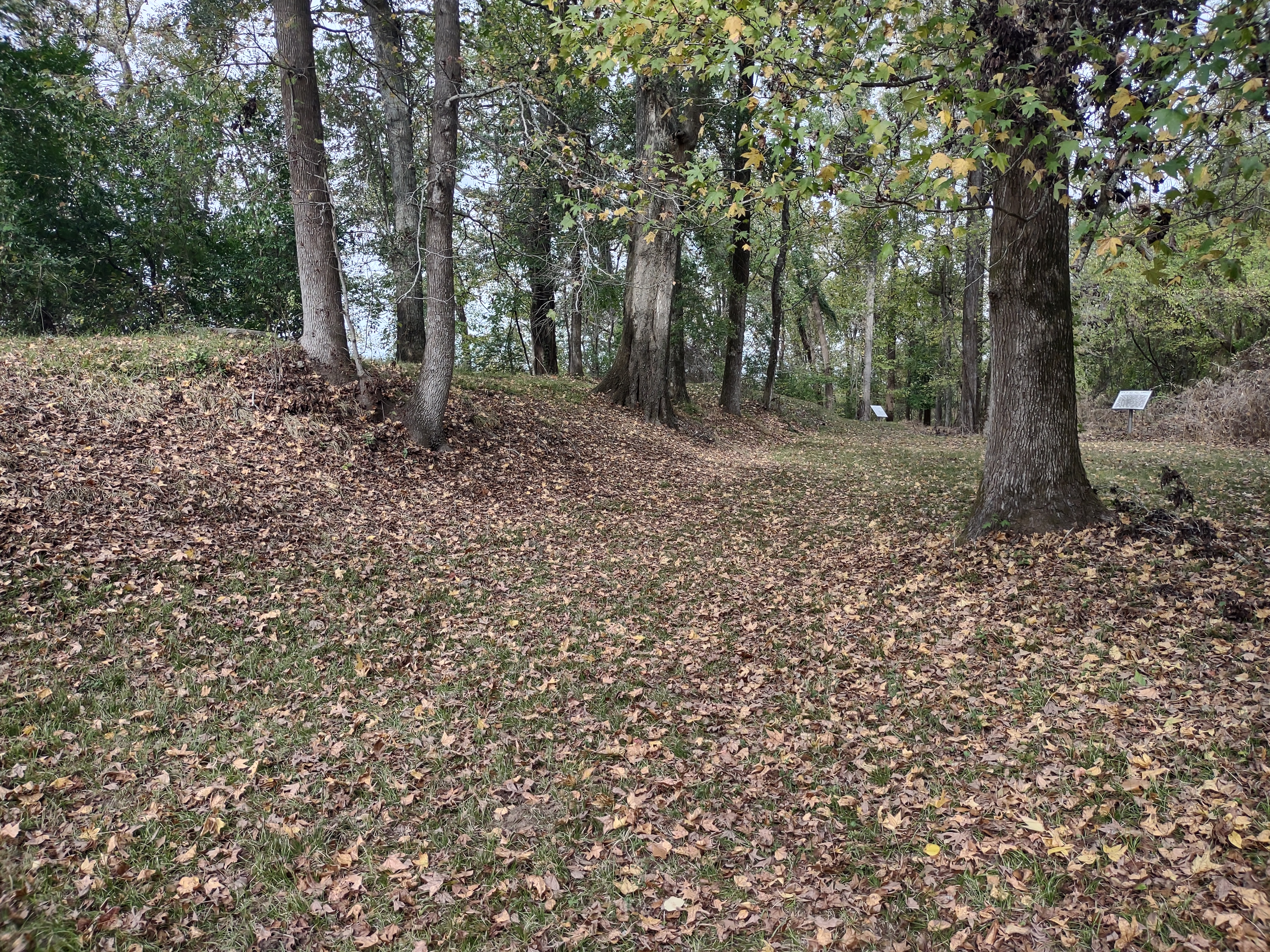
Today Grand Gulf Military State Park preserves the land where Forts Wade and Cobun once commanded the river. The earthen outlines of the fortifications remain visible among the trees, and an observation tower offers views across the Mississippi. A small museum houses artifacts from the battle and the vanished town of Grand Gulf, which never recovered from the war's destruction. The park was listed on the National Register of Historic Places on April 11, 1972. From the air, the bluffs still dominate the riverbank exactly as they did when Porter's ironclads steamed into range -- a landscape that reveals why Grant, seeing what his navy could not overcome, chose audacity over attrition and changed the course of the war.
From the Air
Located at 32.03N, 91.06W on the Mississippi River in Claiborne County, Mississippi. The bluffs where Forts Wade and Cobun stood are visible along the east bank of the river. Grand Gulf Military State Park marks the site. Nearest airports: Vicksburg-Tallulah Regional Airport (KTVR) approximately 30 nm north, and Natchez-Adams County Airport (KHEZ) approximately 45 nm south. Recommended viewing altitude: 2,000-3,000 ft AGL for best perspective of the river bluffs and fortification sites.