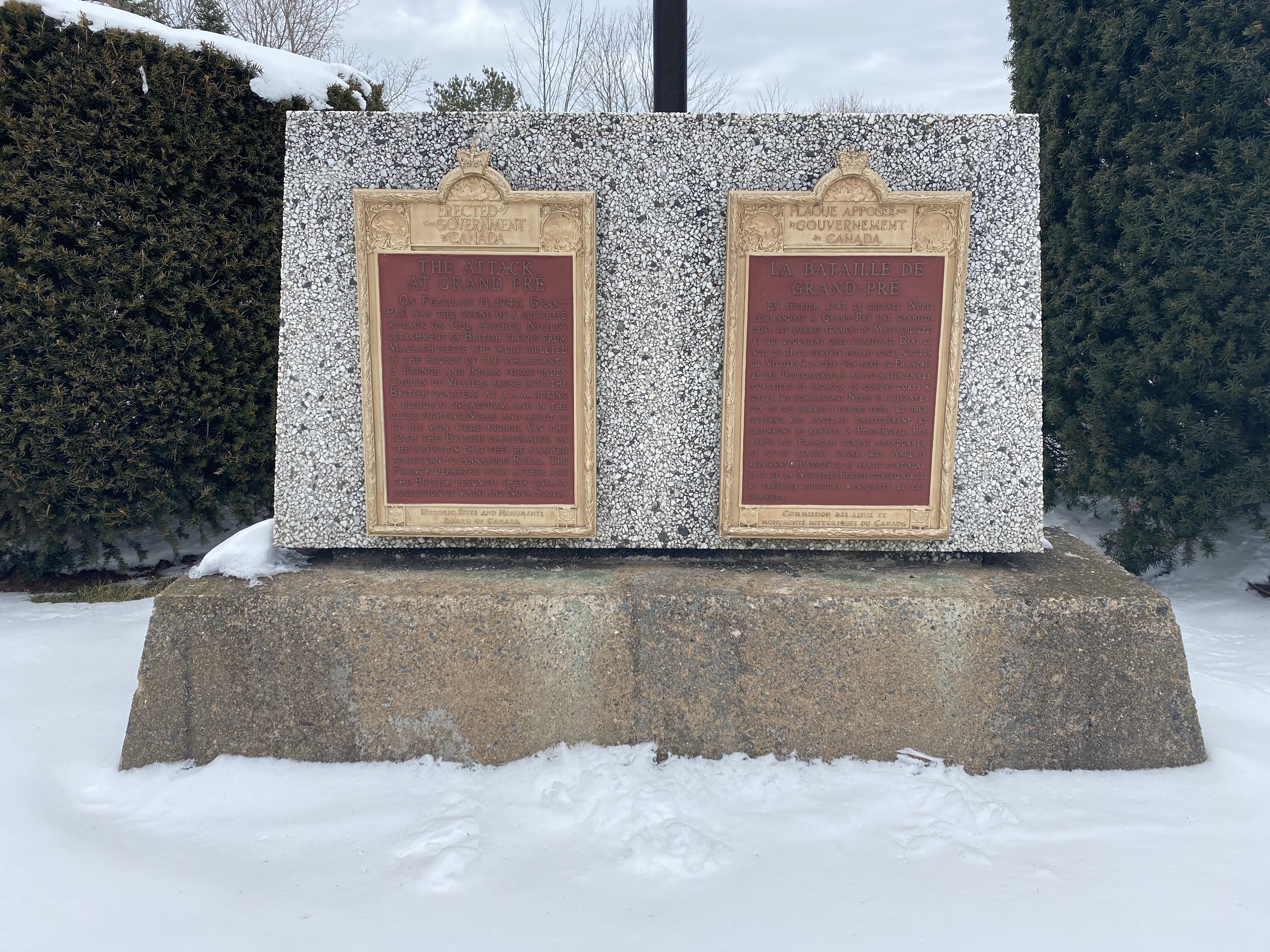
Battle of Grand Pré
Twenty-one days through deep snow, across frozen rivers choked with grinding ice, over the Cobequid Mountains in the dead of a Nova Scotia winter. The force that arrived at Grand-Pre on the night of February 10, 1747, had marched nearly the full breadth of the province on snowshoes and sleds, fed and sheltered by Acadian families along the way. What happened next -- a predawn assault in a blinding snowstorm on sleeping New England soldiers scattered across two and a half miles of village houses -- would become one of the most storied episodes in Nova Scotian military history.
A Village Between Empires
Grand-Pre sat at the contested heart of 18th-century Nova Scotia. The Acadian village on the southern shore of the Minas Basin had already served as the staging ground for French and Mi'kmaq sieges of the British capital at Annapolis Royal in 1744 and 1745. King George's War, the North American theater of the War of the Austrian Succession, had turned the Bay of Fundy region into a landscape of competing loyalties -- Acadian farmers caught between French and British demands, Mi'kmaq warriors defending their territory, and New England colonists pushing to secure the head of the Bay. In late 1746, Governor Shirley of Massachusetts sent Colonel Arthur Noble with approximately 500 provincials and rangers to occupy Grand-Pre and deny it to the French. Noble billeted his men across twenty-four houses stretching the length of the village. Some Acadian inhabitants warned him that Ramezay had designs on an attack. Noble dismissed the threat as impracticable -- no force could march that distance through winter.
The Long March Through Ice
On January 21, 1747, Nicolas Antoine II Coulon de Villiers led 250 Canadians and 50 Mi'kmaq warriors out of Beaubassin under orders from Jean-Baptiste Nicolas Roch de Ramezay. The column crossed to Bay Verte, followed the Northumberland shore to Tatamagouche, then climbed over the Cobequid Mountains to Cobequid Bay near present-day Truro. By February 2, they reached the Shubenacadie River only to find it choked with dangerous ice. De Villiers sent Boishebert ahead with ten men to block the roads and prevent word of their approach from reaching the British. The force skirted upriver past the tidal reach, crossed to the western bank, and pushed overland to the Kennetcook River. At the Acadian village of Pisiguit, villagers replenished supplies that had been running dangerously low for days. Throughout the trek, Acadian militia and Mi'kmaq warriors swelled the ranks -- though not all Acadians were allies. At Cobequid, de Villiers took care to block paths lest unsympathetic inhabitants alert the English.
Red Snow at Grand-Pre
By midday on February 10, despite a raging blizzard, the combined force of roughly 500 men made their final approach along the old Acadian road over Horton Mountain to Melanson Village in the Gaspereau Valley. Acadian guides led them directly to the houses where the New Englanders slept. That night, in near-zero visibility, the attackers struck ten houses simultaneously. Colonel Noble was killed along with four other officers, and fierce close-range fighting claimed more than 60 New England lives in the opening hours. De Villiers himself took a musket ball that shattered his left arm -- a wound that would eventually kill him. His second-in-command, Louis de la Corne, assumed leadership. The surviving New Englanders rallied roughly 350 men into a stone house at the village center, where they held out with small artillery. A sally to recover captured supply sloops failed in the deep snow drifts. By the next morning, with ammunition and food nearly gone, the defenders capitulated under honorable terms.
The Cost of a Winter Night
Captain Charles Morris reported 67 New England troops killed, upwards of 40 taken prisoner, and another 40 wounded or sick. Morris estimated 30 French dead, but Acadians who witnessed the burials counted 120 bodies from both sides in all. The more severely wounded were left in the care of Acadian families at Grand-Pre. Some prisoners were released in spring; others were marched to Quebec and eventually sent to Boston. The battle slowed the British advance to control the head of the Bay of Fundy, though New Englanders returned to Grand-Pre by March 1747, taking possession of the stone house and demanding the inhabitants renew their pledge of obedience to the English government. The battle entered Nova Scotian literary tradition through works like Archibald MacMechan's 'Red Snow on Grand-Pre' and Mary Jane Katzmann Lawson's poem 'The Battle of Grand Pre.' One participant, an Acadian named Zedore Gould who was twenty years old at the time, survived the later Expulsion and lived to a great age, fond of recounting his part in what he considered the most famous exploit in the province's history.
From the Air
Located at 45.10N, 64.31W on the southern shore of the Minas Basin. Grand-Pre National Historic Site is visible from the air as a landscape of dyked farmland along the Minas Basin shoreline. Nearest airport is Halifax Stanfield International (CYHZ) approximately 80 km east. The Gaspereau Valley and Horton Mountain, over which the French force made its final approach, are visible to the south. Best viewed at 2,000-4,000 feet to appreciate the terrain the attackers traversed.