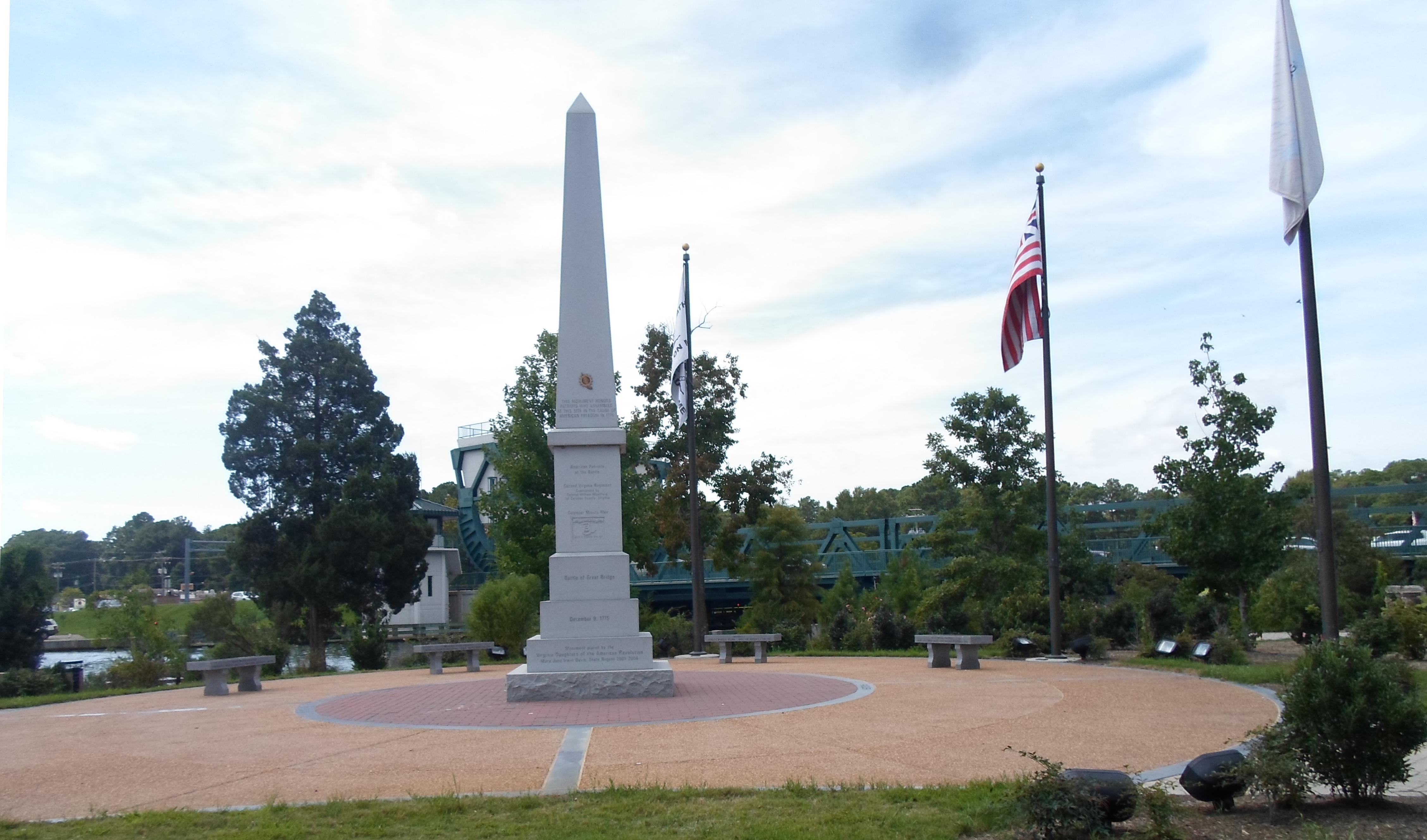
Battle of Great Bridge
The only rebel casualty was a man with a slight wound to the thumb. On December 9, 1775, British grenadiers charged across a narrow causeway spanning the southern branch of the Elizabeth River at Great Bridge, Virginia, bayonets fixed, advancing into a wall of musket fire from colonial militia entrenched behind earthworks. The assault collapsed within minutes. Captain Charles Fordyce fell dead just steps from the rebel breastworks, and roughly half his men went down with him. Colonel William Woodford, commanding the Virginia militia, called it "a second Bunker's Hill affair, in miniature; with this difference, that we kept our post, and had only one man wounded in the hand." Within weeks, Royal Governor Lord Dunmore and every vestige of British power in the Colony of Virginia were gone.
A Governor at Sea
The trouble had been building all year. Lord Dunmore, the Royal Governor of Virginia, fled Williamsburg in June 1775, fearing for his safety as political tensions exploded into open defiance. He put his family aboard a Royal Navy vessel and began assembling a small British fleet at Norfolk, whose merchants had strong Loyalist sympathies. Through the autumn, incidents between rebels and Tories escalated. General Thomas Gage, the British commander-in-chief for North America, sent detachments of the 14th Regiment of Foot to Virginia at Dunmore's request. These troops raided surrounding counties for rebel military supplies. When colonial militia repulsed Navy boats sent to punish the town of Hampton after a skirmish, Dunmore raised the stakes dramatically. On November 7, he issued a proclamation declaring martial law and offering freedom to enslaved people in Virginia willing to serve in the British Army.
Dunmore's Desperate Gamble
The proclamation alarmed slaveholders on both sides. But Dunmore recruited enough formerly enslaved men to form the Ethiopian Regiment, alongside a Loyalist company he called the Queen's Own Loyal Virginia Regiment. These local forces, plus two companies of the 14th Foot and the Royal Navy, were the entirety of British military power in Virginia. Dunmore fortified the bridge at Great Bridge, the only road leading south from Norfolk toward North Carolina. The crossing was a natural chokepoint, flanked on both sides by the Great Dismal Swamp and accessible only by narrow causeways. His men erected a small stockade called Fort Murray on the Norfolk side and pulled up the bridge planking. The garrison numbered between 40 and 80 soldiers. On the opposite side of the bridge, the colonial militia camp had swelled to nearly 900 men by December 8.
Sixty Muskets Behind the Earthworks
Dunmore learned the militia had acquired cannons, though he did not know they were inoperable. Believing the rebel position would only strengthen with time, he ordered an attack for the morning of December 9. The plan called for a diversionary assault downriver by the Ethiopian companies while the main force, reinforced from Norfolk, stormed across the bridge at dawn. The militia commander initially mistook the early morning gunfire for a routine salute. But shortly after reveille, the reality became clear. About sixty militiamen took positions behind the earthworks and held their fire with iron discipline as the British grenadiers advanced across the narrow causeway with bayonets fixed. They waited until the column was within close range, then unleashed a devastating volley. Captain Fordyce went down leading from the front. The assault disintegrated under sustained fire. Navy gunners provided covering fire for the retreat, but their small cannons barely dented the earthworks.
Full Honors for the Enemy Dead
After a truce allowed the British to collect their dead and wounded, the surviving Tory forces slipped away in the night back to Norfolk. Casualty estimates ranged from Dunmore's official count of 62 killed or wounded to a patriot report of 102 British losses. The rebels buried Captain Fordyce with full military honors near the battle site, a gesture of respect for an officer who had led from the front and died for it. In the following days, Dunmore and his Loyalist supporters abandoned Norfolk entirely, taking refuge on Royal Navy ships. The victorious rebel forces occupied the city. On January 1, 1776, Norfolk was destroyed in an action begun by British naval bombardment but completed by rebel troops who looted and burned the former Tory stronghold.
The Governor Who Never Came Back
Dunmore occupied Portsmouth briefly in February 1776 and launched raiding operations along the Chesapeake until General Charles Lee forced him back to his fleet in late March. By August 1776, Dunmore and the British fleet sailed for New York City. He never returned to Virginia. The Battle of Great Bridge was modest in scale but decisive in consequence. It ended British civil and military authority in the largest American colony months before the Declaration of Independence. A highway marker was placed near the site in 1934. In 2021, the American Battlefield Trust and its partners preserved two-thirds of an acre of the original battlefield, a small patch of ground where a thumb wound was the worst a rebel suffered and an empire lost its grip on Virginia.
From the Air
Located at 36.72N, 76.24W in the Great Bridge area of Chesapeake, Virginia, along the southern branch of the Elizabeth River. The battle site sits where the road crosses the waterway, with the Great Dismal Swamp extending to the south and west. From the air, the causeway geography that made this a natural chokepoint is still evident. Norfolk lies approximately 10 miles to the north. Nearest airports: Norfolk International (KORF) about 12 miles north, and Chesapeake Regional Airport (KCPK) approximately 8 miles southeast. Best viewed at 2,000-3,000 feet AGL to appreciate the swamp-flanked terrain that shaped the battle.