Battle of Groningen
The Canadians could have flattened Groningen. They had the tanks and they had the howitzers, and they were three weeks away from the end of the war in Europe. They did not flatten it. The 2nd Canadian Division's commanders forbade artillery support across the entire battle. The civilians of Groningen were still in their cellars - tens of thousands of them - and the soldiers would have to take the city the hard way, room by room, square by square, with rifles and grenades and the cannon of supporting tanks. The fighting lasted from 13 to 16 April 1945. About a hundred Dutch civilians died anyway.
Why Here, Why Now
The First Canadian Army had a choice in April 1945. They could push west into the densely populated heart of Holland, where every meter of advance would cost civilian lives, or they could swing northeast and clear the German rear. They chose northeast. Groningen mattered because the Germans were funnelling forces back through it from Friesland toward Germany proper, and because the Ems estuary - the back door to the Kriegsmarine's U-boat pens at Emden - had to be cut. The city's defenders numbered around 7,000: regular German troops, Luftwaffe flak crews, and Dutch and Belgian SS. The SS had nowhere to go. The Malmedy massacre had happened only four months earlier, and they knew what surrender to the Allies might mean. They fought to the last building.
Across the Canals
Groningen's old centre is ringed by a canal - a medieval moat, more or less - and the Germans had blown most of the bridges. The Herebrug bridge to the south was still standing, but machine-gun positions in the buildings just north of it pinned the Canadians for a full day. In the north, after two hours of close fighting through the Noorderplantsoen park - laid out, ironically, along the trace of the old city walls - the Canadians broke into the Nieuwe Stad. Tanks crept down narrow streets behind infantry. Every doorway was a possible ambush. The Calgary Highlanders, the Royal Hamilton Light Infantry, and the Essex Scottish moved building by building, while combat engineers cleared booby traps and demolitions. Civilians in cellars listened to the rifles and prayed the war would step past them rather than through them.
The Grote Markt
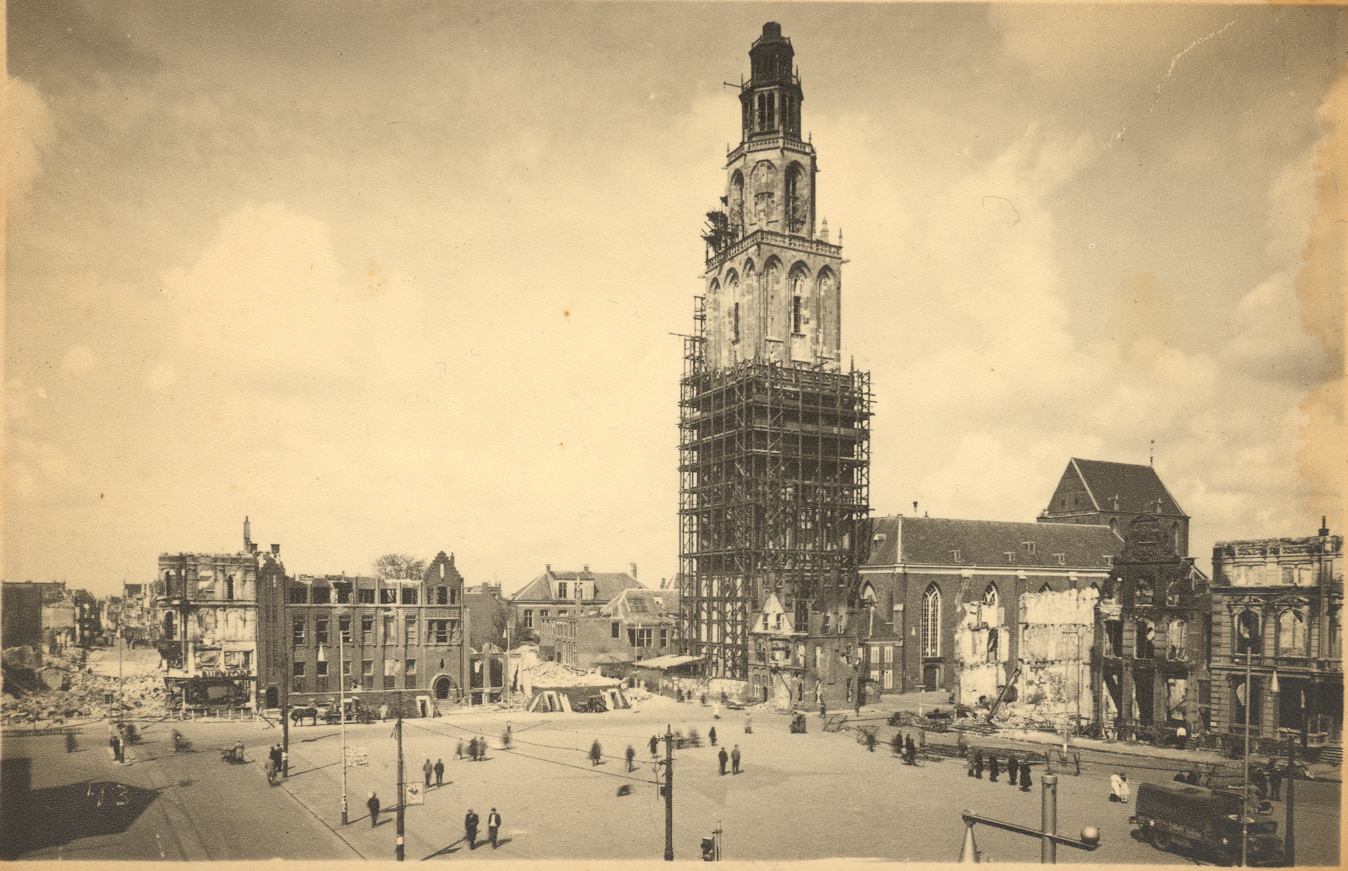
The fiercest fighting came on the Grote Markt, the central market square. German machine guns had been emplaced in the buildings along the north side - tall, narrow gabled houses, the sort that has stood since the Hanseatic League. There was no way to take them with infantry alone, and no artillery would be called in. The Canadians used their tanks instead, firing cannon rounds into the buildings until the gunners were silenced. Many of those medieval facades came down in the process. Photographs from the days after liberation show the square ringed by burned-out shells. About 270 buildings were damaged or destroyed across the city. The Martini Tower, by some grace, survived.
The Cost
On 16 April the German commander surrendered. Over 5,200 Germans went into Canadian captivity, including 95 officers. About 2,000 more fled northeast and the Canadians met them again days later in Germany. The dead were counted as roughly 130 Germans, 43 Canadians, and 100 Dutch civilians, though the civilian figure is the one that haunts. Each of those hundred had a name and a family. Most died in their own homes, killed by stray rounds or collapsing buildings as the war they had endured for five years finally ended on top of them. Groningen was, by some measures, the largest urban battle Canadian forces fought in the war - more Canadian soldiers in direct combat here than at Ortona, which the press had called Little Stalingrad. There is a Canadian war cemetery at Holten, an hour south, where many of the 43 are buried. Every May, Groningen still remembers them.
The City Today
Stand in the Grote Markt today and the rebuilt facades look almost original. They are not. The north side of the square was reconstructed in the years after the war, and the seam is visible if you know to look. The Noorderplantsoen is a park again, families with strollers walking past plaques to the men who died taking it. Liberation Day, 5 May, brings flowers to the Canadian graves at Holten and to the small memorials scattered through the city. The Canadians who fought here were mostly twenty-year-olds from the prairies and Ontario towns, a long way from home. The Dutch have not forgotten. Eighty years on, when Canadian veterans return, the crowds still come out.
From the Air
Groningen lies at 53.22 N, 6.57 E. The city centre, the historical battlefield, is unmistakable from low altitude: a roughly circular old town ringed by canals, the Martini Tower rising above everything else at 97 meters. Groningen Airport Eelde (EHGG) sits about 10 km south. The Ems River, the strategic objective behind the battle, flows northeast toward Emden in Germany. On a clear day you can trace the entire Canadian axis of advance from the south.