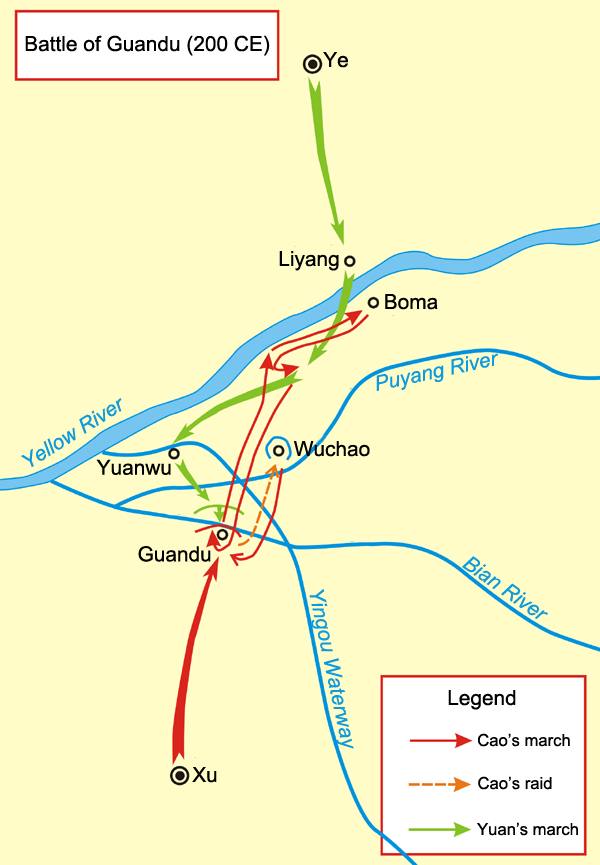
Battle of Guandu
Cao Cao's advisors were divided. A defector from the enemy camp had arrived with intelligence about a lightly guarded supply depot at Wuchao, forty li from the front lines. Some of Cao Cao's generals suspected a trap. His counselors Xun You and Jia Xu urged him to strike. It was the autumn of 200 AD, and Cao Cao's army was starving behind its earthworks at Guandu, outnumbered by Yuan Shao's forces perhaps five to one. Under cover of darkness, Cao Cao led 5,000 soldiers disguised as Yuan Shao's reinforcements toward Wuchao. The gamble would determine who controlled northern China.
Two Warlords, One River
By 196 AD, the fracturing Eastern Han dynasty had produced two dominant powers. Yuan Shao, scion of one of China's most prestigious families, controlled the lands north of the Yellow River. Cao Cao, the shrewder and more ruthless of the two, held the territory to the south and -- crucially -- kept the last Han emperor, Emperor Xian, under his control in the capital city of Xu. The emperor was a puppet, but a useful one: Cao Cao governed in his name, lending legitimacy to every decree. Yuan Shao's advisors Ju Shou and Tian Feng warned their lord that Cao Cao would grow too powerful if left unchecked, but Yuan Shao dismissed their counsel. It was a pattern that would define his generalship throughout the coming campaign: good advice received, acknowledged, and ignored.
Tiger Skins and Scattered Treasure
Before the main confrontation at Guandu, a series of preliminary clashes along the Yellow River bloodied Yuan Shao's forces and shattered their confidence. Yuan Shao's general Yan Liang was killed by Guan Yu -- later one of the most worshipped figures in Chinese history -- during the relief of Cao Cao's fort at Boma. When Wen Chou and Liu Bei pursued Cao Cao's retreating column with 6,000 horsemen, Cao Cao ordered his soldiers to scatter their weapons, horses, and valuables along the road. Yuan Shao's cavalry broke formation to grab the plunder, and six hundred of Cao Cao's elite riders, hidden in ambush, destroyed them. Wen Chou was killed. The loss of two generals before the main battle even began devastated Yuan Shao's army's morale.
The Night Wuchao Burned
The armies settled into trench warfare at Guandu through the late summer and autumn. Yuan Shao built archer platforms; Cao Cao destroyed them with trebuchets. Yuan Shao dug tunnels; Cao Cao dug counter-tunnels. As supplies dwindled, Cao Cao considered retreat until Xun Yu, defending the capital, wrote him a letter invoking the Chu-Han Contention: both sides were exhausted, and the one who blinked first would lose everything. Then came the defection of Xu You, a disgruntled Yuan Shao advisor whose wife had been arrested by a rival faction. Xu You revealed that Yuan Shao's main supply depot at Wuchao was guarded by only 10,000 men under the general Chunyu Qiong. Cao Cao attacked at night with 5,000 soldiers, burned almost every grain cart, and cut off the noses of the dead to display to Yuan Shao's troops as an act of psychological warfare.
The Collapse of a Dynasty
When news of Wuchao's destruction reached Yuan Shao's camp, his general Zhang He urged an immediate rescue mission. The advisor Guo Tu argued the opposite: attack Cao Cao's lightly defended main camp instead, forcing him to abandon the raid. Yuan Shao chose Guo Tu's plan. It failed on both fronts. Zhang He's assault could not breach Cao Cao's lines, and the small cavalry force sent to relieve Wuchao arrived too late. Zhang He and his fellow general Gao Lan, suspecting that Guo Tu was slandering them behind their backs, surrendered to Cao Cao. Yuan Shao's army disintegrated. He fled north across the Yellow River with roughly 800 cavalry -- the remnants of a force that had numbered 110,000. Yuan Shao died two years later in 202 AD, and his sons tore each other apart in a succession struggle that Cao Cao methodically exploited. By 207, northern China was unified under Cao Cao's control, laying the foundation for the state of Cao Wei and the legendary Three Kingdoms period.
From the Air
Located at 34.91N, 114.62E northeast of present-day Zhongmu County, Henan province. The battlefield site sits on the flat Yellow River plain between modern Zhengzhou and Kaifeng. Nearest major airports include Zhengzhou Xinzheng International (ZHCC/CGO) to the southwest and Kaifeng to the east. The terrain is uniformly flat agricultural land, bisected by the Yellow River to the north.