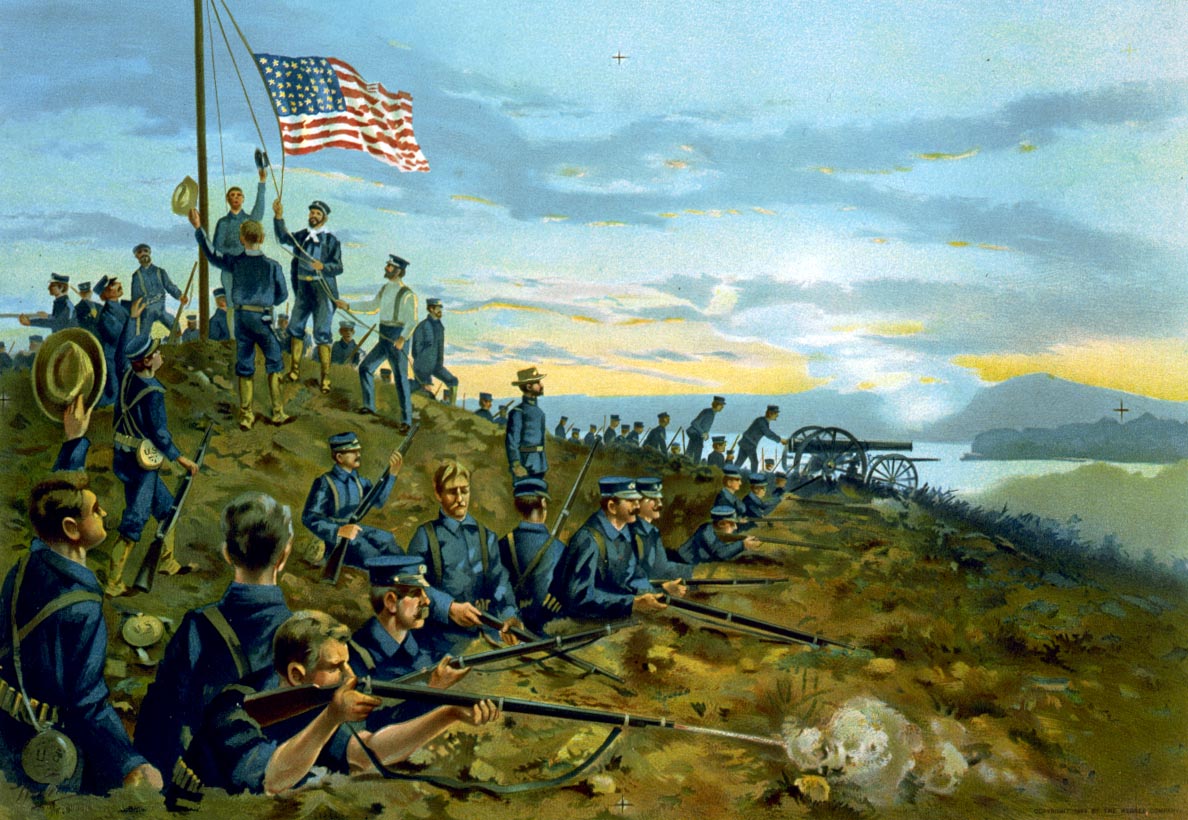
Battle of Guantánamo Bay
Barnacles saved the USS Marblehead. As the cruiser steamed up the narrow channel of Guantánamo Bay in June 1898, she passed unknowingly through a field of eighteen Spanish contact mines. Not one detonated. When Navy divers recovered fourteen of them days later, they found the contact levers crusted over with marine growth, the triggers frozen shut by the patient work of sea creatures that knew nothing of war. It was that kind of battle - improvised, chaotic, decided as much by luck and biology as by strategy. Yet the nine days of fighting at Guantánamo Bay, overshadowed then and now by the more famous clashes at Santiago and San Juan Hill, produced something that outlasted the war itself: America's oldest overseas naval base, still operating more than a century later on land the United States has never owned.
Cutting the Wires
The battle began not with a bombardment but with a pair of wire cutters. On June 6, 1898, Commander Bowman McCalla brought the cruiser Marblehead and two auxiliary warships into the outer bay at dawn. His orders from Rear Admiral William T. Sampson were straightforward: reconnoiter the harbor for a naval base and cut the undersea telegraph cables connecting Cuba to the outside world. The Spanish had 5,000 troops garrisoned around the bay under General Felix Pareja, a gunboat named Sandoval lurking in the inner harbor, and a fort on Cayo del Toro commanding the channel between the outer and inner bay. McCalla's six-pounder guns cleared the blockhouse on Fisherman's Point. The Sandoval and a second gunboat, Alvarado, came down the channel to fight but retreated when they realized what they were facing. By the next day, three telegraph cables had been severed - east to Haiti, west to Santiago, south across the inner bay. Guantánamo City went dark. For nearly a month, the Spanish garrison would fight blind, cut off from news of a war collapsing around them.
Marines on the Beach
Three days after the cables were cut, the transport USS Panther arrived carrying the First Battalion of Marines - six companies, roughly 650 men under Lieutenant Colonel Robert W. Huntington. They were the first American ground force to land in Cuba. Their welcome was less than ideal. The Panther's captain, Commander Reiter, refused to let his sailors help unload the ship and withheld much of the Marines' ammunition, claiming it served as ballast. Huntington's men landed anyway, burned the abandoned Spanish village to prevent yellow fever, and pitched camp on an open beach. It was a sniper's dream.
At 5 a.m. on June 11, Spanish guerrillas opened fire from the surrounding brush. Wearing palm leaves tied to their uniforms as camouflage and firing smokeless powder cartridges, they were nearly invisible. The Marines fought back with Lee straight-pull rifles, machine guns, and three-inch field artillery. The exchange lasted days - a grinding siege under tropical sun where the enemy appeared as muzzle flashes in dense undergrowth and vanished before anyone could fix a target.
The March on Cuzco Well
The solution was elegant in its brutality: destroy the only freshwater source available to the Spanish forces. On June 14, Captain George F. Elliott - a future Commandant of the Marine Corps - led about 160 Marines alongside fifty Cuban insurgents toward Cuzco Well, advancing along sea cliffs in suffocating heat. A second flanking force under Second Lieutenant Magill moved through an inland valley with a Cuban scout named Polycarpio as guide. Both columns struggled through mountainous, jungle-choked terrain. Company commanders collapsed from heat exhaustion mid-march.
What happened next entered military history. The Marines' machine guns provided mobile fire support during an offensive advance - the first known tactical use of this technique in combat. The lightweight 6mm Lee cartridges proved their worth, each Marine carrying enough ammunition to fire some sixty rounds during the engagement and still resupply Cuban allies who had run dry. When Elliott called in naval gunfire from the gunboat Dolphin, a signal miscommunication nearly turned the support into a disaster - shells fell directly in the path of Magill's flanking force. The well was destroyed nonetheless, and Camp McCalla never saw another Spanish attack.
The Stranglehold That Won Santiago
The battle's true significance lay not in what happened at Guantánamo Bay but in what did not happen at Santiago. Forty miles to the west, 17,000 American troops under General William Shafter were landing to assault the city where Spain's fleet lay trapped. The 7,000 Spanish soldiers at Guantánamo - a force large enough to have changed the outcome - never marched to Santiago's defense. They could not. Before his communications were severed, General Pareja had received orders to hold Guantánamo at all costs, and after the cables were cut, he had no way to learn that Santiago was under siege. Cuban insurgents maintained such a tight cordon around the city that none of General Linares' frantic requests for reinforcements got through. Fifteen messengers were caught and executed as spies.
So while San Juan Hill and El Caney entered the national mythology, it was the quiet stranglehold at Guantánamo - a few hundred Marines, a thousand Cuban fighters, and three warships - that pinned down an army seven times their number. Less than a week after Santiago surrendered on July 17, 3,500 American troops sailed from Guantánamo Bay to invade Puerto Rico. The war ended on August 12. Five years later, the United States signed a lease for the base it had already proven indispensable.
From the Air
Located at 20.02N, 75.11W at the southeastern tip of Cuba. The bay is clearly visible from altitude as a large natural harbor surrounded by steep hills, with a narrow channel connecting outer and inner bays. Guantánamo Bay Naval Base (ICAO: MUGM, also known as Leeward Point Field) sits on the western shore with a 2,400m runway. The base covers 116 sq km on both sides of the bay. From the air, look for the distinctive horseshoe shape of the bay opening to the Caribbean Sea. McCalla Hill, site of the 1898 battle, overlooks the eastern entrance. Caimanera, the sugar port on the inner bay's western shore, is visible roughly 8 km from the sea entrance. Santiago de Cuba (ICAO: MUCU) lies approximately 65 km to the west. The surrounding terrain is hilly and semi-arid - one of Cuba's driest regions. Best viewed at 3,000-5,000 ft for the full layout of the bay and its military significance.