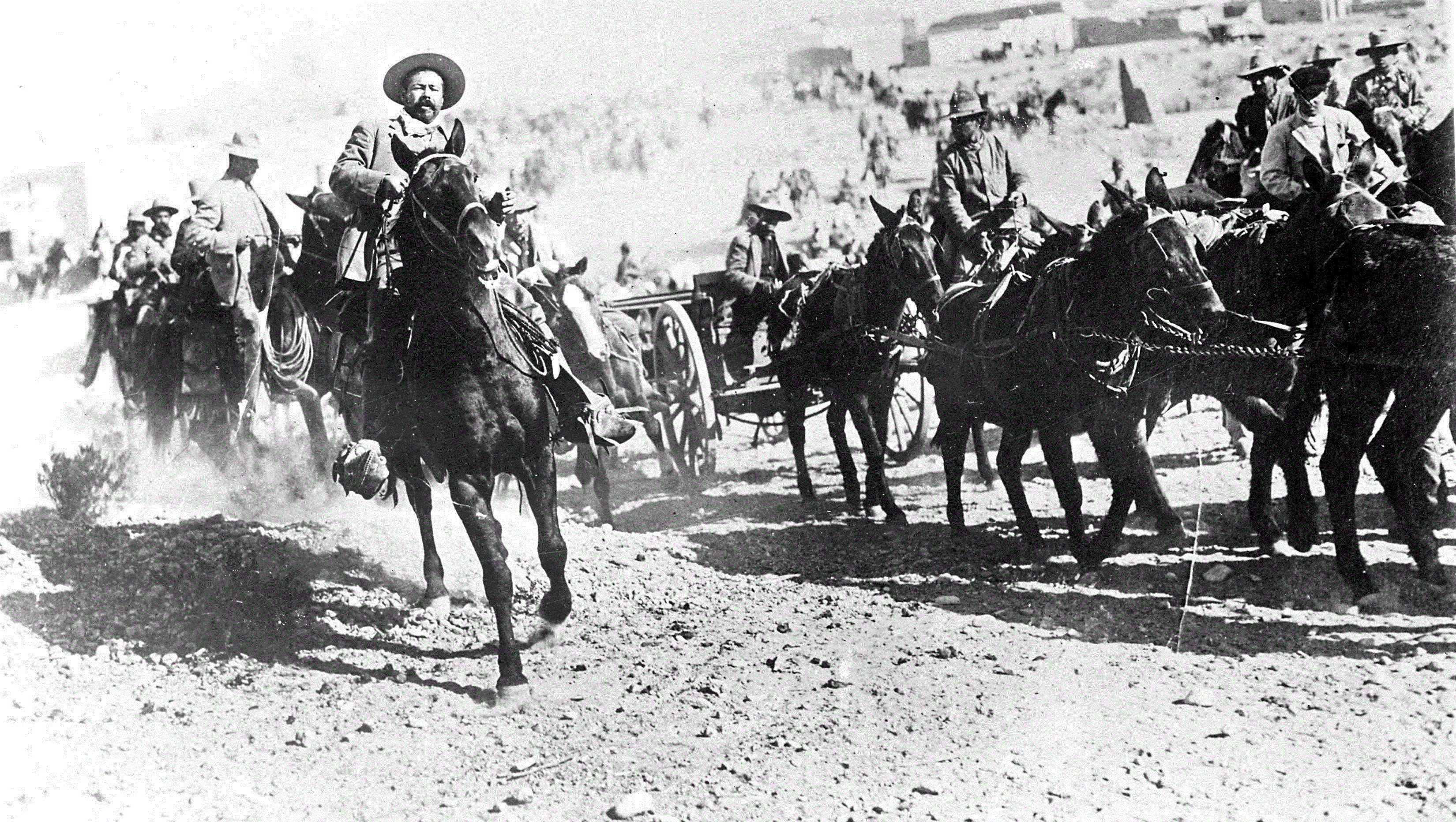
Battle of Guerrero
Pancho Villa heard them before he saw them. Hidden in a valley while his wounded knee healed, the Mexican revolutionary watched a column of American cavalrymen ride past, close enough to hear them singing 'It's a Long Way to Tipperary.' They never knew how close they came. It would be the nearest American forces ever got to capturing the man who had raided Columbus, New Mexico, and pulled the United States Army into Mexico for the first time since the Mexican-American War. The Battle of Guerrero on March 29, 1916, has been called the last true cavalry charge in American military history. It was both a tactical victory and a strategic failure, the tantalizing moment when everything almost came together.
Four Hundred Miles in Fourteen Days
The Punitive Expedition began twenty days after Villa's forces killed eighteen American soldiers and civilians in Columbus. General John J. Pershing led the U.S. Army into Mexico with one mission: capture or kill Pancho Villa. Colonel George A. Dodd received intelligence that Villa was holed up in Guerrero, 230 miles south of Columbus. He had 370 cavalrymen and inaccurate maps of the Mexican frontier. A civilian guide named J.B. Baker led them on what became a 'circular march' through the rugged Sierra Madre Occidental. The men covered 400 miles in fourteen days, including 55 miles in the final seventeen hours after learning Villa's position. They arrived at Guerrero exhausted, low on rations, facing extreme heat by day and freezing temperatures by night.
The Last Cavalry Charge
Villa had attacked Guerrero just two days earlier, capturing the Carrancista garrison and taking a bullet to his right kneecap that would impair his command for weeks. By the morning of March 29, between 200 and 500 Villistas occupied the town. Colonel Dodd spent the first hours after arrival assessing enemy strength. At 8:00 AM, he gave the order to attack. He divided his command into three contingents with instructions to charge and surround the town, cutting off escape routes. When the Americans charged, fighting erupted at three points. Mountains flanked Guerrero on two sides, providing cover for the defenders and making encirclement impossible. After the charge, the cavalrymen dismounted to fight on foot through a five-hour battle.
The One That Got Away
Part of Villa's army mounted up and fled east through a valley, pursued by American cavalrymen in a ten-mile running engagement. Another group calmly rode out of town displaying a Mexican national flag, pretending to be Carrancista allies. The 7th Cavalry let them pass unmolested. Villa escaped, wounded but alive. He lost his close friend General Elicio Hernandez and fifty-five others killed, with another thirty-five wounded. The Americans suffered only five wounded. They captured thirty-six horses and mules, two machine guns, many small arms, and liberated several condemned Carrancista prisoners. It was the most successful single engagement of Pershing's Punitive Expedition.
Victory and Aftermath
News of the victory circulated widely in the United States. The Senate approved Colonel Dodd's promotion to brigadier general. But Guerrero marked the closest they would ever come to capturing Villa in battle. After the retreat, the Villista army dispersed and posed no significant threat to American forces for the next three months. Villa hid in the hills while his knee healed, watching American patrols ride by, listening to their songs. The Punitive Expedition would continue for nearly another year, covering thousands of miles of Mexican territory, but Pancho Villa remained elusive. He survived until 1923, when assassins finally caught up with him in Parral. The 7th Cavalry, meanwhile, would carry the legacy of Guerrero forward. They had conducted what many historians consider the last classic cavalry charge in American military history.
From the Air
Located at 28.55N, 107.49W in the Sierra Madre Occidental of Chihuahua state, Mexico. The town of Guerrero (now Vicente Guerrero) sits in a valley flanked by mountains on two sides. From altitude, the rugged terrain that complicated Dodd's encirclement is clearly visible. Nearest major airport is General Roberto Fierro Villalobos International Airport (MMCU) in Chihuahua city, approximately 150 miles south. Columbus, New Mexico, where Villa's raid triggered the expedition, lies 230 miles to the north. Expect mountainous terrain with limited emergency landing options. The Sierra Madre Occidental presents challenging terrain for low-altitude flight.