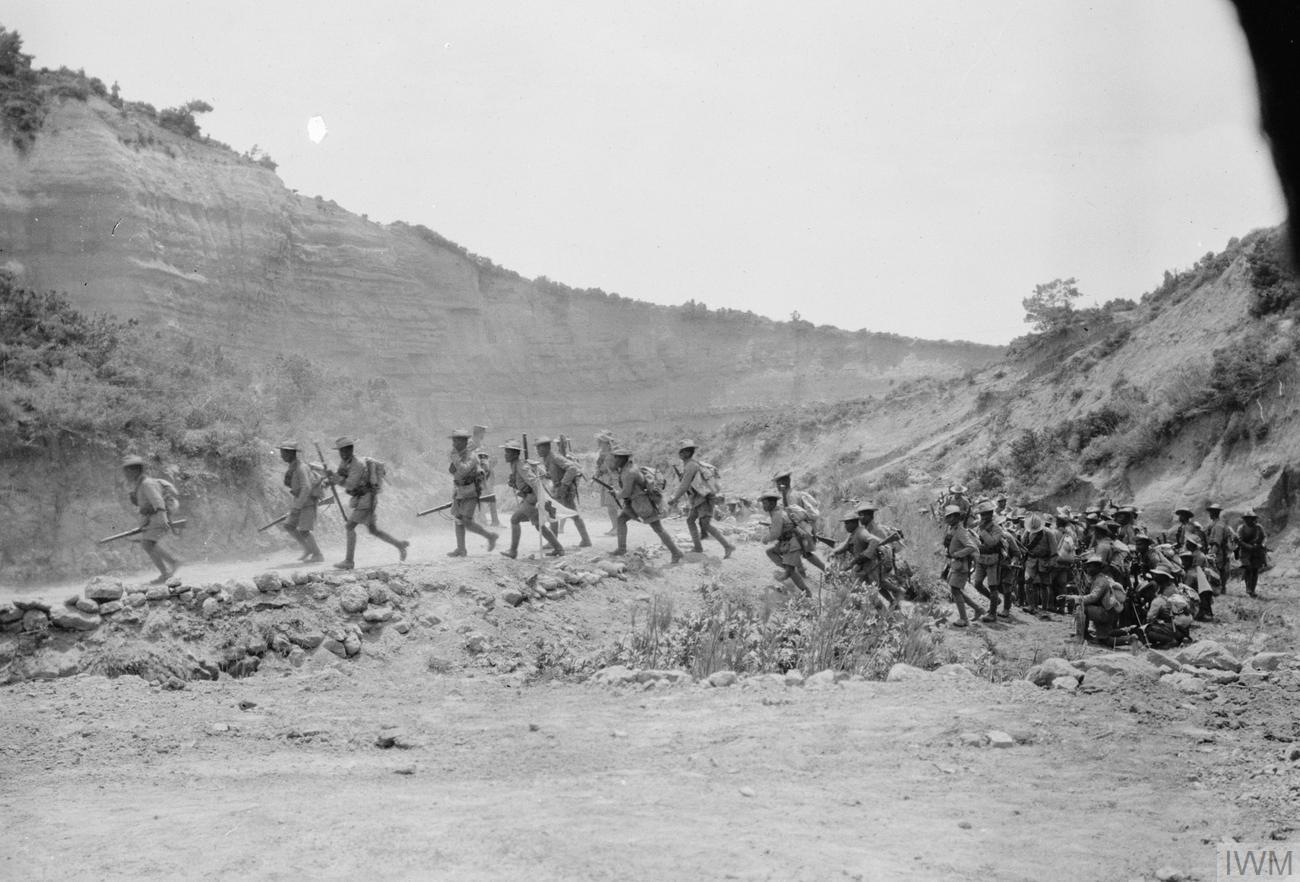
Battle of Gully Ravine
The Turks call it Zığındere. Most British accounts call it Gully Ravine. Either way, by late June 1915 it was a narrow, twisting cut on the western flank of Cape Helles, scrub-choked and shallow enough that men could walk along its bottom without ever seeing what lay above. The terrain looked nothing like the chalk fields of the Western Front and almost everything like the wild scrub at Anzac Cove a few miles north. For a single week starting on 28 June, this ravine became one of the bloodiest stretches of the entire Gallipoli campaign.
An attack worth winning
The Allies had been at Helles for two months and had run out of ideas. The Third Battle of Krithia on 4 June had inched the centre forward but failed on both flanks. Lieutenant General Aylmer Hunter-Weston, the corps commander, settled on a smaller, more honest ambition: take the high ground on each side, one flank at a time. The French handled the right, gaining Haricot Redoubt on Kereves Spur on 21 June after 40,000 shells fell on the Ottoman 2nd Division. The bombardment cost the Ottomans 6,000 casualties; their commander, Captain Kemal Bey, was hit at the line of fire and died the next day. London and Paris cabled congratulations. By the standards of Helles, this was a victory worth telegrams.
The Gurkhas on the spur
On 28 June at 10:45 a.m., after two days of bombardment, the British attacked along Gully Spur and into the ravine itself. Naval guns at sea joined the field artillery, and on the spur the effect was overwhelming. The 2/10th Gurkha Rifles and the 2nd Battalion of the Royal Fusiliers covered half a mile of ground in a rapid advance and dug in at a point soon known as Fusilier Bluff. It became the northernmost Allied position at Helles for the rest of the campaign. Down in the ravine, the 1st Battalion, Border Regiment, found their Ottoman opponents better sheltered from the seaward bombardment. The Border men halted earlier and stacked rocks into a makeshift parapet that survives in regimental memory as Border Barricade.
Fir Tree Spur
On the right of the line, the men of the 156th (Scottish Rifles) Brigade, newly arrived from the British 52nd (Lowland) Division, walked into a different battle. They had little artillery support and the Ottoman 7th and 12th Divisions held their line with machine guns and bayonet. Eight hundred Scots were killed before the attack was halted, and entire battalions were so reduced they had to be merged into composite formations. When the rest of the 52nd Division came ashore in the days that followed, their commander, Major General Granville Egerton, was openly furious at the way one of his brigades had been used up. He would say so again, more loudly, two weeks later, and it would briefly cost him his command.
The counter-attacks
From the night of 1–2 July through 5 July, Ottoman commanders threw division after division at the new British line. Faik Pasha, given the right wing, pushed his 2nd and 7th Divisions forward and then asked to rest his decimated troops. Liman von Sanders relieved him and gave the sector to Mehmet Ali Pasha, whose freshly arrived 3rd Division had crossed the Narrows at midnight and was ordered to attack at dawn. They did. So did the Ottoman 1st Division under Cafer Tayyar Bey, reaching within thirty metres of the British trenches before machine gun fire stopped them. Estimates put Ottoman losses for the week at 14,000 to 16,000, roughly four times the British figure. A truce to bury the dead was refused, the British having decided the bodies were a useful obstacle. It was, even contemporaries admitted, an ugly decision, and it left a mark on Ottoman memory of the Allies long after the war. Two soldiers of the Royal Inniskilling Fusiliers, Captain Gerald O'Sullivan and Corporal James Somers, won the Victoria Cross for retaking a trench during the counter-attacks.
The end of Helles
Hunter-Weston tried once more on 12 July, sending the rest of the 52nd Division up Achi Baba Nullah, the valley the troops had already started calling Bloody Valley. By the end of that day a third of his division was gone. He himself left the peninsula soon after, citing some unspecified ailment that historians have read as exhaustion. Helles never saw another major British offensive. The fighting moved north to Sari Bair and to a new landing at Suvla Bay, and in January 1916 the trenches at Helles were quietly emptied. The ravine itself remained scrub and stone, mined from below for months afterwards by both sides, with a graveyard now near the head of it for the men who never left.
From the Air
40.08°N, 26.19°E, on the western coast of the Gallipoli peninsula about 4 km north of Cape Helles. From altitude, the ravine appears as a dark scar running roughly south to north into the Aegean. Nearest airport is Çanakkale (LTBH) across the Dardanelles to the east; Tekirdağ (LTBU) lies to the north. Best viewed in clear weather; the peninsula is often hazy in summer and the cuts in the terrain wash out at the wrong angle of light.